
GEO optimization for real estate in AI answers
I help residential developments and developer projects enter recommendations from ChatGPT, Yandex Alice, Gemini, Perplexity and other AI systems when buyers ask about choosing, comparing and verifying real estate.
Not only when someone already types the name of your development.
The main GEO task is for AI to include the property in the right shortlist on its own, explain its advantages correctly and rely on current sources.

An AI system may know your development very well and still almost never recommend it
This is one of the main mistakes in evaluating GEO visibility for real estate.
You can open ChatGPT, type the name of your residential project and get a detailed answer. It may look as if the property is already well represented in AI.
But a buyer who is only starting to choose a property does not know your name yet.
They ask differently:
- Which premium residential development should a family with children choose?
- Where should I live close to nature if I work in Moscow City?
- Which boutique residential projects offer more privacy?
- Where can I find apartments with views without a window-to-window effect?
- Which should I choose: Project A or Project B?
- What are the real advantages and disadvantages of this development?
Queries like these determine whether the property enters the buyer's initial shortlist.
What a real pre-audit of a premium Moscow residential project showed
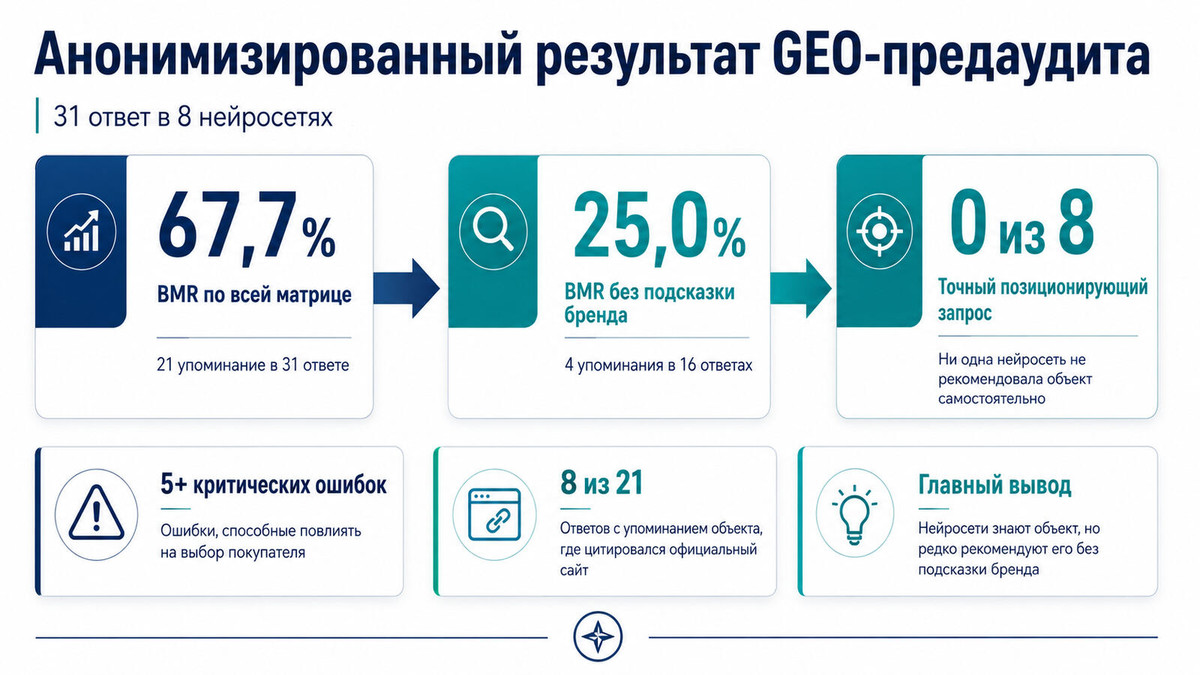
In one of my projects under NDA, I examined the property's starting visibility across 8 AI systems.
At least 5 of the 31 answers also contained critical factual errors that could influence the buyer's decision.
The official website was cited in only 8 of the 21 answers in which the project was mentioned at all.
In other words, AI systems knew the development. They connected it poorly with the buyer needs the project had been designed to satisfy.
That is exactly where GEO work begins.
I explain the methodology and conclusions from this research in detail in a separate article.
What GEO for real estate actually optimizes
In traditional SEO, semantics often starts with search wording.
For real-estate GEO, I start with a different question:
What stage of the decision journey is the buyer in, and what should the AI system do at that moment?
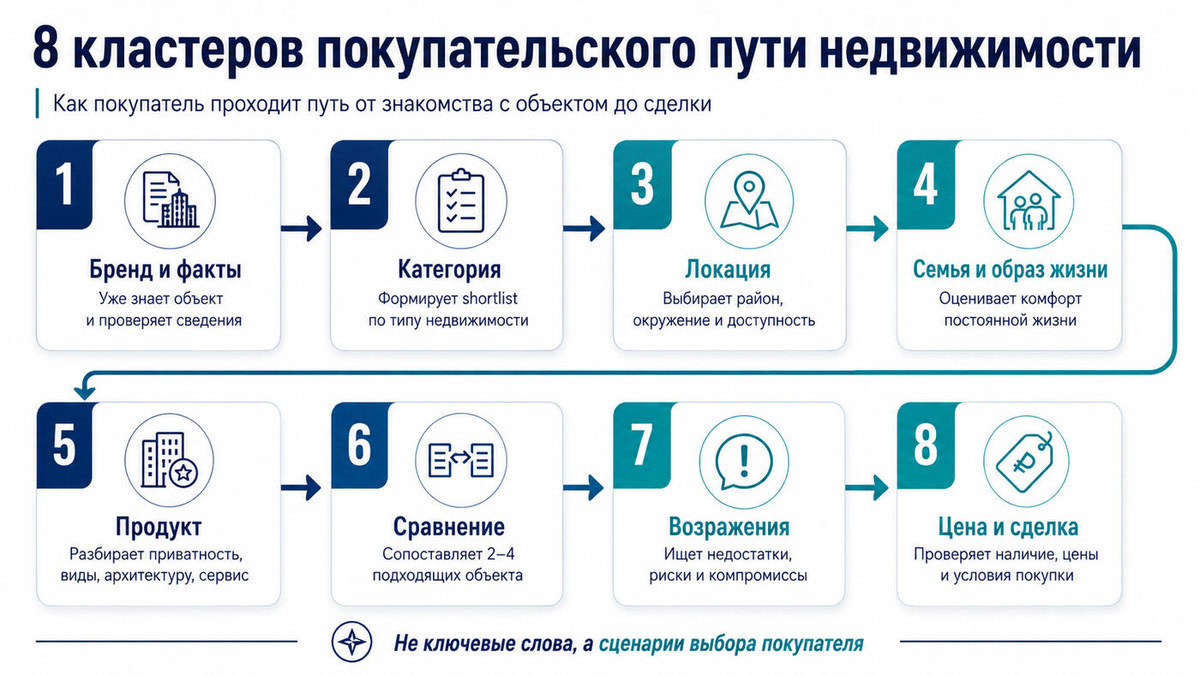
For a residential project, I usually work with several groups of scenarios.
Brand and facts
The buyer already knows the property and wants to verify:
- what the development is;
- where it is located;
- what class it belongs to;
- who designed it;
- what stage construction is at;
- where to find current apartments and prices.
Initial selection
The buyer does not know specific project names yet.
For example:
- a premium boutique residential project in western Moscow;
- a low-density new development for permanent living;
- an apartment with views close to nature;
- a private-feeling residential project instead of a large housing district.
This is where it is especially important for the AI system to name the project on its own.
Location
The buyer is choosing a district and the lifestyle around the home: nature, transport, business districts, sports, water and parks, and familiar everyday infrastructure.
Family and lifestyle
The buyer checks whether the property suits everyday life: children, safety, schools, sports, walking, logistics and a quiet environment.
Product
The AI system should correctly explain specific characteristics of the building: privacy, architecture, views, service, common spaces and resident infrastructure.
Comparison
The buyer is already choosing between several properties. A simple mention is not enough here. The AI system should explain who each option suits and by which criteria.
Objections and reputation
The buyer deliberately looks for risks: disadvantages, reviews, transport, noise, surroundings, infrastructure, deadlines and whether the price is justified.
Price and transaction
Only current data is useful here: available apartments, layouts, prices, purchase terms, mortgages and special offers.
Real-estate GEO does not mean creating dozens of pages for queries
A list of 40, 50 or 100 GEO queries does not mean every one of them needs a separate website page.
Especially in premium real estate.
The website of an expensive residential project should preserve its architecture, visual language and commercial function.
I use a simple criterion:
A new page belongs on the official website if it is useful to the buyer, can be kept current and has its own commercial function.
Some information therefore stays on the project website.
Other information is better established in independent sources that already participate in search results and AI answers: industry media, real-estate portals, expert publications, reviews, comparisons and materials from brokers and agencies.
What real-estate GEO optimization includes
1. Initial GEO audit
I first record the current position.
I check:
- which AI systems know the property;
- where it appears without a brand cue;
- which scenarios lead AI to recommend competitors;
- which characteristics AI associates with the project;
- which factual errors occur;
- which sources are used in answers;
- how the property is represented in Yandex and Google.
This becomes the baseline. Without it, there is no way to prove that anything actually changed several months later.
2. Buyer-intent map
I do not build the core only from phrases such as “buy an apartment” and “residential project + district”.
It includes real decision situations: initial selection, district, family, architecture, privacy, views, competitor comparisons, objections, reputation, price and transaction.
The wording of control queries is fixed and later repeated using the same methodology. Otherwise, monitoring can easily turn into a collection of favorable screenshots.
3. Digital property passport
Before active promotion, the internet itself needs to stop contradicting itself.
The project gets a single approved set of facts: name, address, class, construction stage, completion date, number of floors, number and structure of apartments, parking, architects and designers, infrastructure, services, key product characteristics, official sources and dates of validity.
I also record where each fact is published.
This is especially important for changing information. Prices, availability, mortgage programs and promotions should not be replicated thoughtlessly across articles that may remain online for years.
4. Advantages are translated from advertising language into provable properties
The word “privacy”, for example, proves very little by itself.
I break it down into mechanisms: number of apartments, floor organization, access, separation of flows, closed spaces, visual privacy and layout solutions.
The same applies to views, ecology, architecture, service and other advantages.
AI systems can recommend something more easily when the reason can be explained, rather than merely repeated as an advertising adjective.
5. Official website and AEO
The website should be an unambiguous source of facts for AI systems and search engines.
Depending on its current state, work may include adjusting positioning, FAQ, important text blocks, resolving contradictions, improving title, description and H1, indexing, internal linking, Schema.org, and links to the current catalog and offers.
Structured data helps systems recognize the entity more accurately. Schema.org alone will not make ChatGPT recommend the property.
6. External evidence
In real estate, the official website is rarely the only source.
AI systems use aggregators, specialist portals, maps, media, expert articles, architecture resources, brokers and reviews.
That is why important project advantages should be supported by more than the seller's own website.
Different claims need different sources. Architecture is best supported by architectural materials. Location by city sources and maps. Reviews by genuine user platforms. Prices only by commercial sources that can be kept current. Comparisons by data for every compared project captured on the same date.
Source consensus instead of copy-paste
One article published almost unchanged on 15 websites still remains one article in substance.
I work toward a different model.
The same verified facts can appear in an architectural analysis, an article for families, a comparison of several projects, a district guide, an expert column, or content published by a broker or agency.
The facts stay consistent. The structure, reasoning, examples and author's angle differ.
This creates a durable connection between the property, its advantages and the decision scenarios where it belongs.
GEO and SEO for real estate should work together
For broad commercial queries, a residential project's official website competes with more than other developments.
Search results also contain aggregators, property portals, brokers, reviews, rankings, editorial content and special search-engine modules.
A useful SEO result therefore is not always just the position of the official domain.
If the same query returns the official website, a strong property profile, an independent article, a comparison and a detailed review, this can be more valuable than one position held by the project's own website.
I measure not only the official domain's ranking, but also the share of search results that helps a potential buyer consider the property.
Reputation is part of GEO
People ask both search engines and AI systems about “reviews”, “disadvantages”, “is it worth buying” and “what problems are there”.
The official website almost never controls this intent on its own.
The task is not to make the AI system claim that the property has no disadvantages.
A good result looks different:
- real advantages and disadvantages are reproduced correctly;
- outdated complaints are not presented as current;
- the AI system understands the context;
- trade-offs are explained for different buyer types;
- review information is checked against verifiable facts.
This is especially important in real estate because the decision cycle is long and the cost of a mistake is high.
How I measure the result of GEO optimization
I do not evaluate GEO from one query and a few favorable ChatGPT answers.
The main metrics are:
BMR without a brand cue – how often the project appears when the user did not name it.
Independent recommendations – how many AI systems include the property in a relevant initial shortlist.
Presence in target scenarios – for example family, privacy, district, views or comparison.
Positioning accuracy – which characteristics AI systems associate with the project.
Factual errors – address, stage, deadlines, characteristics and comparison geography.
Sources – which websites and profiles AI systems rely on.
Competitive presence – which projects are recommended alongside it and who receives the advantage.
SEO visibility – the official website and useful external pages in search results.
Real-estate GEO cannot be measured only by clicks from ChatGPT
A buyer journey may look like this:
AI answer → independent article → property aggregator → brand search → project website → ad → lead
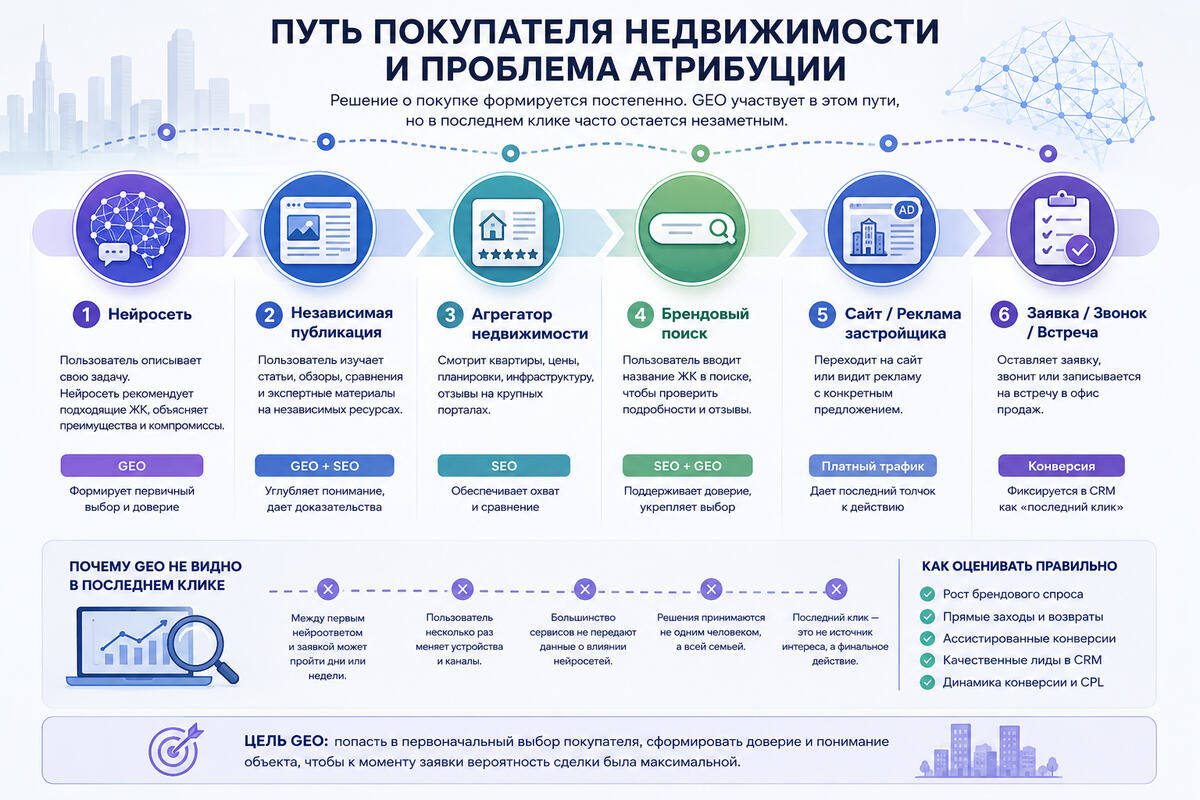
In standard attribution, the last source will be advertising or brand search. GEO disappears from the report.
That is why it also makes sense to track changes in branded demand, direct visits, returns, assisted conversions, qualified leads, CRM data, paid-traffic conversion and total CPL at comparable quality and media mix.
For a developer, this is especially interesting.
If GEO helps a buyer verify a property, see independent evidence and reach a decision faster, it can improve the effectiveness of paid traffic the company already buys, even when direct clicks from AI are few.
A real premium Moscow residential case under NDA
I conducted a detailed pre-audit of a premium residential project in Moscow.
The name and characteristics that could identify the project are covered by NDA.
What the baseline already showed:
- 31 AI answers analyzed;
- 8 AI systems;
- overall BMR – 67.7%;
- BMR without a brand cue – 25%;
- 0 of 8 recommendations for a query that precisely described the stated positioning;
- at least 5 critical factual errors;
- the official website was cited in only 8 of the 21 answers where the property appeared.
The main conclusion from the pre-audit:
AI systems knew the project, but its advantages rarely translated into an independent recommendation.
Based on this research, I developed the semantic and entity architecture for GEO optimization, a measurement system and a model for working with official and external sources.
The first public version of the research was published on Workspace and received the editorial “Best” badge. A detailed version of the methodology is published on GAEO.ru.
Who real-estate GEO optimization is for
Primarily:
- residential developments in active sales;
- developers;
- premium and boutique projects;
- properties where comparison against strong competitors matters;
- projects with clear advantages that AI systems do not yet reproduce well;
- properties with contradictory information in external sources;
- agencies and brokers promoting specific residential developments.
GEO is especially useful where buyers study the market for a long time and ask many comparative questions before contacting the sales office.
What you get at the start
Before scaling promotion, we need to understand the current situation.
I can run an initial check of the property and show:
- whether major AI systems know it;
- whether they recommend it without a brand cue;
- which projects they choose instead;
- which advantages they already understand;
- where errors occur;
- which sources influence the answers;
- which buyer scenarios have the highest growth potential.
Let's check whether AI systems recommend your property
If you are promoting a residential development or developer project, we start with the current position.
I will check several key buyer scenarios and show:
- whether the property appears without a brand cue;
- which competitors AI systems recommend instead;
- what they already know correctly;
- which errors and information gaps interfere with the choice;
- where it makes sense to start promotion.
Alexey Yakovlev
Independent GEO/AEO Consultant
GAEO.ru
Frequently asked questions
How is GEO for real estate different from SEO?
GEO additionally addresses whether a property appears in AI answers and recommendations.
In practice, I combine the two: an external publication can simultaneously become an AI source, rank in search and pass link authority to the official website.
Can you guarantee that a residential project will appear in ChatGPT?
AI answers depend on algorithms, sources and the exact wording of the query.
I therefore guarantee the methodology, the agreed scope of work and result measurement, while recommendation dynamics are measured against the starting point.
How long does GEO optimization for real estate take?
For a stable evaluation of dynamics, it is reasonable to work over several months and compare results against the same control set of queries.
Does the residential project's website need to be rebuilt?
More often, the work involves targeted corrections to facts, positioning, FAQ, technical optimization and structured data.
For a premium project, I try to preserve the website's visual concept rather than damage it for the sake of informational SEO content.
Do we need to publish a large number of articles?
Materials should address specific buyer scenarios and create independent grounds for recommendation.
One strong publication on the right platform can be more useful than dozens of near-identical texts.
Does GEO work if the user does not click from AI to the website?
AI can influence the initial shortlist and trust, while the eventual lead may arrive through brand search, an aggregator, direct traffic or advertising.
For real estate, that is why it is important to look beyond direct AI referrals and consider the full path to a qualified inquiry.