
GEO for real estate: how a residential project can enter AI recommendations
A GEO methodology for residential projects based on a real pre-audit of a premium Moscow development: non-branded recommendations, a digital property passport, sources, evidence and result measurement.

The first version of this article was published on Workspace. The GAEO.ru version is expanded: it includes more methodology, measurement logic and conclusions from a real pre-audit of a premium residential development in Moscow.
Real estate is well suited to GEO. A buyer rarely makes a decision based on one attribute: they compare the district, transport, architecture, privacy, views, infrastructure, schools, parks, price, developer reputation and dozens of other factors.
Increasingly, they delegate part of this work to AI.
“Which premium residential project should a family with children choose?”
“Where should I live close to nature if I work in Moscow City?”
“Which boutique residential projects offer more privacy?”
“Which should I choose: Project A or Project B?”
If the property does not appear in such an answer, brand awareness by itself helps little.
What a pre-audit of a premium Moscow residential project showed
In July 2026, I conducted a pre-audit of a premium residential development in Moscow. The project is under NDA, so I do not disclose its name, but the methodology and aggregated metrics can be discussed.
I checked 31 answers across 8 AI systems and interfaces.
At least 5 of the 31 answers contained critical factual errors that could influence a buyer's decision.
The official website was cited in only 8 of the 21 answers in which the project was mentioned at all.
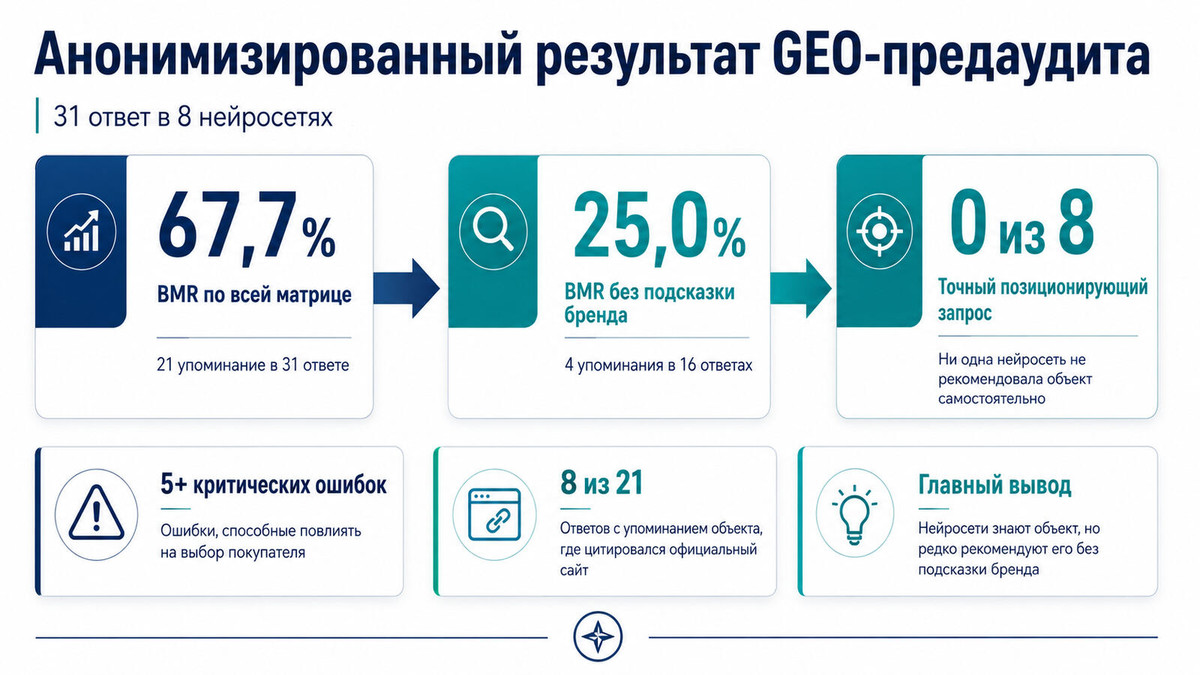
The main conclusion: AI systems knew the project, but connected it poorly with the buyer needs the development had been designed to satisfy.
Knowing a property and recommending a property are different things
In real estate, it is especially easy to get a false sense of good GEO visibility.
If you ask an AI system about a specific residential project by name, it may give a long description, name the developer, address, class and infrastructure, and even compare it with competitors.
But at the beginning of the decision journey, the buyer does not know the name.
They describe a problem.
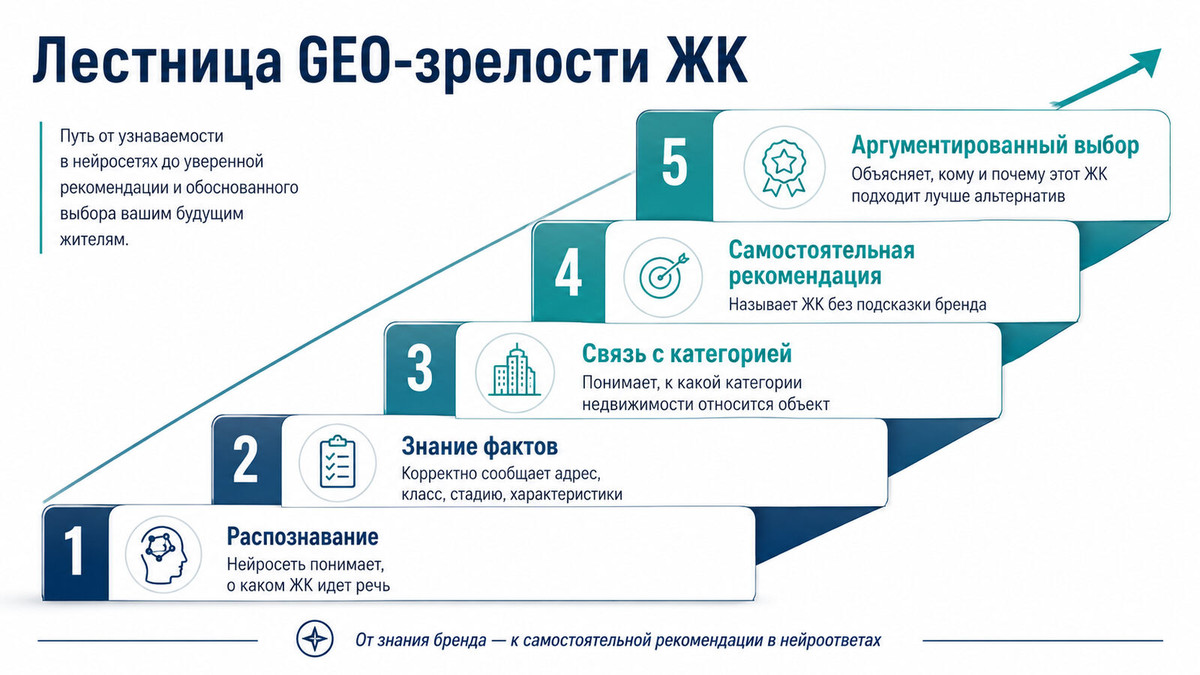
That is why I separate at least 3 tasks:
- Identification. The AI system should know the property and its facts correctly.
- Connection to a scenario. It should understand which user needs make the property relevant.
- Recommendation. It should include the property in a shortlist and explain why.
The second and third levels are usually weaker than the first.
8 buyer-journey clusters for real-estate GEO
For real estate, I do not start with a mechanical list of search keywords. I first break the buyer journey into groups of scenarios.
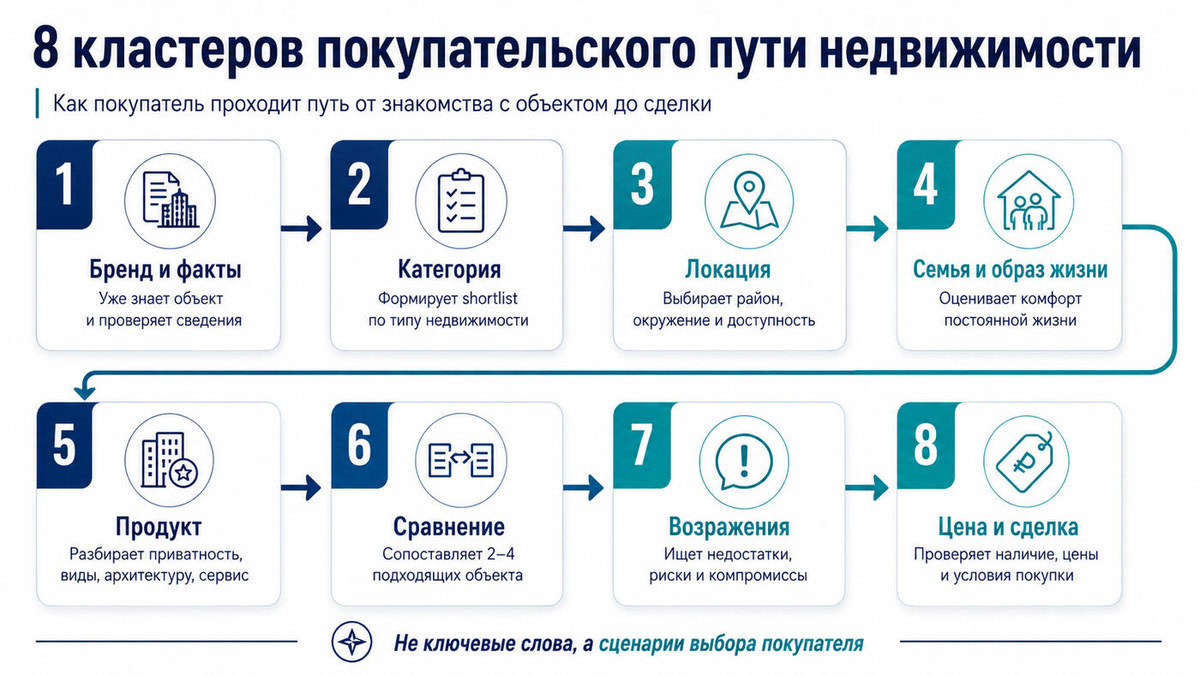
1. Brand and facts
The buyer already knows the development and wants to verify basic information: address, class, developer, timeline, architecture, available units, prices and purchase terms.
2. Category and initial selection
The project name is not known yet. The user asks for options: premium boutique developments, low-density projects, apartments with views, housing near nature and other property types.
3. Location
The buyer is choosing the lifestyle around the home: transport, business district, park, water, schools, sports, walking, travel time.
4. Family and lifestyle
The buyer checks whether the project works for everyday family life: children, safety, privacy, infrastructure, a quiet environment and logistics.
5. Product
Specific characteristics matter: architecture, views, layouts, ceiling height, finish, common areas, parking, service and residential density.
6. Comparison
The user is already choosing between several projects. Comparable criteria and an honest explanation of differences matter here.
7. Objections and reputation
The buyer deliberately looks for risks: disadvantages, reviews, noise, transport, surroundings, infrastructure, deadlines and whether the price is justified.
8. Price and transaction
Freshness is critical here: available units, layouts, prices, mortgages, installments, special offers and sales-office contacts.
48 prompts do not mean 48 new website pages
A working matrix for one project may contain 40, 50 or 100 queries. That does not mean each query needs a separate SEO page.
Especially in premium real estate.
A residential-project website should preserve its architecture, visual language and commercial function. GEO should not turn it into a catalog of artificial pages for every wording variation.
I use another principle: one strong document should answer a group of related user tasks.
For example, a substantial location page can answer questions about proximity to the city center, parks, travel time, walks, schools and infrastructure at the same time, if its facts are assembled well.
The official website does not control the whole picture
Even an ideal website does not become the only source for AI.
An AI system may simultaneously use the developer's website, a map, a property aggregator, an architecture studio publication, media, reviews, a forum, a ranking and a competitor review.
That is why real-estate GEO is built outside the website as well.
I roughly divide sources into 4 levels:
- Source of truth. The official website and controlled project data.
- Strong specialist platforms. Maps, major aggregators, developer and property profiles.
- Independent evidence. Media, architecture publications, industry publications and partner case studies.
- Distributed evidence. Reviews, topical discussions, expert analyses and other parts of the digital footprint.
Start with a digital passport for the property
To prevent different pages and platforms from contradicting one another, it helps to create a canonical set of facts.
For a residential project's digital passport, I would include:
- canonical name;
- address and geography;
- project class;
- construction stage and deadlines;
- number of floors;
- unit mix;
- parking;
- architects and studios;
- infrastructure;
- product characteristics;
- supporting sources;
- date of validity;
- a list of URLs where each fact is published.
This becomes the working base for the website, PR, directories, aggregators and AI-answer quality control.
Separate stable and dynamic facts
Not all property information has the same lifespan.
The architect, location and core product characteristics are relatively stable.
Prices, inventory, promotions, mortgage programs and construction stages change.
If a dynamic fact is copied across dozens of articles and profiles, it quickly begins to contradict itself.
That is why dynamic data especially needs one current source and clear links back to it.
Turn an abstract advantage into a verifiable mechanism
Marketing copy often says:
“A private environment for a discerning resident.”
For GEO, that is not enough.
AI systems work more easily with specifics:
- how many apartments are in the building;
- how many apartments are on each floor;
- whether there are separate elevator lobbies;
- how access is organized;
- what share of the property is common space;
- which physical design solutions create privacy.
Then “privacy” stops being an advertising adjective and becomes a conclusion derived from facts.
Evidence architecture: which source should confirm which fact
For every meaningful advantage, it is useful to decide in advance which sources are natural confirmations.
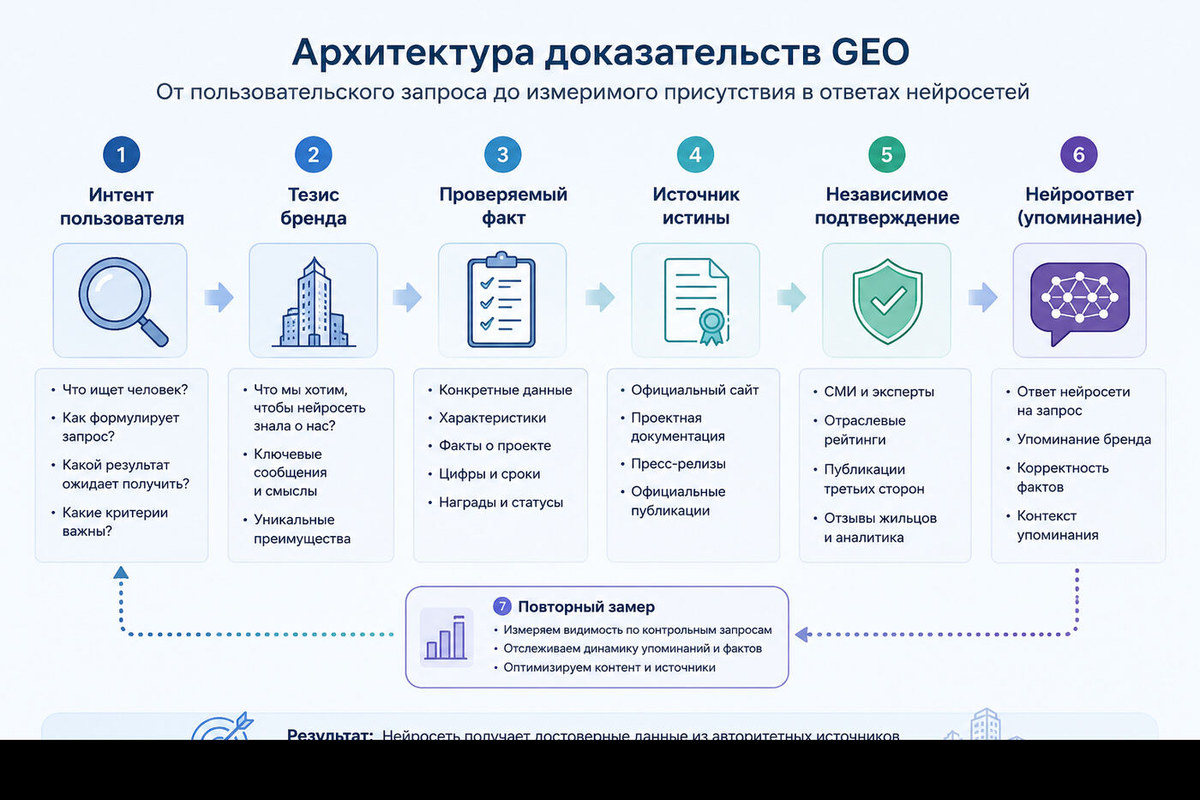
| Topic | Primary evidence | Additional evidence |
|---|---|---|
| Address and project stage | Official website and project data | Maps, aggregators, government sources |
| Architecture | Project website | Architecture studio and professional publications |
| Natural surroundings | Maps and geodata | City and independent sources |
| Sports infrastructure | Official property description | Geodata and external publications |
| Privacy | Specific product mechanisms | Independent analysis and reviews |
| Reputation | Real reviews | Review platforms and independent materials |
| Price and availability | Current commercial source | Major aggregators when the data matches |
| Property comparison | Consistent criteria and current facts | Independent comparison materials |
Do not copy the same text to 20 platforms
For AI, information consensus across different documents is more useful than 20 identical copies of a promotional article.
One platform may contain a case study from the architecture studio, another a location article, a third a comparison, and a fourth a property profile with characteristics.
All these documents should agree on the facts, but they do not need to repeat one another word for word.
GEO and SEO in real estate overlap, but they are not the same
Good SEO architecture helps GEO: indexable pages, correct headings, internal links, tables, FAQs, structured data and a fast website make information easier to access.
But GEO adds another task: the property needs to be understood and confirmed correctly outside its own domain.
In real estate, this external layer is especially important because users naturally look for comparisons, reviews, location, reputation and independent assessment.
I separately tested the relationship between classic SEO and GEO in this sector in the study SEO and GEO in Russian real estate in 2026.
Reputation is part of GEO
You cannot demand that an AI system use only positive wording.
If there is persistent negative information in open sources, it may use it.
The GEO task is accuracy and context.
For example, if a problem was relevant 2 years ago and has since been fixed, fresh documents should confirm that. If a limitation genuinely exists, it is better to explain it and show for whom it matters and for whom it does not.
Artificially trying to “erase” every disadvantage is not only bad for trust. It also makes the digital footprint unnatural.
Which metrics to measure
For real estate, one overall BMR is not enough.
I would monitor at least:
- BMR without a brand cue;
- share of independent recommendations;
- visibility for each choice scenario;
- factual accuracy of answers;
- accuracy of positioning;
- source set;
- competitive composition of the answer.
When measuring trends, the control prompt set should be frozen. Otherwise it is impossible to know whether the result changed or only the sample changed.
How to connect GEO with business results
The user journey rarely looks like “saw a ChatGPT recommendation and immediately submitted a lead.”
It may look like this:
ChatGPT → article → aggregator → branded search → website → advertising → lead.
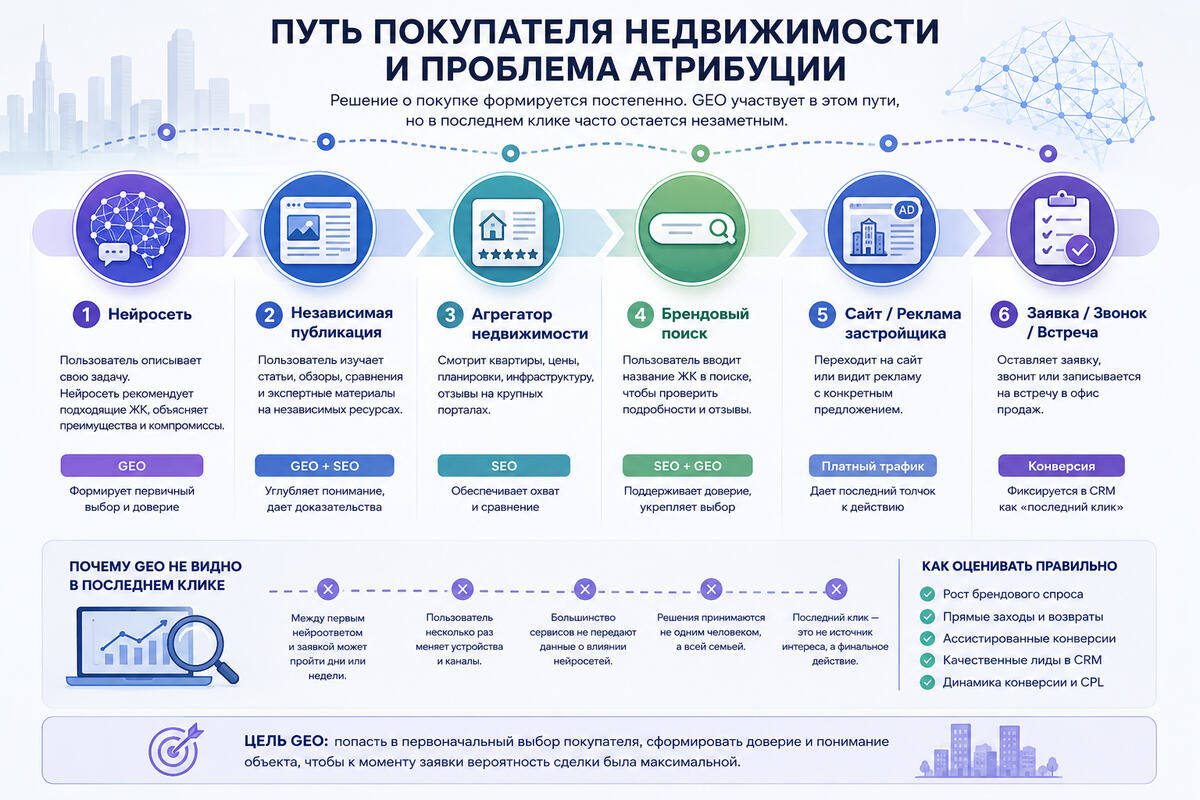
So the business should not look only at direct traffic from AI.
Useful metrics include:
- branded search demand;
- direct traffic;
- returning users;
- assisted conversions;
- qualified leads;
- source of discovery recorded in the CRM;
- changes in paid-traffic conversion;
- blended CPL.
Why real estate is especially suitable for GEO
Real estate has a long decision cycle and a high cost of error.
Buyers rarely choose simply “the cheapest option.” They formulate a complex combination of criteria.
These multi-criteria tasks are exactly the kind AI systems handle willingly.
They can build a shortlist, explain pros and cons, compare 3–5 projects and answer follow-up questions.
That means appearing in the first recommendations can influence the earliest stage of the funnel, before branded search begins.
Where to start GEO for a residential development
I would not begin with mass publication of articles. I would begin by fixing the current position.
- Collect real buyer choice scenarios.
- Build a stable control matrix of prompts.
- Check several target AI systems.
- Record mentions, positions, errors and sources.
- Compare the property with competitors.
- Create the digital passport and organize the source of truth.
- Determine which external confirmations are missing.
- Only then build the content, PR, profile and technical-improvement plan.
On the page GEO optimization for real estate in AI, I separately describe the commercial model of this work and how I break buyer scenarios down inside a project.
Conclusion
The goal of real-estate GEO can be stated quite simply.
The buyer describes their life situation and criteria without naming a brand. The AI system independently includes your residential project in a relevant shortlist and correctly explains why it fits.
For that to happen, describing the project once on the official website is not enough.
You need consistent facts, a digital passport, strong owned pages, current external profiles, independent evidence, reviews and documents that explain the property across different choice scenarios.
And what should be measured is not brand awareness, but the AI system's ability to recommend the property correctly without a cue.
Check GEO visibility for a residential project
In a mini-audit, I will test several choice scenarios and show where AI already knows the property, where it recommends it without a brand cue, and which sources it relies on.
Request a Mini-Audit