
Prep-Center GEO case study: 6 paying customers from AI in 1.5 months, BMR grew from 0% to 30%
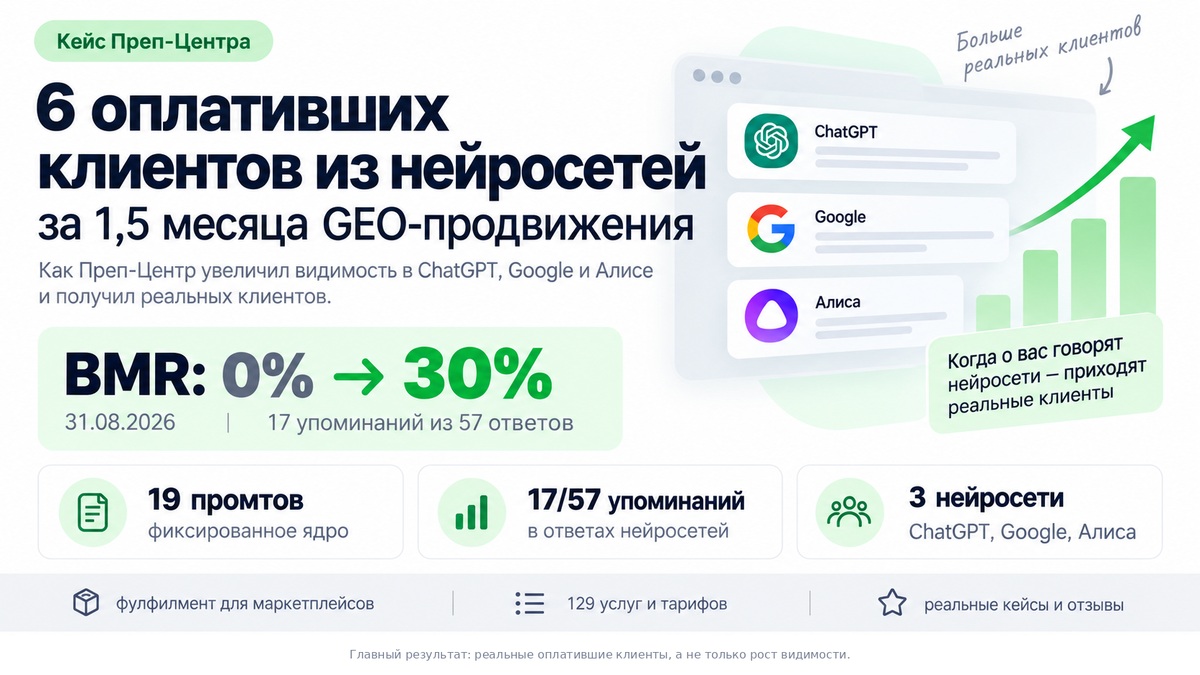
Prep-Center's Brand Mention Rate grew from 0% to 30%. In the first 1.5 months, 6 new customers who discovered the company through AI had already paid for its services.
The client is Prep-Center, a fulfillment company that prepares goods for Wildberries, Ozon, Yandex Market and other marketplaces in Moscow and the Moscow Region.
Active work period: July 15 to August 31, 2026.
BMR, or Brand Mention Rate, is the share of AI answers within a fixed set of commercial prompts that mention the brand.
The main result of this stage can no longer be described only through BMR growth. Visibility rose from 0% to 30%, and paying customers then appeared who themselves named AI as the source through which they discovered Prep-Center.
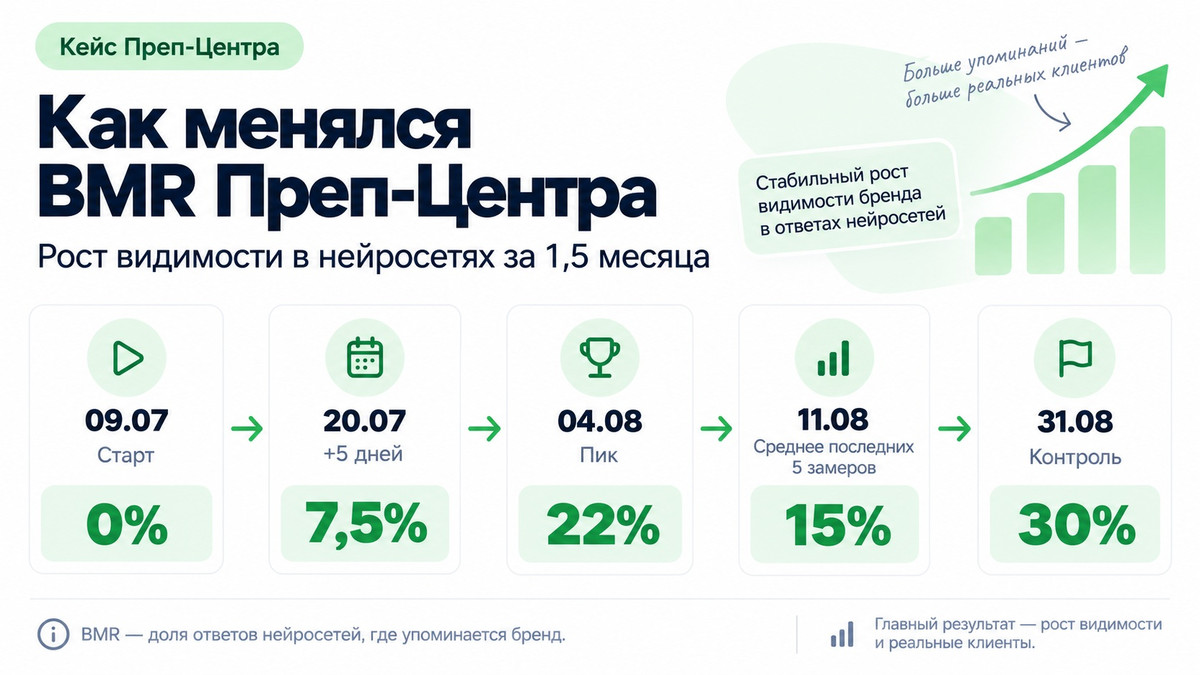
We recorded the first quick result just 5 days after work began: BMR rose from 0% to 7.5%, and Prep-Center started appearing in several AI services. This stage is described in detail in the first public case study, “5 AI services in 5 days,” on Workspace.
The main question then remained: was this a short-lived spike after the first publications were indexed, or the beginning of sustainable growth? After 1.5 months, the answer could be evaluated not only through AI visibility but also through customers.
The most important result is no longer measured only by BMR
From the start of the project, we decided not to limit measurement to answers from ChatGPT, Google and Yandex Alice. Prep-Center managers ask new customers, “How did you hear about us?” and record the answer.
This tracking was built into the project from the beginning. The customer data was therefore not reconstructed after a successful measurement; it existed as a separate business metric.
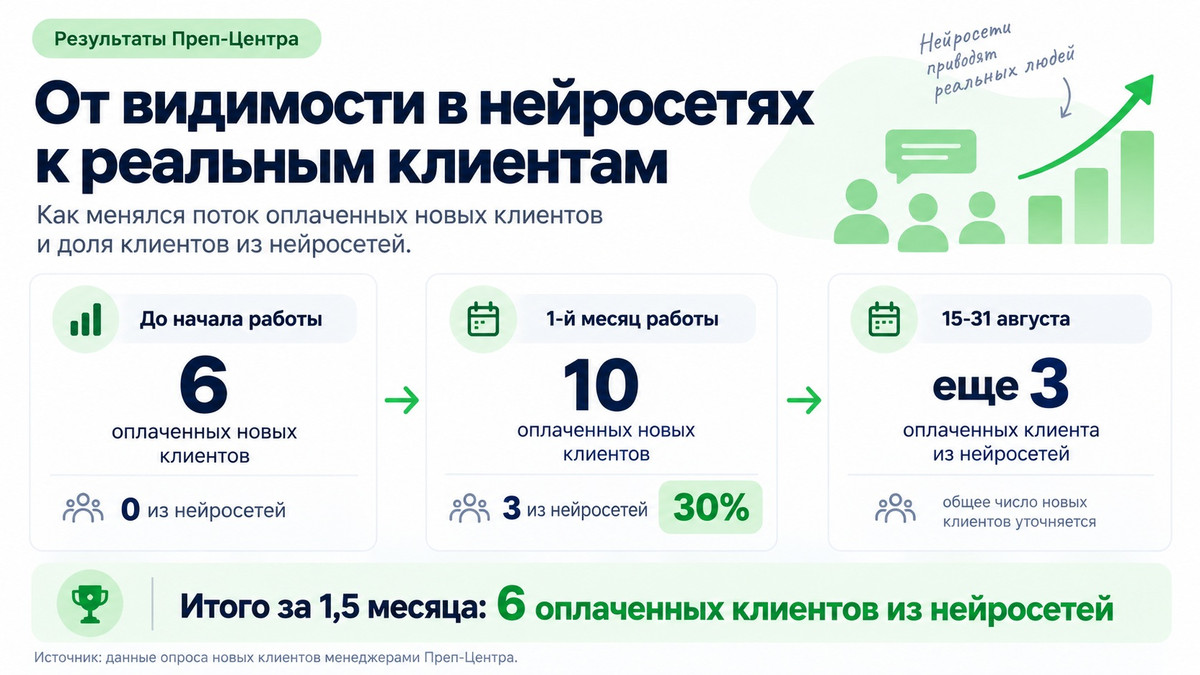
| Period | Total new paying customers | From AI |
|---|---|---|
| Before GAEO work began | 6 | 0 |
| 1st month of work | 10 | 3 |
| August 15–31 | total being confirmed | 3 |
In the first full month, 3 of 10 new paying customers, or 30%, named AI as the source.
Over the next 17 days, another 3 customers from AI paid for Prep-Center's services. The total number of new paying customers for that period was still being confirmed when this case study was prepared, so I deliberately do not calculate the share for the second half of August.
Total by August 31: 6 new paying customers from AI in 1.5 months of GEO work.
These are not leads, calls or submitted forms. The services were paid for.
What this may mean in monetary terms
We do not yet know the actual order amounts for these 6 customers.
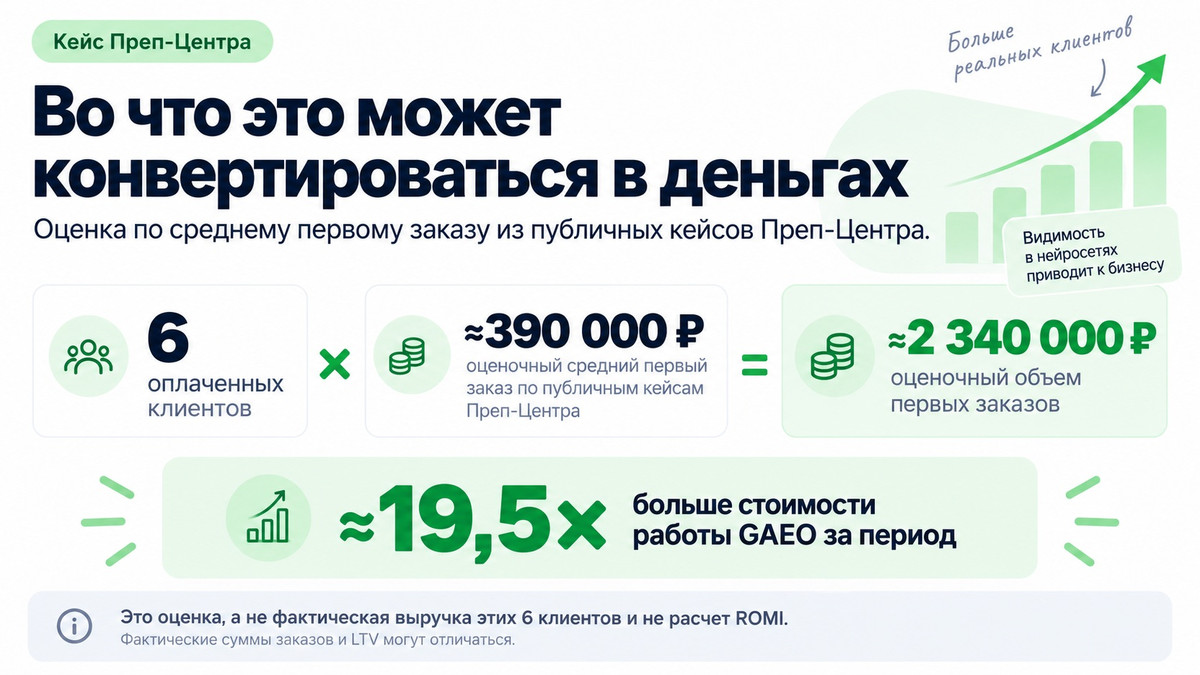
There is, however, a reference point: based on Prep-Center's public case studies, the average first order can be estimated at roughly RUB 390,000.
6 customers × RUB 390,000 ≈ RUB 2,340,000.
So the estimated volume of the first orders from these 6 AI-sourced customers may be around RUB 2.34 million.
This is an estimate, not the actual revenue generated by these 6 customers. Their real order values may have been lower or higher. In addition, most Prep-Center customers continue working with the company over time, so the first order does not represent their future LTV.
Even this rough estimate gives useful scale: RUB 2.34 million is about 19.5 times the cost of my work with Prep-Center over the same period, if the first 1.5 months of project fees are used for comparison.
This is not ROMI. A proper ROMI calculation requires the actual order values for these customers, margins and the full cost of promotion.
The correct conclusion at this stage is narrower: after just 1.5 months, GEO had become a source of real paying customers for Prep-Center, while the potential economic effect by order of magnitude was materially higher than the cost of the work.
Starting point
Prep-Center already had a strong real-world business: a warehouse, in-house receiving and packing processes, WMS, FBO and FBS operations, automated shrink wrapping, bubble wrap, labeling, experience with liquids and other complex product categories, high throughput and good reviews.
On July 9, 2026, we ran an extended baseline measurement in BrandFound. We checked 19 target user prompts across 4 AI interfaces, for a total of 76 answers.
Prep-Center did not appear once. BMR = 0%. Share of Voice = 0%. 0 mentions in 76 answers.
Competitors appeared regularly. Many of them had better-organized digital evidence: separate service pages, pricing, FAQ, case studies, reviews, directories and external publications.
This created a situation typical for GEO: the real business was much stronger than its representation online.
At the same time, the web contained the main prep-center.ru website, a Yandex mini-site and an older website on a Cyrillic domain. External sources contained different addresses and phone numbers left over from previous relocations. Strong operational case studies were buried inside the home page, and there was almost no detailed public price list.
AI systems could see individual fragments, but it was harder for them to assemble a stable chain:
Prep-Center → specific product category → required operations → proven experience → suitable provider.
Strategy: start with commercially strong narrow intents
We deliberately did not start with a broad query such as “best fulfillment company in Moscow.”
Instead, we broke demand down into real commercial tasks where Prep-Center already had an operational advantage. The initial core included household chemicals, shampoos and gels, cosmetics, automotive chemicals and car-care products, construction chemicals, shrink wrapping and bubble wrap.
We fixed 19 prompts and then kept this core unchanged so the results could be compared over time.
One person first asks how to prepare cosmetics correctly for Wildberries. Another is already looking for a fulfillment company that will handle the full process. A third asks ChatGPT or Alice to recommend 5–10 companies.
For an informational question, a detailed page and FAQ are useful. When a user chooses a specific provider, case studies, prices, reviews and company profiles start to matter. For a query such as “recommend 10 companies,” rankings, directories and independent external publications become especially important.
The main principle of the project became: one verified fact about the business should appear in several independent sources and in the context relevant to the user's task.
What we did in 1.5 months
1. Standardized company information
We established a single version of the Prep-Center name, warehouse address, contacts, working hours, floor area, throughput, marketplaces served and core services.
The old website on a Cyrillic domain was permanently redirected with a 301 to the main prep-center.ru site. Later, we also standardized www handling, canonical URLs, internal links and parameter processing.
2. Rebuilt the website around real user intents
Instead of concentrating nearly all useful information on the home page, the site gained separate pages for specific product categories and tasks: liquid products, household chemicals, shampoos and gels, cosmetics, automotive chemicals, construction chemicals, labels, Chestny ZNAK marking, FBO, set assembly and urgent processing of large batches.
The structure gradually began to follow the buyer's logic: category → required operation → supporting case study → price → inquiry.
3. Turned real operations into evidence-rich case studies
Instead of generic statements about “high-quality packaging,” the site began to show specific batches and numbers:
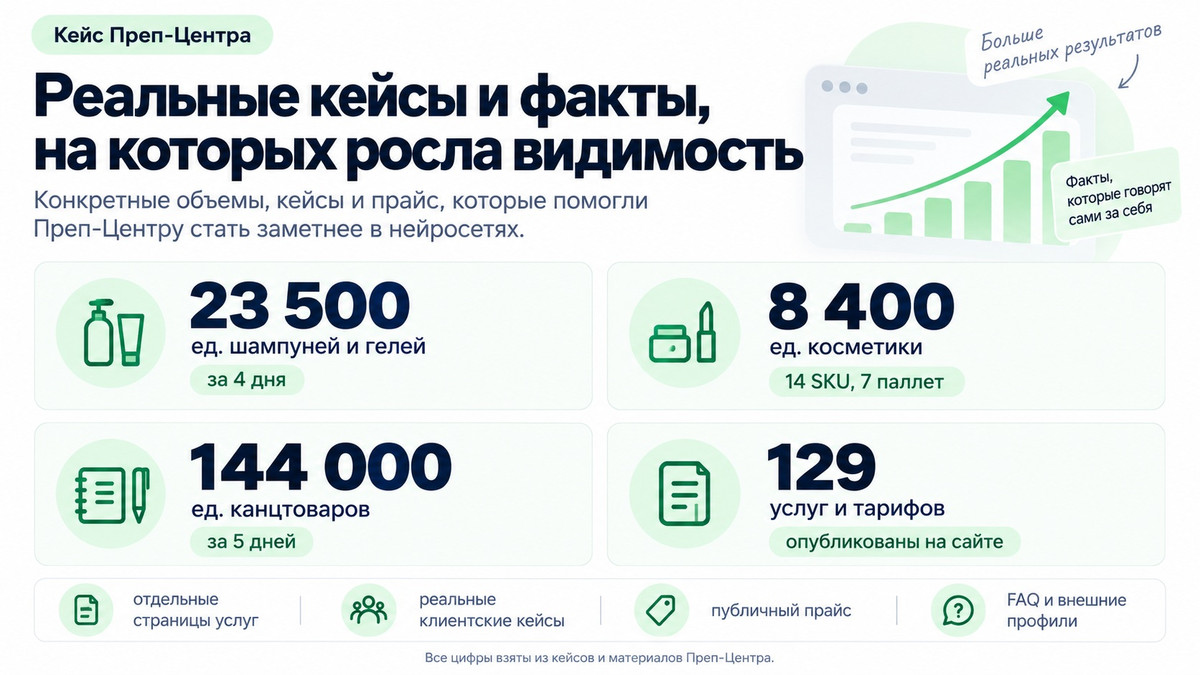
- 23,500 units of shampoos and gels in 4 days;
- 10,000 units of household chemicals in 3 days;
- 8,400 cosmetic units, 14 SKUs and 7 pallets;
- 2,393 automotive-chemical sets in 2 days;
- 144,000 stationery units in 5 days.
For the cosmetics batch, 55 problematic units were found during receiving. 12 were corrected and 43 excluded. As a result, 8,357 units were prepared, 164 shipping cartons were formed and 5 FBO shipments were created for Wildberries and Ozon.
For an AI answer, this is a very different level of evidence: there is a product, scale, operation, time frame and result.
4. Published 129 services and prices
Prep-Center's internal price list was broken down into 129 separate services with prices and units of measure. The price list was published on the website and began to be used in external profiles.
5. Expanded structured data on the website
We added and refined Schema.org markup including Organization / LocalBusiness, Service, FAQPage, BreadcrumbList, AggregateRating and sameAs.
The FAQ was built around real user questions from the prompt matrix.
6. Strengthened external profiles
We updated Prep-Center information on Yandex Business, Google, 2GIS, Zoon, Yell, YP, SellerMAP, Pulscen and other available sources.
We added services, prices, photographs and consistent company facts.
7. Launched external publications
During the first month, baseline materials appeared on Sostav. The publication program then expanded to TenChat, full-full.ru, Dzen, Oborot and other platforms.
The topics gradually expanded to liquid products, cosmetics, automotive chemicals, construction chemicals, shrink wrapping and bubble wrap.
8. Measured the result again after each stage
BrandFound was run against the same matrix. I also manually rechecked the automated labeling of answers: the service sometimes missed a real brand mention or, conversely, marked an irrelevant match.
It gradually became clear that different AI systems use different sources.
How BMR changed
| Stage | BMR |
|---|---|
| Baseline | 0% |
| After 5 days | 7.5% |
| First-month peak, August 4 | 22% |
| Average of the last 5 measurements by August 11 | 15% |
| Control measurement, August 31 | 30% |
Five days after the start, BMR reached 7.5%. By the end of the first month, the average BMR across the last 5 measurements had risen to 15%, while the peak measurement reached 22%. On August 31, the new control measurement produced 17 real mentions in 57 answers, or 30% BMR.
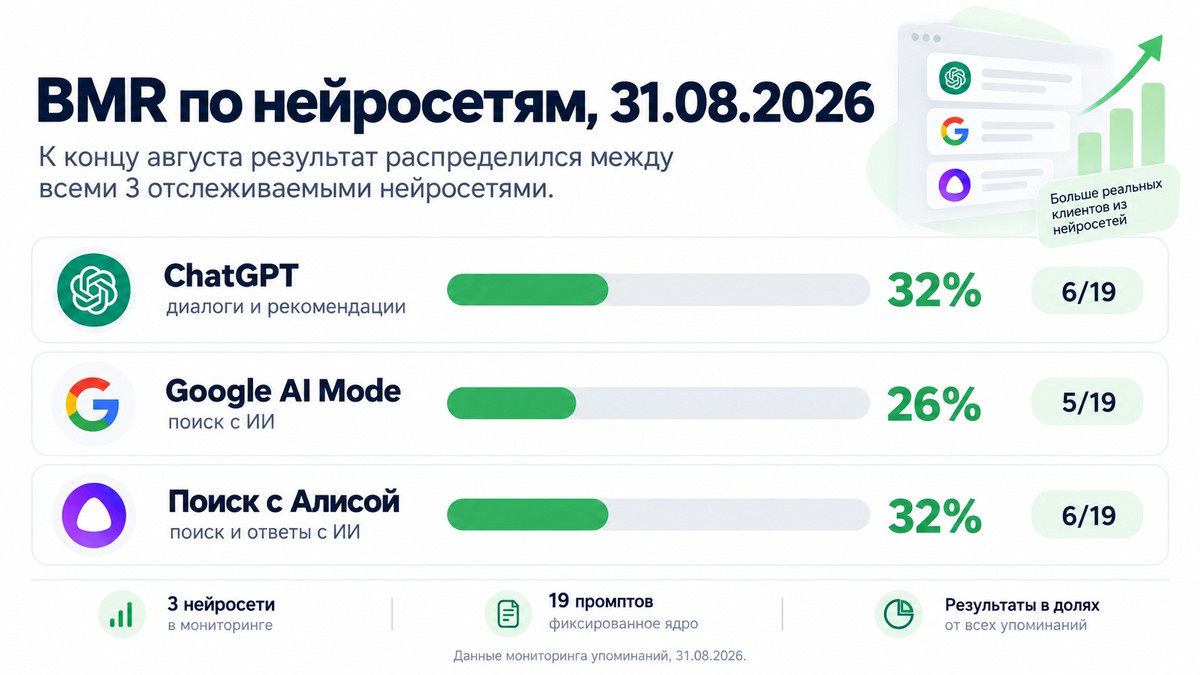
By August 31, the result was already distributed across 3 AI systems
| AI system | BMR on August 31 |
|---|---|
| ChatGPT | 32% (6/19) |
| Google AI Mode | 26% (5/19) |
| Yandex Search with Alice | 32% (6/19) |
ChatGPT grew from roughly 2% across the last 5 measurements of the first month to 32% at the August 31 control point. Google grew from roughly 10% to 26%. Alice maintained strong visibility at 32%.
What happened with the sources
The first month produced a particularly interesting picture.
Sostav appeared as a source in 78 BrandFound answers and was present alongside 23 real mentions of Prep-Center.
One article about fulfillment for liquid products appeared in 75 answers and accompanied 23 brand mentions. In Google AI Mode, it appeared alongside 18 of 19 real Prep-Center mentions.
Prep-Center's own prep-center.ru site appeared in 30 answers and was present alongside the brand in all 30 cases. Alice used the site especially often: 26 of the 38 accumulated brand mentions at that point were accompanied by prep-center.ru.
Zoon appeared in 11 answers, with Prep-Center present in 10 of them.
This does not prove that a specific article or page caused a specific mention. It does demonstrate something else clearly: Google, Alice and ChatGPT use different combinations of sources.
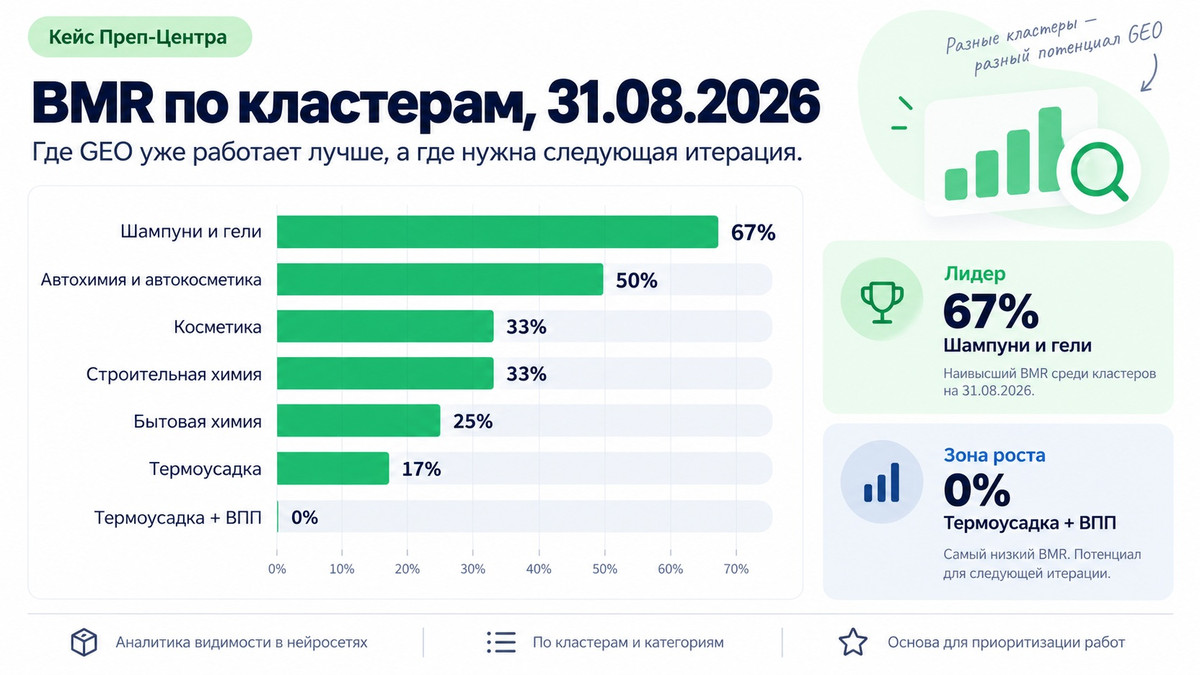
Where Prep-Center was most visible
| Cluster | BMR on August 31 |
|---|---|
| Shampoos and gels | 67% |
| Automotive chemicals and car-care products | 50% |
| Cosmetics | 33% |
| Construction chemicals | 33% |
| Household chemicals | 25% |
| Shrink wrapping | 17% |
| Shrink wrapping + bubble wrap | 0% |
Why paying customers matter more to me than BMR
With GEO, it is easy to become absorbed in your own analytics: counting mentions, positions, sources and citations.
All of that is useful while it helps make decisions.
But the final test of the strategy sits outside BrandFound. People have to arrive at the business.
In July, Prep-Center was almost absent from our measured sample of AI answers. By August, BMR had reached 30%.
At the same time, managers started regularly hearing “I found you through AI” from customers who then actually paid for the work.
In the first full month, these were 3 of 10 new paying customers. Over the next 17 days, another 3 paying customers from AI appeared.
It is too early to build a complex attribution model from this sample. We cannot prove which specific material led each person to the company or how many brand touchpoints occurred before the inquiry.
But we now have a sequence of 2 independent measurements:
AI systems began recommending Prep-Center more often → real customers began naming AI as the source through which they discovered the company.
I consider this connection the main result of the first 1.5 months.
Scope of work
During this period, the project included much more than publishing several external articles. The overall workflow is described in How GEO optimization works.
We built a fixed matrix of 19 prompts and regularly rechecked the answers, synchronized company information across external profiles, structured 129 services and prices, substantially expanded the website, turned real operations into separate case studies, added FAQ and Schema.org, and corrected URLs and canonicalization.
At the same time, we developed directory and map profiles, published external materials and analyzed which sources actually appeared in the answers of different AI systems. I examine this topic separately in my research on the sources AI systems use.
At the end of August, we also ran a major website-speed optimization cycle. Before optimization, some mobile pages showed LCP as high as 14 seconds, TBT up to 3.6 seconds and CLS around 0.208.
After several iterations, the home page showed approximately 1.21 seconds FCP, 2.44 seconds LCP and CLS around 0. A total of 26 public pages were checked at the end.
Result after 1.5 months
On July 9, Prep-Center received 0 mentions in 76 AI answers. Baseline BMR was 0%.
After 5 days, it rose to 7.5%. By the end of the first month, average BMR across the last 5 measurements reached 15%, while the peak was 22%. On August 31, the control matrix of 19 prompts across 3 AI systems produced 17 mentions in 57 answers, or 30% BMR.
The initial benchmark for the first 3 months was 15–25%, so it was exceeded in roughly half the planned time.
But there is now a more important result.
In the first 1.5 months, 6 new customers who came from AI had already paid for Prep-Center's services.
In the first full month, they represented 3 of the company's 10 new paying customers.
If we use an average first order of around RUB 390,000 based on Prep-Center's public case studies, the potential first-order volume of these 6 customers is around RUB 2.34 million. Actual invoices and LTV may produce a different figure, so this is an estimate rather than reported revenue.
The next task is to maintain visibility, expand it in weaker categories and, after several months, calculate the economics of acquired customers using actual data.
Methodological note
The extended baseline measurement on July 9 used 19 prompts across 4 interfaces and produced 0/76.
The main contracted matrix was then fixed at the same 19 prompts across 3 AI systems, or 57 answers per measurement.
Because the baseline result was zero across every AI system checked, the statement “BMR grew from 0% to 30%” is valid.
Customer data was collected separately from BrandFound. Prep-Center managers ask new customers how they learned about the company. This case study counts customers who named AI as the source and later paid for services.
The RUB 2.34 million estimate is calculated as 6 customers × an estimated average first order of RUB 390,000 based on Prep-Center's public case studies. It is not the actual revenue from these 6 customers and it is not ROMI.
Check your business visibility in AI
I will review commercial prompts used by your audience, competitors and the sources used by ChatGPT, Alice, Google and other AI systems.
Request a Mini-Audit