
Which sources AI systems use when choosing GEO specialists: research based on 500+ answers
An analysis of 500+ answers from ChatGPT, Google AI Mode, Yandex Alice, Perplexity, DeepSeek and other AI systems: which websites and source types they use when choosing GEO specialists.
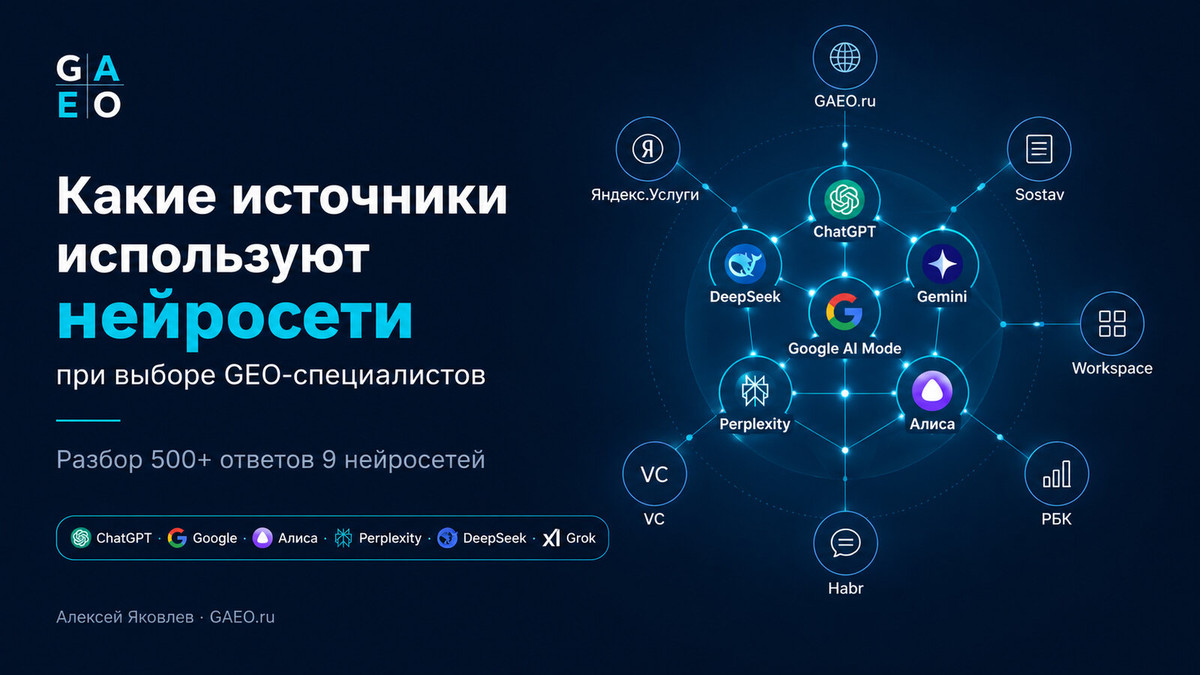
The first version of this research was published on Workspace. For GAEO.ru, I reworked the article, added more data about my monitoring methodology and connected the observations with other results from my own GEO work.
When a business starts working on GEO, a practical question appears very quickly: where exactly should it publish so that AI systems begin using information about the company or expert and recommending them to users?
On the company's own website? In media? On Habr or VC? On Sostav? In Yandex Services? On maps? In industry directories?
While promoting GAEO.ru, I collected more than 500 AI answers around one competitive intent and separately analyzed which sources those answers relied on.
The conclusion is inconvenient for anyone hoping to find one “best platform for GEO.”
There is no such platform.
ChatGPT, Google AI Mode, Yandex Alice, Perplexity, DeepSeek and other AI systems can answer almost the same query while using noticeably different parts of the web. That directly affects promotion strategy.
What exactly I researched
GAEO.ru is my personal GEO/AEO practice. I also use my own project as a testing ground: I can quickly change the website, external profiles and publications, then see what happens in AI answers.
One of the main monitoring queries was:
“Recommend 5–10 specialists in Russia for GEO optimization in AI answers. No agencies.”
This is a useful test intent for several reasons. It is not enough for the AI system to know that Alexey Yakovlev exists. It has to:
- find specialists in a competitive niche;
- determine who actually works in GEO;
- distinguish an independent expert from an agency;
- compare candidates;
- choose those it is willing to recommend to the user.
The monitoring covered:
- ChatGPT;
- Google AI Mode;
- Gemini;
- Perplexity;
- Yandex Search with Alice;
- Alice AI chat;
- DeepSeek;
- Grok;
- GigaChat.
I collected the main dataset through BrandFound, then manually rechecked the answers.
Manual verification is essential here.
Why you cannot simply take BMR from a monitoring system
Automated brand detection saves an enormous amount of time when you have dozens of prompts and several AI systems.
But it makes mistakes.
For example, BrandFound could count a mention of another Alexey or a person with a similar surname.
There was a more interesting case: GigaChat really did write “Alexey Yakovlev,” but attached someone else's professional biography to that person.
Formally, the surname was found. For a real GEO result, that is zero.
That is why in my own reports I check at least 4 things:
- whether the intended person or brand is actually mentioned;
- whether the AI system recommends them;
- which position they occupy;
- which sources were used.
Only after this cleanup do I calculate measured visibility.
I cover the trend in my own promotion in detail in the GAEO.ru case study: during the first month, average visibility for this competitive intent grew from roughly 22% to 48%.
Here, I focus on another part of the same data: which sources AI systems used to form their recommendations.
Main result: each AI system uses its own source set
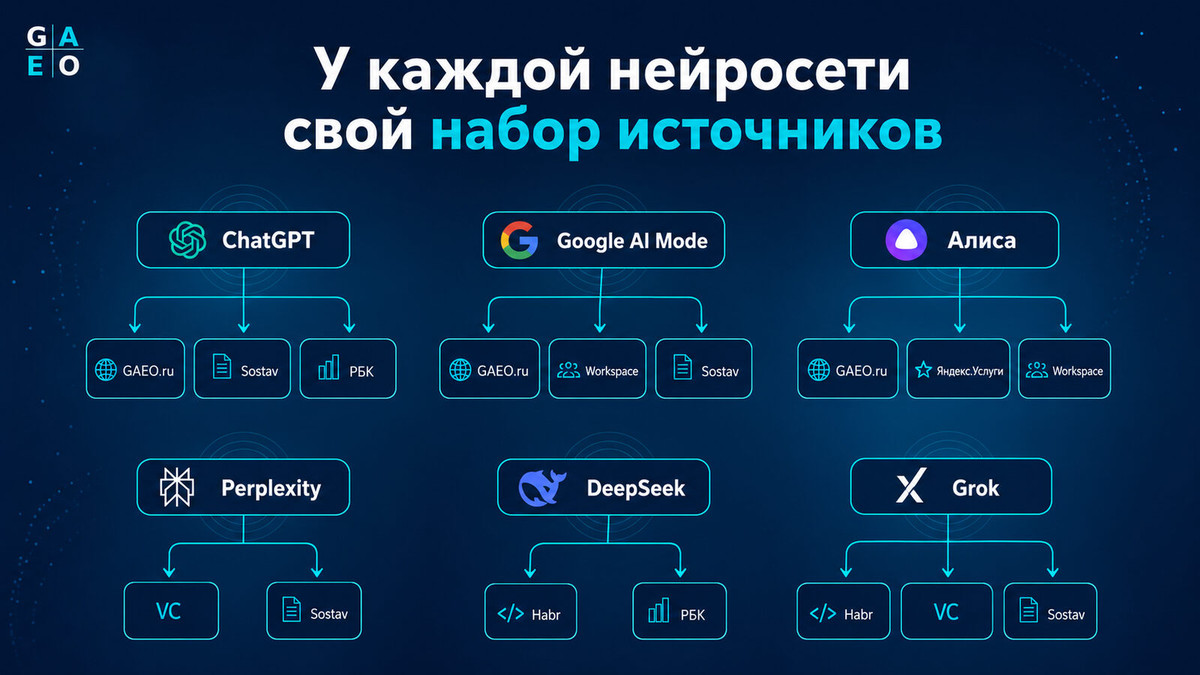
After several weeks of monitoring, consistent differences became visible.
ChatGPT regularly used GAEO.ru and external publications.
Google AI Mode picked up the own website, Workspace and Sostav well.
Yandex Alice used Yandex Services and other sources inside the Yandex ecosystem noticeably more often than the others.
Perplexity relied heavily on VC and comparison publications in some measurements.
DeepSeek used Habr, RBC and other external materials.
Grok assembled a fairly broad set including Habr, VC, Sostav and other sources.
So the universal advice:
“Everyone doing GEO should publish on platform X.”
is almost certainly too simplistic.
First, you need to see what your target AI systems actually use for your commercial intents.
Your own website remains the foundation
In my experiment, GAEO.ru became the most stable owned source.
It appeared especially often in ChatGPT, Google AI Mode and Alice.
This confirms the basic logic of GEO: you need a website as the place where the business owner controls the core facts.
GAEO.ru currently includes:
- Alexey Yakovlev's professional biography;
- articles;
- my own GEO case study;
- client reviews;
- external publications and mentions.
At the same time, the experiment showed the limitation of an owned website.
An AI system can find the website and still not include the candidate in its recommendation.
Early in the work, Perplexity found GAEO.ru several times but classified the project as an agency.
The test prompt explicitly required:
“No agencies.”
After more external sources began using unambiguous wording:
Alexey Yakovlev is an independent GEO/AEO specialist; GAEO.ru is a personal practice.
the situation changed.
For me, this is an important conclusion.
Your own website establishes a version of the facts. External documents help the AI system verify and classify those facts.
Sostav: one publication became a source for several AI systems
One of the most visible external documents was a Sostav publication comparing GEO specialists.
The Sostav comparison became a source for ChatGPT, Gemini, Google AI Mode, Perplexity and Grok.
Alexey Yakovlev was ranked No. 1 in the article.
For this research, however, the ranking itself is not even the most interesting part.
The document structure proved useful.
It already answered a question close to the user's intent:
- who works in the niche;
- which specialists exist;
- how they differ;
- who is an individual expert;
- why a candidate matches the query condition.
In the first large sample, this page appeared in more than 50 answers.
It was used by ChatGPT, Gemini, Google AI Mode, Perplexity and Grok.
In the overwhelming majority of answers where the AI system used this document, Alexey Yakovlev was also present.
The change was especially noticeable in Gemini and Perplexity. Before a strong external comparison document appeared, visibility there was low. Afterward, recommendations appeared noticeably more often.
This does not prove that one article created the entire result. By then, the website, profiles and other publications already existed.
But the contribution of this specific document can be traced fairly clearly.
So should you mass-produce rankings?
No.
The GEO market itself shows the limitation of that approach especially quickly.
Almost every participant in the industry understands the mechanics of AI visibility and is promoting themselves at the same time.
As a result, publications appear with titles such as:
“Top GEO specialists”
“Best agencies for AI visibility”
“Best GEO experts”
where the party behind the material predictably occupies a strong position.
Everyone in the trade is practicing what they preach.
As long as this format works as a source, it can be used. But building the entire strategy around it is risky.
I would treat ranking articles as one type of evidence, not the central element.
A much more durable combination is: own website + case studies + expert articles + profiles + reviews + independent mentions.
Workspace: a case study works differently from a ranking
Another strong source was the public GEO case study on Workspace.
The Workspace case study was used especially often by Google AI Mode and Yandex Search with Alice.
In the first sample, the case-study page appeared in roughly 20 answers, and Alexey Yakovlev was present in every one of those answers.
A case study provides a different kind of evidence.
A ranking says:
“Here is a list of specialists.”
A case study says:
“Here is the person, here is the task, here is what they did, and here is the result.”
For a commercial recommendation, that is strong evidence of practical experience.
That is why I consider case studies one of the most valuable GEO content formats.
A good case study should also be a full text page.
It is useful to record:
- the starting situation;
- the task;
- the actions;
- the numbers;
- the result;
- the timeline;
- supporting materials.
Yandex Services: Alice lives in its own ecosystem
Another characteristic source is my Yandex Services profile.
The Yandex Services profile repeatedly appeared among sources used by Alice.
In the first sample, the profile appeared in roughly 14 answers, especially often in Alice AI chat.
This demonstrates why external profiles should not be evaluated only through direct traffic and leads.
You might conclude:
“Yandex Services does not bring me clients, so I do not need the profile.”
Then you may discover that Alice uses exactly this page to understand:
- who you are;
- which service you provide;
- whether you work personally;
- which website you are associated with;
- how well you match the query.
For visibility in Alice, that is already a separate form of value.
Conversely, the same source may play almost no role for ChatGPT.
RBC Companies and DeepSeek: a small natural experiment
An interesting episode occurred with my publication on RBC Companies.
From July 21 to 23, DeepSeek recommended Alexey Yakovlev in answers where the RBC Companies publication appeared among the sources.
On July 21, 22 and 23, DeepSeek included me in its recommendations several days in a row.
Later, the document stopped appearing in the source set, and I disappeared at the same time.
This is not enough to say:
“RBC guarantees visibility in DeepSeek.”
The data does not support such a conclusion.
But it does illustrate a plausible mechanism well.
In a specific generation, the AI system assembles a set of documents. If that set contains a strong document that unambiguously connects the specialist with the required topic, the probability of a recommendation may increase.
On another day, the set changes. The candidate disappears.
This is exactly why GEO visibility can fluctuate noticeably even when nothing on the website changes.
Perplexity: in one measurement, much of the market came from VC
On August 11, I ran an additional control measurement with a similar prompt.
Perplexity did not recommend me that day.
Its source set, however, was very revealing.
There was a lot of VC:
- GEO specialist rankings;
- curated lists;
- agency materials;
- market reviews.
In that specific generation, Perplexity effectively built a substantial part of its candidate list from VC documents.
This is one of the best examples of why you should analyze more than your own presence.
If I am absent from the answer, the next question is: who is present, and where did the AI system get them from?
Very often, that question immediately turns into a list of next actions.
If competitors regularly reach Perplexity through a specific industry platform, it is worth studying that platform.
In another niche, it may not be VC.
Habr: one common source for several AI systems
After analyzing the answers, I separately increased the priority of Habr.
It appeared among sources used by DeepSeek, Grok, Google AI Mode and Alice.
And often specifically in answers where I was absent.
That is a useful competitive signal.
If several target AI systems use one domain where competitors are well represented, it is worth checking whether you can publish a substantive document there.
Not an advertising article.
A document with standalone value.
Research, a technical analysis, original data, a methodology or a measurable experiment.
Such publications serve a dual purpose better: they help the reader and create an external source of facts about the author.
ChatGPT: stability appeared together with a body of evidence
By the end of July, ChatGPT was recommending me almost consistently for the main intent.
In the August 11 control measurement, Alexey Yakovlev was again ranked No. 1.
I saw no indication that ChatGPT has one mandatory platform.
The opposite.
As the project developed, a body of evidence formed around the name:
- GAEO.ru;
- professional biography;
- case studies;
- articles;
- external publications;
- profiles;
- reviews.
This looks like the most stable configuration.
If one document disappears from the set, others remain.
Google AI Mode: website + structured external materials
Google AI Mode also became one of the strongest points in my experiment.
By the final week of July, visibility reached 100%.
GAEO.ru, Workspace, Sostav and external expert materials appeared regularly among the sources used.
Substantive documents with clear structure worked particularly well.
A case study with a task, actions and result.
A comparison article with criteria.
An expert article with concrete answers.
This is very different from a conventional advertising landing page where half the page consists of promises.
Yandex Search with Alice and Alice AI chat should be measured separately
Another conclusion from the monitoring: sharing the same AI brand name does not mean every interface works identically.
Yandex Search with Alice and Alice AI chat showed different visibility. Their sources also differed.
That is why in my projects I try to treat them as separate monitoring points.
The same applies to Google AI Mode and other Google interfaces.
For the user, they may look like parts of one ecosystem. For GEO, the results can differ significantly.
Gemini: external evidence gradually changed the situation
At the start, Gemini almost never recommended me.
Later, visibility grew.
External comparison publications, including Sostav, began appearing among the documents used.
For an owned website, this is an important observation.
There are situations where the AI system receives your own statement:
“I am an expert in topic X.”
But that is not enough for a competitive recommendation.
When independent documents with the same positioning appear around it, the picture changes.
Gemini remained less stable in my experiment than ChatGPT or Google AI Mode, but the growth was visible.
Grok and GigaChat: no attractive victory slide yet
I do not yet have a reason to draw a victory presentation for Grok and GigaChat.
That is also a result of the research.
Grok uses a broad external set containing Habr, VC, Sostav and other platforms.
I did not yet have a stable recommendation there.
The result was even weaker with GigaChat.
Automated monitoring showed appearances several times, but manual verification revealed errors.
So measured visibility there was close to zero.
For me, a proper GEO report should show results like these too.
Otherwise, analysis turns into a marketing presentation to yourself.
Why a single screenshot proves almost nothing
At the end of July, daily visibility for the same intent could look like this:
56% → 44% → 56% → 50% → 33% → 56% → 44%.
One expert. One intent. A difference of only a few days.
Clearly, the person's professional competence was not changing by tens of percentage points every day.
The source set changed. New publications appeared. The candidate set changed. One generation might use one article, and the next another.
So a screenshot saying “Look, today I am No. 1 in ChatGPT” is useful as an illustration. It is not enough to measure GEO.
I focus primarily on trend over a period, frequency of appearance, position, sources used and competitors.
What source mix I would build for a business
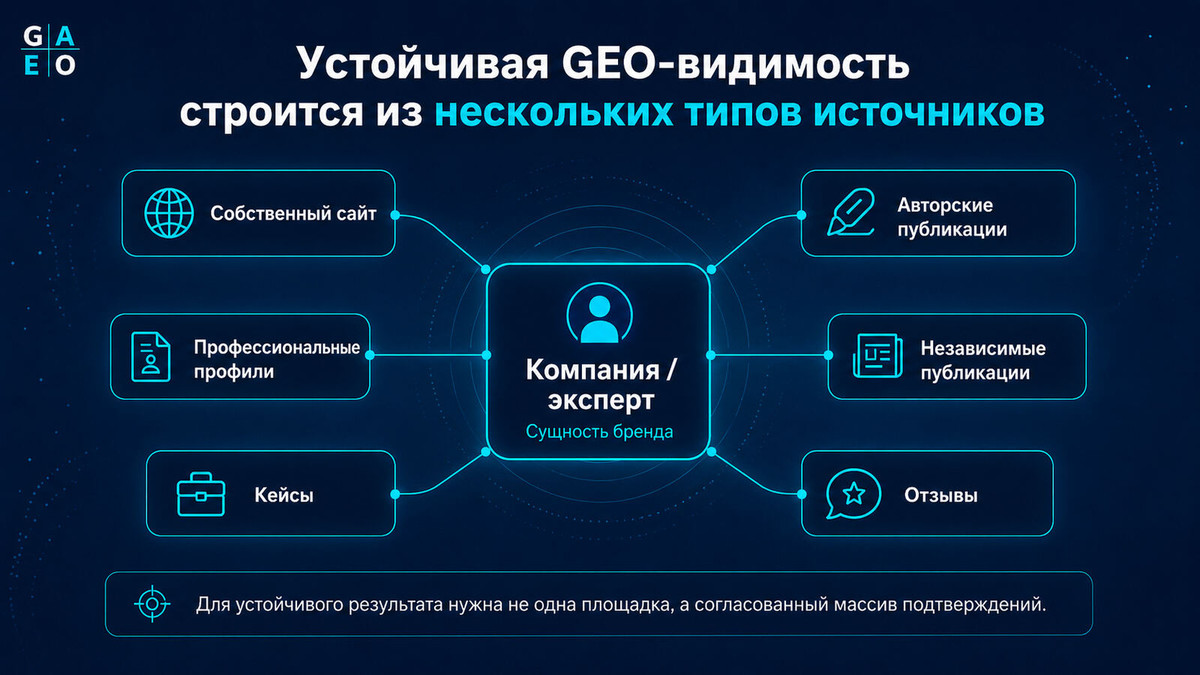
After my own experiment, I would divide the work into 6 source types.
1. Own website
This is where the business controls its own facts.
The website needs services, prices or pricing logic, the expert, case studies, reviews, articles and contact information.
That is the structure I have gradually built for GAEO.ru.
2. Professional profiles
Maps, industry services, directories and specialist profiles.
Their value depends on the specific AI system.
I would not make it a goal to register in 100 directories. It is better to have 8–10 strong, current and consistent profiles.
3. Case studies
On your own website and external platforms.
A case study confirms practical work. This is especially important for services where the AI system must choose a provider.
4. Author publications
Research, guides, analysis and expert comments.
Here, the specialist becomes a source of knowledge for the AI system.
5. Independent publications
Rankings, interviews, reviews and mentions.
They help confirm positioning outside the owned website.
6. Reviews
Especially substantive ones.
A review such as “Everything was great, highly recommended” contains little factual information.
“I came with this problem, the specialist did this, and we got this result” describes a real working scenario.
On GAEO.ru, I separately collect client reviews and external publications so that these confirmations are connected with the core entity.
Where to start GEO optimization
After this research, I would definitely not begin with the question:
“Where should we place 10 articles?”
Start with a baseline measurement.
Take real commercial intents and examine:
- whom each target AI system recommends;
- which sources it uses;
- which document formats repeat;
- where competitors are present;
- what the promoted business lacks.
Then the actions become quite practical.
If Alice uses Yandex Services, improve Yandex Services.
If Perplexity actively uses VC, see whether you can build a credible presence on VC.
If DeepSeek uses Habr, prepare a strong Habr article.
If ChatGPT relies heavily on the official website, strengthen the website.
If the AI system finds the company but misunderstands what it does, synchronize the positioning.
This is much more useful than a universal list of “25 platforms every business needs for GEO.”
What changed in my strategy after the analysis
At the beginning of GAEO.ru, I paid a great deal of attention to my own website.
That was the right decision.
The site became one of the strongest and most stable sources.
But then the next reserve for growth became visible.
External publications.
Especially platforms already used regularly by target AI systems.
That is why GAEO.ru now has a separate publications and mentions section, and I try to complement my own articles and case studies with external materials on appropriate platforms.
This creates different types of evidence around one entity.
How measured visibility changed
Measured visibility of Alexey Yakovlev for the main competitive GEO intent grew from roughly 22% to 48% during the first month of work.
After cleaning the data, the trend looked like this:
| Period | Measured visibility |
|---|---|
| Jun 26–Jul 2 | 22% |
| Jul 3–9 | 26% |
| Jul 10–16 | 30% |
| Jul 17–23 | 41% |
| Jul 24–30 | 47% |
| Final 7 days before the monitoring pause | 48% |
Growth was gradual, then accelerated noticeably in mid-July.
That was exactly the period when more external documents of different types began appearing around the owned website.
I am not claiming that one particular publication caused the growth. The data does not support that conclusion.
But the broader relationship is logical: the more consistent sources confirmed who Alexey Yakovlev is and what he does, the more often AI systems included him in competitive recommendations.
Main conclusion of the research
AI systems do not consult one common database of “best companies” or “best specialists.”
They assemble answers from some set of available documents, and that set differs.
That is why I now see sustainable GEO as work across several source groups at once:
own website + professional profiles + case studies + reviews + author publications + independent mentions.
Together, they should consistently answer simple questions:
- who is this;
- what do they do;
- which problems do they solve;
- which results do they have;
- who confirms it.
During the first month of this work, my measured visibility for the competitive GEO intent grew from roughly 22% to 48%.
The full analysis of my own promotion is in the GAEO.ru case study.
And I describe the broader methodology for promoting experts in the article “How to promote an expert's personal brand in AI in 2026.”
If the entire research is reduced to one practical recommendation, it is very simple:
do not guess which source the AI system needs. First, see which sources it already uses for your queries.
After that, GEO starts to look much less like magic and much more like ordinary systematic work with data, content and reputation.
Check the sources in your niche
You can start with a baseline mini-audit: I will check several commercial intents and show which sources AI systems are using right now.
Request a Mini-Audit