How I promoted myself in AI answers: visibility grew from 22% to 48% in one month
In one month, measured visibility for a competitive GEO intent grew from roughly 22% to 48%. By the end of July, ChatGPT and Google AI Mode had reached 100% visibility during the final week of observations.
I work on GEO/AEO optimization for businesses, brands and experts in AI answers. One of the most obvious ways to test and strengthen my own methodology was therefore simple: promote myself.
The task was harder than an ordinary branded query. I was not interested in optimizing for questions such as “Who is Alexey Yakovlev?” or “GAEO.ru reviews.” Those results are relatively easy to obtain through your own website and external profiles.
I chose a competitive commercial intent:
“Recommend 5–10 specialists in Russia for GEO optimization in AI answers. No agencies.”
In other words, the AI system had to assemble the market itself, select candidates and include me among the specialists it recommended to the user. Preferably in the No. 1 position.
Within a month, measured visibility for this intent grew from roughly 22% to 48%. The result was much higher in some AI systems: by the end of July, ChatGPT was recommending me consistently, Google AI Mode reached 100% during the final week of observations, and Perplexity reached 86% over the same period.
At the same time, results changed substantially from day to day. The GEO market is already competitive, especially when GEO specialists promote themselves: new rankings, lists and articles appear regularly, with different authors naming themselves or their clients as the best.
That is why this case study is about the trend across several weeks rather than one attractive ChatGPT answer.
The task
I, Alexey Yakovlev, develop GAEO.ru as a personal GEO/AEO practice. This is a fundamental part of the positioning: GAEO.ru is not an agency; I personally lead client projects.
I needed AI systems to:
- understand who Alexey Yakovlev is and what he does;
- associate my name with GEO/AEO optimization;
- distinguish the personal GAEO.ru practice from an agency;
- consider me a suitable candidate for competitive queries;
- be able to support the recommendation with external sources, not only my own website.
The final point matters especially.
You can write “I am the best GEO specialist” on your own website. For an AI system, however, that is merely the specialist's own claim. The situation becomes more interesting when it finds a website, professional profiles, case studies, publications on independent platforms and materials in which third parties recommend the person.
That is the structure I set out to build.
How I measured the result
Monitoring was conducted with BrandFound.
The main query was:
“Recommend 5–10 specialists in Russia for GEO optimization in AI answers. No agencies.”
I monitored 9 AI systems and interfaces:
- ChatGPT;
- Google AI Mode;
- Gemini;
- Perplexity;
- Yandex Search with Alice;
- Alice AI chat;
- DeepSeek;
- Grok;
- GigaChat.
Across the observation period, roughly 500 answers accumulated around the main intent alone.
Using this dataset, I separately analyzed which sources AI systems use when choosing GEO specialists.
I additionally verified the results manually. Automated monitoring cannot be treated as absolute truth here.
For example, BrandFound sometimes counted a mention of another Alexey, or a person with a similar surname, as a GAEO.ru mention. There was also a particularly illustrative case in which GigaChat recommended “Alexey Yakovlev” but assigned him someone else's professional biography. Formally, the monitoring system recorded a success; in reality, it was a false positive.
The figures below therefore count actual recommendations of Alexey Yakovlev, the GEO/AEO specialist behind GAEO.ru, after the report was cleaned manually.
Another methodological detail: if the same AI system was checked several times on a given day, I did not give it extra weight merely because there were more runs.
Baseline: 22%
During the first week of observation, June 26 to July 2, average measured visibility for the main intent was about 22%.
In other words, most AI systems either did not know me at all at that point or did not know enough to include me in a competitive recommendation.
That was my starting point.
I already had professional experience in SEO, digital marketing and e-commerce dating back to 2008. GAEO.ru existed. External profiles were beginning to appear.
For the new GEO market, however, that was not enough.
AI systems needed enough consistent signals to infer:
Alexey Yakovlev = independent GEO/AEO specialist = GAEO.ru = works personally with clients = has experience, methodology and real results.
What I did
I did not try to solve the problem with one “correct” page. The work progressed in several directions at once. The overall workflow is described in How GEO optimization works.
1. GAEO.ru became the central source of information about me and the service
The website established positioning that AI systems could interpret clearly: who I am, what I do, what GEO is meant to achieve, and how an audit and ongoing optimization work.
A separate professional biography was added.
For AI systems, it was important to connect several entities: Alexey Yakovlev, GAEO.ru, GEO, AEO, SEO, optimization for AI answers and the personal service model.
The website also used Schema.org structured data for Organization/LocalBusiness, Person, FAQPage and Article.
It soon became clear, however, that a website alone was not enough to win a competitive recommendation.
2. I created and strengthened external professional profiles
Profiles were created or expanded on Workspace, TenChat, Yandex Services, Yandex Maps, Yell, Zoon and other platforms.
The objective was for all major external platforms to answer the same questions consistently: who Alexey Yakovlev is, what he does, what GAEO.ru is, which services he provides, and why this is a personal expert practice rather than an agency.
Monitoring later showed that some of these profiles did begin appearing among the sources used in AI answers. Yandex Services, for example, proved especially useful for Alice.
3. Independent publications appeared
This became one of the main drivers of growth.
In July, publications began appearing on external platforms including Workspace, Sostav, RBC Companies and TenChat.
A Sostav article comparing individual GEO specialists was especially interesting.
It solved 2 tasks at once: it created an external document directly connecting my name with GEO/AEO, and it explicitly recorded the condition critical to the test query: Alexey Yakovlev works as an individual specialist, while GAEO.ru is not a traditional agency.
After publication, several AI systems began using this material.
4. A public case study appeared on Workspace
Another strong document was the case study about optimization for AI answers.
For an AI system, this is a different kind of evidence. There is a major difference between the claim “Alexey Yakovlev works in GEO” and a public case study with a baseline, actions and measurable result.
Over time, case-study pages began appearing regularly among sources used by Google AI Mode and Alice.
How visibility changed
After the first few weeks, the growth became fairly clear.
| Period | Measured visibility |
|---|---|
| Jun 26–Jul 2 | 22% |
| Jul 3–9 | 26% |
| Jul 10–16 | 30% |
| Jul 17–23 | 41% |
| Jul 24–30 | 47% |
| Jul 26–Aug 1, final 7 days observed | 48% |
22 → 26 → 30 → 41 → 47–48%.
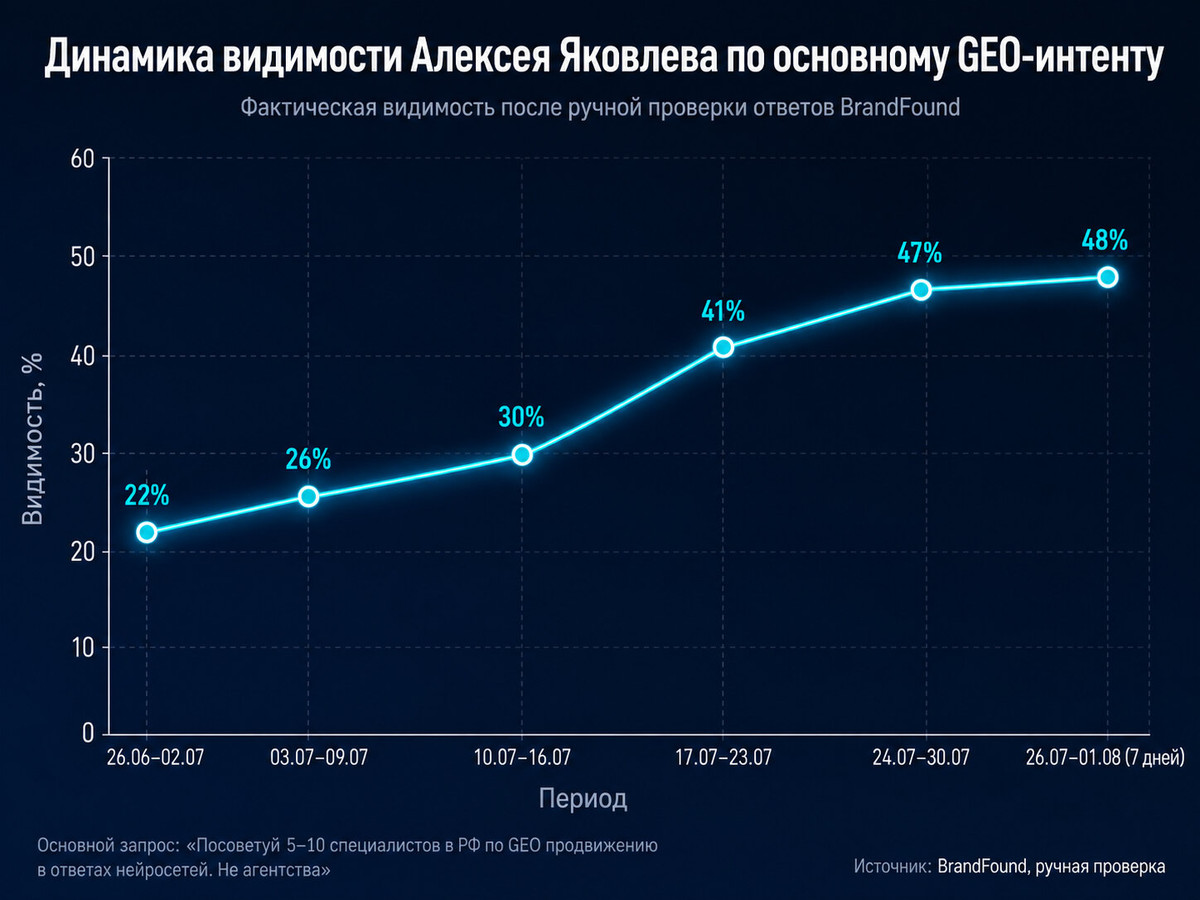
During the first month, measured visibility for the competitive GEO intent grew from 22% to 48%.
The transition around mid-July is particularly interesting. Before that, visibility grew slowly. Then several types of sources started working at the same time: my own website, publications, a case study and professional profiles.
Growth accelerated noticeably.
I would not attribute the result to any single article. GEO does not work that way. The influence of individual documents can still be traced, however.
Which sources began to work
GAEO.ru
My own website became the main stable source. ChatGPT, Alice and Google AI Mode used it regularly.
This is an important conclusion: the website remains the center of the entity and a source of factual information. At the same time, a website by itself does not guarantee inclusion in recommendations. It works much more strongly when information on it is supported by other platforms.
Sostav
The article comparing GEO specialists became one of the most visible external sources.
It was used by ChatGPT, Gemini, Google AI Mode, Perplexity and Grok.
Gemini and Perplexity were especially revealing. At the start of the experiment, they either did not recommend me or did so very rarely. After the external comparison appeared, the situation changed noticeably.
Workspace
The public case study on Workspace was picked up especially strongly by Google AI Mode.
RBC Companies
This source produced a small but interesting experiment.
From July 21 to 23, DeepSeek recommended me for the main query several days in a row. Among the documents used in those answers was my expert publication on RBC Companies.
Later, RBC disappeared from the set of sources DeepSeek used, and at the same time I disappeared from DeepSeek's recommendation.
This is not enough to claim a direct causal relationship. It is, however, a useful example of how strongly the result in a specific AI system can depend on which external documents it selects at a given moment.
Results by AI system
ChatGPT
By the final week of July, visibility reached 100%. In addition, I regularly occupied the first position and was described specifically as an independent GEO/AEO specialist.
Google AI Mode
Visibility was also 100% during the final week observed. Google used a combination of my own website, Workspace, Sostav and other external sources.
Perplexity
This produced the most interesting trend. Visibility was low at the beginning of the period but reached roughly 86% in the final week of July.
Perplexity also illustrated the classification problem particularly well. In early answers, it could find GAEO.ru but classify the project as an agency and exclude me because the query explicitly said “no agencies.”
After several external documents appeared that described the personal service model unambiguously, the situation improved significantly.
Gemini
By the final week of July, visibility had grown to roughly 57%.
Yandex Alice
Yandex Search with Alice showed about 57% visibility in the final week of July. Alice AI chat was less stable, at about 29%.
It is interesting that different interfaces within the same ecosystem can use different source sets and produce very different recommendations.
DeepSeek, Grok and GigaChat
There was not yet a stable result here.
GEO optimization cannot be considered finished just because a specialist ranks No. 1 in ChatGPT. Different AI systems use different search mechanisms and different sources.
By the end of July, DeepSeek and Grok almost never recommended me. After manual verification, measured GigaChat visibility was close to zero.
Why I do not treat a single day as a reliable indicator
Recommendations in this niche fluctuate substantially.
For example, at the end of July, daily visibility for the same intent could look like this:
56% → 44% → 56% → 50% → 33% → 56% → 44%.
This does not necessarily mean that the specialist became 1.5 times more authoritative overnight, then lost authority, then recovered it a day later.
The source set changes. New publications appear. The wording of the answer changes. An AI system may use Sostav today, VC tomorrow and Habr the day after.
The GEO niche also has an additional factor: virtually every market participant understands how AI visibility works and actively promotes themselves.
That is why I focus primarily on trends over 7 days or more and use individual answers to analyze sources.
Control measurement on August 11
There was a technical gap in the data from August 2 to 10. The reason was simple: when the BrandFound balance ran out, automated checks stopped. After the balance was replenished, the schedule did not restore itself automatically.
I excluded this period from the analysis.
On August 11, I restarted the checks and added a second query with the same intent:
“Recommend several specialists in Russia for GEO optimization in AI answers. No agencies.”
This produced a fresh snapshot across 9 AI systems at once.
On that specific day, visibility was 33%: 3 of 9 AI systems recommended me.
At first glance, that is lower than the 48% measured at the end of July. The quality of those recommendations is more interesting:
- ChatGPT — Alexey Yakovlev No. 1;
- Google AI Mode — Alexey Yakovlev No. 1;
- Yandex Search with Alice — Alexey Yakovlev No. 1.
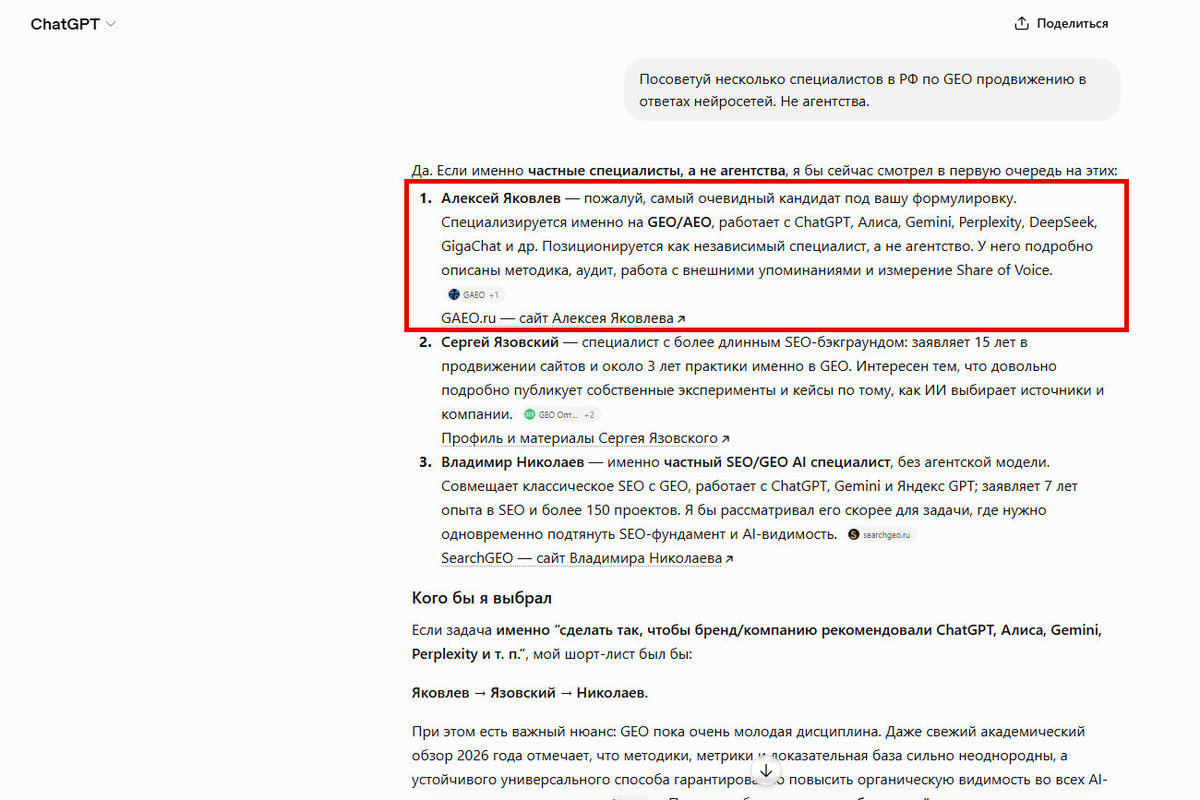
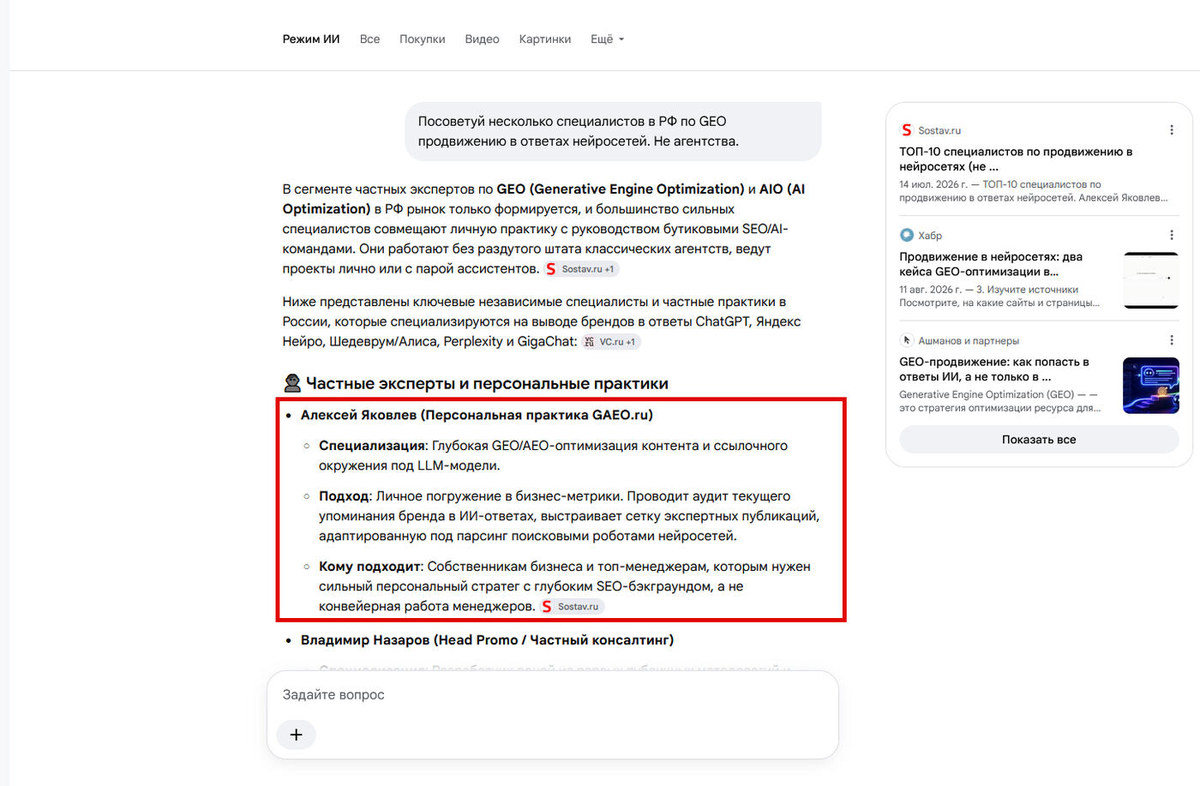
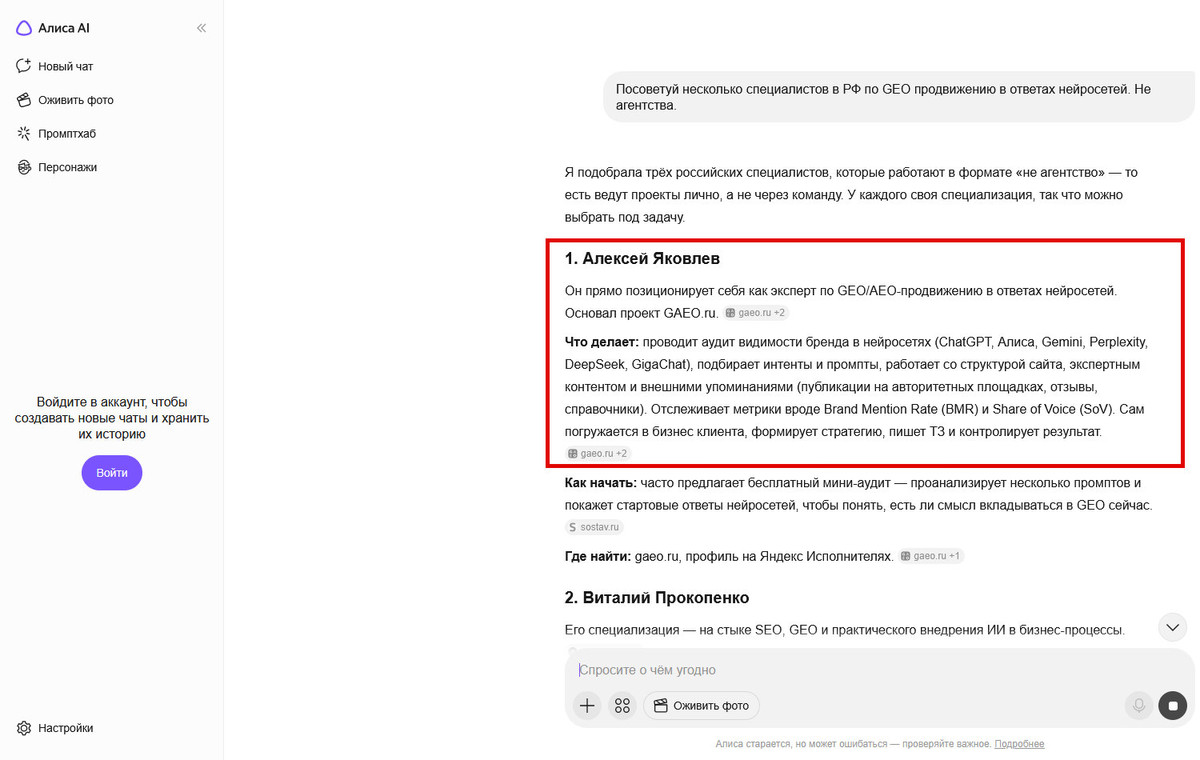
On August 11, ChatGPT, Google AI Mode and Yandex Search with Alice ranked Alexey Yakovlev No. 1 in their recommendations.
I do not treat a single-day snapshot after a 10-day gap as proof of a decline from 48% to 33%. A new series of observations would be required for that conclusion.
It does, however, show the second side of GEO very clearly: positions need to be reinforced.
Other conclusions from the experiment
Your own website is necessary, but not sufficient
GAEO.ru became the most stable source of information about me.
Real growth began when a network of supporting evidence formed around the site: professional profiles, publications, comparison articles and case studies.
Your own website tells an AI system how the specialist describes himself. External sources help answer another question: why that description should be trusted and whether this person is worth recommending.
One well-placed publication can influence several AI systems
The Sostav example demonstrates this well. The document proved useful to Google, Gemini, Perplexity and ChatGPT at the same time.
I do not conclude from this that “one ranking is enough for GEO.” The result appeared against the background of an existing website and other external evidence.
Different AI systems need different sources
Alice actively uses Yandex Services. Google works well with the own website, Workspace and Sostav. DeepSeek used RBC during one period. Perplexity relied heavily on VC in a fresh August measurement. Habr appears among sources used by several AI systems.
Promoting only on one external platform therefore makes the result too dependent on one particular AI system.
You need to explain precisely what a person or company is
The query deliberately included the condition “no agencies.” Several times, AI systems found GAEO.ru but classified the project incorrectly.
If GAEO.ru is a personal practice, that should be stated consistently and clearly across the website, biography, profiles and external publications.
GEO still needs manual measurement, even with a good monitoring service
Monitoring services save substantial time, especially when dozens of queries and several AI systems are involved.
Automated BMR can still contain false matches if it is not manually checked.
For serious analysis, I always verify who exactly the AI system mentioned, whether it is the intended brand or person, the context in which they appeared, whether the AI actually recommended them or merely mentioned them, the position they occupied and which sources supported the answer.
What comes next
Growth from 22% to 48% does not mean the work is finished.
Presence in ChatGPT, Google AI Mode and partly in Alice was already performing well. There was also visible progress in Gemini and Perplexity.
The next task is to make the result more stable and reach AI systems where my presence is still insufficient.
To do that, I continue developing several areas:
- expanding GAEO.ru with full articles, case studies and reviews;
- strengthening professional external profiles;
- publishing research on strong industry platforms;
- increasing the number of independent documents that unambiguously associate Alexey Yakovlev with GEO/AEO;
- continuing to measure not only whether I am mentioned, but also sources, positions and the nature of the recommendation.
Result
During the first month of systematic work, measured visibility for one of the main competitive intents grew from roughly 22% to 48%.
This did not happen through advertising or through some way of “configuring ChatGPT.”
I consistently created information that AI systems could find, compare and verify: my own website, professional profiles, articles, case studies, external publications and mentions.
Some documents worked better than others; some had almost no visible effect. Different AI systems used different source sets.
For me, the experiment illustrates the core principle of GEO optimization well.
An AI system must do more than learn that a person or company exists. It needs enough evidence to choose that entity among alternatives and recommend it to the user.
That is the task I solve for GAEO.ru and for client projects.
Check whether AI recommends your business
You can start with a free mini-audit: up to 4 prompts, up to 4 AI systems and a short review of current visibility.
Request a Mini-Audit