
How AI recommends tour operators and DMCs: GEO methodology for VIP and business travel
AI travel recommendations become more defensible when the itinerary, supplier role and actual trip terms match a specific buyer's request.
A private buyer can ask for a tailored Brazil trip, while a travel agency may need a destination management company to support a corporate delegation with interpreters and meetings. Both involve Brazil, yet the buyers compare different services and sources. At GAEO.ru, I study how AI assistants choose these suppliers. My commercial approach is described under GEO for tour operators and DMCs.
This guide uses verified industry sources and the public Ada Tours case study. Its measured results refer to a fixed September sample. Availability and prices of future programs require separate confirmation for each booking.
1. Eight types of travel inquiry, each with its own provider evidence
A useful GEO study separates the destination, service type, buyer and degree of operational responsibility. The eight groups below correspond to the published Ada Tours study. The example questions illustrate the method and are not presented as verbatim BrandFound prompts.
| Commercial segment | Illustrative unbranded question | Key evidence |
|---|---|---|
| Brazil end to end | Who can organize Brazil with transfers, hotels and excursions? | Itinerary, allocation of responsibility and inbound services |
| VIP Brazil | Which company handles private Brazil tours with dedicated guides? | Personalized itinerary, languages, hotel category and actual service scope |
| MICE and delegations | Who coordinates a Brazil business mission with meetings and interpreting? | Group size, meetings, ground transport and partner roles |
| Rio and Carnival | Which operator arranges Carnival travel with confirmed accommodation? | Dates, booking rules and actual package inclusions |
| Multi-country routes | Who can combine Brazil, Argentina and Peru in one trip? | Cross-border transfers, operators in each country and continuity of service |
| Argentina and Patagonia | Who organizes guided Patagonia trips? | Actual stops, seasonality, transfers and supplier accountability |
| Amazon and Pantanal | Who arranges wildlife viewing trips to the Pantanal? | Guides, allowable activities, safety and season |
| Antarctica via Argentina | Who can help select an Antarctic cruise departing from Argentina? | Cruise operator, port access, trip conditions and visitor rules |
Each segment needs unbranded supplier-selection prompts. Questions about weather, sightseeing or local history are useful informational topics but should be measured outside the commercial recommendation baseline.
2. Nine checks to assess a tour operator's real capabilities
- Who sells and delivers? Establish who contracts with the traveler, who receives the group and who executes each service.
- Where does it operate? Verify supported countries and regions. Name local partners according to their actual duties.
- What is the itinerary? Compare the day's locations, transport and connections with the advertised inclusions.
- Who is the buyer? Distinguish B2C travelers, travel agencies and corporate clients.
- When can it run? Verify dates, seasonality and current availability before recommending a program.
- What does it cost? Specify currency, number of travelers, hotel category and excluded expenses; per-person prices must not be confused with group totals.
- What proves delivery? Use verified real programs, appropriately sourced reviews and disclosable client examples.
- Which rules apply? Check travel documents, border conditions and special destination requirements for the traveler's citizenship and route.
- How is support provided? Give a clear quote path and define who assists travelers during itinerary changes.
For MICE groups, assess meeting arrangements, group transport and the promised operational scope. For VIP trips, test customization and verifiable service terms. For cruises, clearly distinguish the booking agent, ground handler and actual ship operator.
3. Primary sources for entry, supplier status and destination restrictions
Travel program content benefits from authoritative references. IATA Travel Centre provides passport, visa and health requirement information personalized to the traveler and itinerary. Brazil's official Cadastur registration service describes registration requirements for several types of local tourism providers. Any registration claim should be checked against the provider's actual activity.
An Antarctic cruise requires its own operational evidence. The Antarctic Treaty Secretariat publishes tourist rules and organizer guidance. The IAATO visitor guidance provides further practical environmental and safety rules. A company selling or coordinating a cruise is not necessarily the expedition operator. Role descriptions should reflect contractual and operational facts.
Entry restrictions, costs and schedules change. A GEO article should explain where the user can verify a requirement instead of making universal visa promises across citizenships.
4. Measuring more than Brand Mention Rate
For each full response, record the exact prompt, date, language, provider, answer and cited URLs. Keep four variables distinct: literal brand mention, active recommendation of the provider, website citation and accuracy of the service description.
A link to the operator's domain without its written name is not a literal mention. Negative comments should be classified separately. Comparable periods require an unchanged prompt set, AI panel and mention rules. The formulas are explained in the BMR and Share of Voice guide.
5. Verified Ada Tours case: the fixed September measurements
The September 6, 2026 baseline recorded 20 mentions in 200 responses (10%). A September 21 repeat found 70 in 200 (35%). Both samples covered 40 Russian-language commercial prompts, five in each of eight segments, across the same five AI interfaces. The underlying method and caveats appear in the public Ada Tours GEO case study.
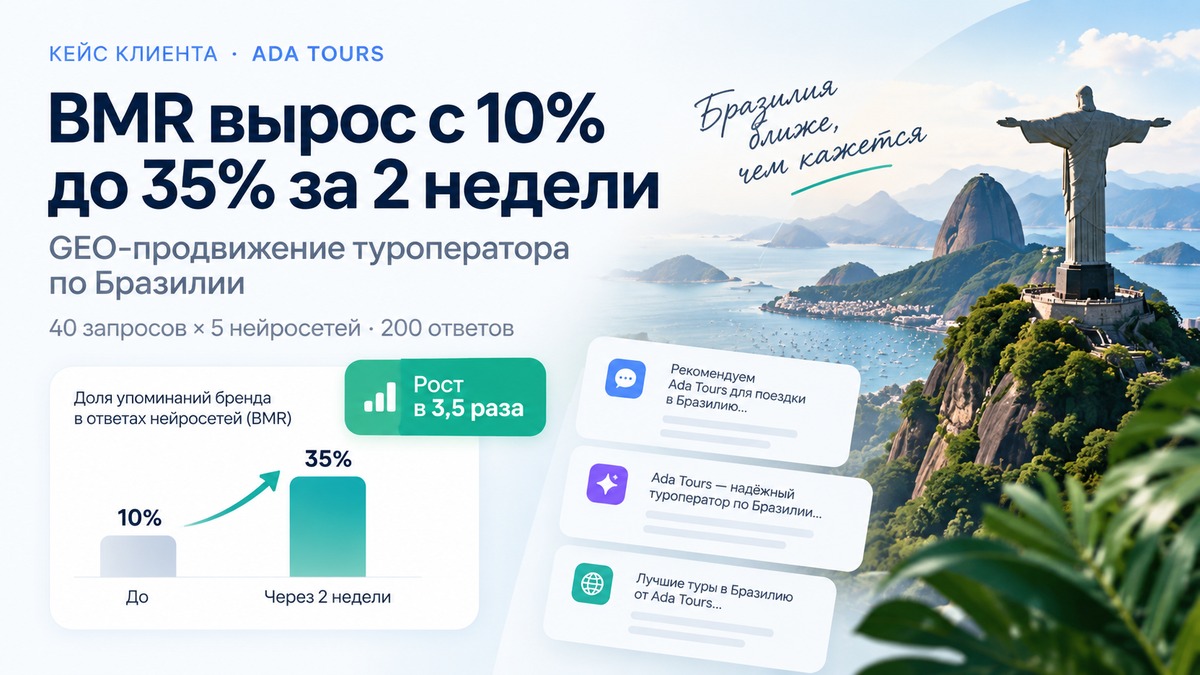
Different travel intents gave different results. For business trips and delegations, mentions changed from 1 in 25 to 14 in 25 (4% to 56%). For VIP Brazil, the figure went from 9 in 25 to 15 in 25 (36% to 60%). These groups belong to the same fixed study and can be compared under consistent rules.

During those two weeks, the project changed website pages, external materials and the structure of commercial information. The result describes the combined work; the dataset cannot isolate the contribution of each edit.
6. Expanding destinations without distorting the baseline
After the initial study, additional regions, trip themes and languages may become important: family itineraries, fishing, wildlife trips and agency partnerships. Each new intent should receive its own baseline. For instance, 40 × 5 and 52 × 5 correspond to different studies of 200 and 260 answers. Their overall percentages cannot be read as one continuous performance trend.
Keep a separate study for each language and buyer market. A Russian traveler, an English-speaking agency and a corporate delegation may expect different providers and sources. Track changes within each stable market panel.
7. Website evidence needed for a credible travel recommendation
An effective travel website connects crawlable destination pages, full tour programs, excursions, places, travel interests, corporate services, operator information and correctly sourced reviews. Program descriptions must agree with what the provider can actually deliver.
Multi-country itineraries need explicit connections between destinations and services, and the real role of local partners must be visible. Schema.org markup should reflect that visible content. Google Search Central states that structured data must meet content policies and does not guarantee special search appearances or AI recommendations.
In GAEO, this method connects the tour operator GEO service, the measured Ada Tours case and the SEO/GEO website development offering, where structural problems require site-level changes.
Frequently asked questions about GEO for tour operators
Which prompts should a tour operator measure for GEO?
Does a link to a tour operator's website count as a recommendation?
How does a travel agency's query differ from a private traveler's?
How should new destinations be included in GEO tracking?
Does growing AI visibility prove more tour bookings?
What evidence is needed for Antarctic cruise recommendations?
Author: Alexey Yakovlev, independent GEO/AEO expert. Related methods and measured projects are indexed under Strategies and Case Studies.
Check your business visibility in AI answers
I will review commercial prompts, competitors and the sources used by ChatGPT, Alice, Google and other AI services.
Get a mini-audit