How Ada Tours Grew Brand Mention Rate from 10% to 35% in 2 Weeks
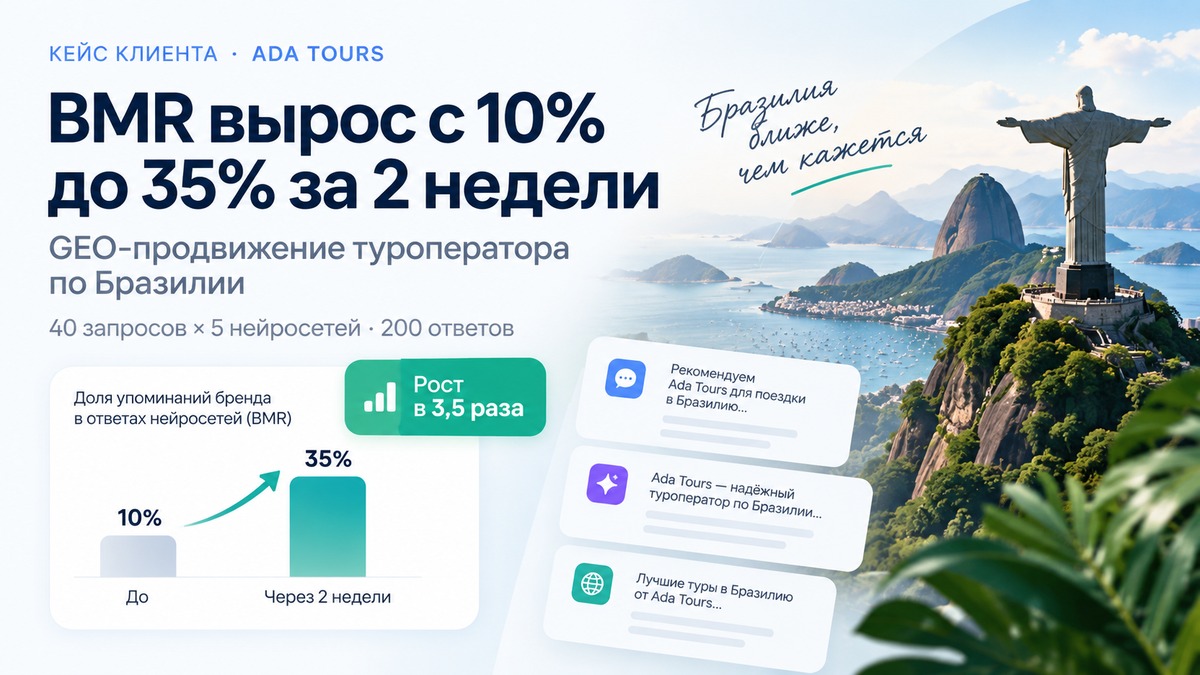
In 2 weeks, the share of AI answers mentioning Ada Tours grew from 10% to 35% on an unchanged control matrix: 40 queries × 5 AI services = 200 answers. All 8 promoted segments improved.
We started active GEO work for Ada Tours on September 7, 2026. The baseline measurement from September 6 found the brand in 20 of 200 AI answers, giving a Brand Mention Rate of 10%.
Ada Tours is a destination management and tour operator focused on Brazil and Latin America. For the Russian-speaking market the company also operates through BrasilTours.ru. We repeated the same control measurement on September 21, exactly 2 weeks after work began.
Brand Mention Rate, or BMR, is the share of answers across a fixed query set in which the brand appears. For this case study I use the strict version of the metric: only explicit Ada Tours, AdaTours or Russian transliterations in the answer text count.
What we measured
To keep the comparison valid, both measurements used the same control set:
- 40 Russian-language commercial queries;
- 8 segments with 5 queries each;
- 5 AI services for every query;
- 200 answers in each measurement.
The set included ChatGPT, Gemini, Google AI Mode, Yandex Search with Alice and Alice Chat. The September 21 run returned all 200 answers with no missing responses.
What changed during the 2 weeks
The work went well beyond publishing several articles. We changed both Ada Tours' own pages and the external source environment that AI systems can use when selecting a tour operator.
1. We split the promotion into 8 commercial segments
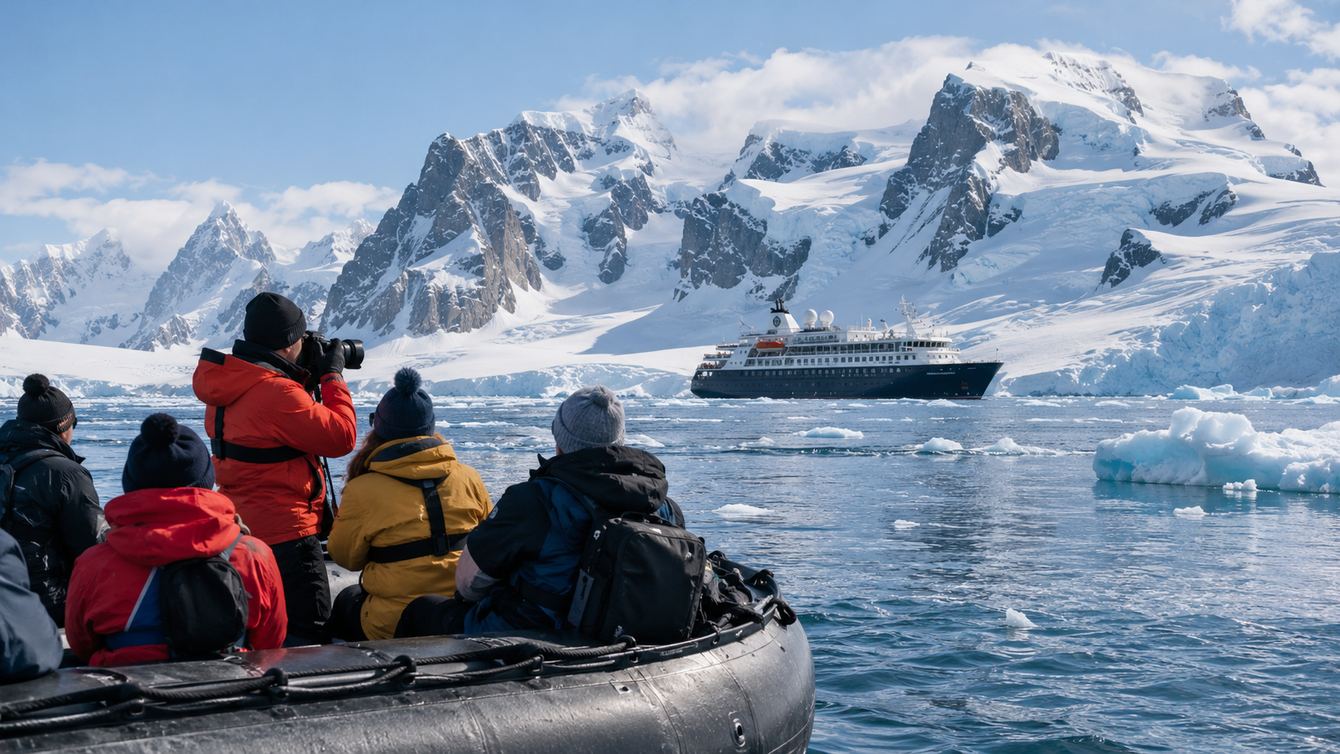
Instead of treating “Brazil tours” as one broad topic, we built separate intent clusters: Brazil trips end to end, VIP travel, business trips and delegations, Rio and Carnival, multi-country South America, Argentina and Patagonia, Amazon and Pantanal, and Antarctica via Argentina.
2. We strengthened the landing pages
During the first days we updated 5 existing pages and selected 3 more as target landing pages. The work included titles and descriptions, opening copy, page structure, factual Ada Tours information and internal links between related destinations.
3. We strengthened external sources
External publications and research were created for priority intents. Existing materials on Sostav, TenChat, DTF and Klerk were connected to relevant landing pages and to each other where the relationship was useful to the reader.
4. We kept different buying scenarios separate
A VIP trip, a business delegation and an Antarctica cruise need different evidence. For every segment we built its own combination of landing page, external materials, research and concrete facts that help an AI answer associate Ada Tours with that exact task.
Results across all 8 segments
| Segment | Sep 6 | Sep 21 | Change |
|---|---|---|---|
| Brazil trip end to end | 24% | 48% | +24 pp |
| VIP Brazil | 36% | 60% | +24 pp |
| Business trips and delegations | 4% | 56% | +52 pp |
| Rio, Carnival, New Year | 0% | 16% | +16 pp |
| Brazil + Argentina + Peru | 12% | 28% | +16 pp |
| Argentina and Patagonia | 4% | 32% | +28 pp |
| Amazon and Pantanal | 0% | 16% | +16 pp |
| Antarctica via Argentina | 0% | 24% | +24 pp |
Every segment improved. The largest change came from business trips and delegations: 4% to 56%, or 1 to 14 brand mentions out of 25 answers.
VIP Brazil: 36% → 60%
VIP travel was already the strongest segment at baseline and added another 24 percentage points. In the second measurement Ada Tours appeared in 15 of 25 answers.
For the query asking who can organize a VIP Brazil trip with private guides, transfers and 24/7 support, the brand appeared in 4 of 5 AI services.
Business trips and delegations: 4% → 56%
This was the biggest gain in the case study: +52 percentage points. At baseline Ada Tours appeared in only 1 of 25 answers; 2 weeks later it appeared in 14.
Two long B2B queries about delegations and business missions each produced mentions in 4 of 5 AI services. The strongest pattern was a user looking for a company that could handle complex logistics, interpreters, company meetings and group support.
3 segments moved up from absolute zero
At baseline, Ada Tours was absent from all 75 answers in the Rio/Carnival, Amazon/Pantanal and Antarctica-via-Argentina segments.
After 2 weeks the results were 16%, 16% and 24%. These are not yet high visibility levels, but the brand moved from complete absence to repeat mentions across several AI services.
Current visibility across the 5 AI services
| AI service | Mentions | BMR on Sep 21 |
|---|---|---|
| Yandex Search with Alice | 22/40 | 55.0% |
| Gemini | 21/40 | 52.5% |
| Alice Chat | 18/40 | 45.0% |
| Google AI Mode | 6/40 | 15.0% |
| ChatGPT | 3/40 | 7.5% |
A directly comparable per-AI breakdown was not used for the September 6 baseline in this report, so this table shows only the September 21 state.
Most of the current visibility comes from Yandex and Gemini. Google AI Mode, and especially ChatGPT, remain the main growth areas.
Company-selection queries grew fastest
The strongest results came from long commercial queries where the user is already choosing a specific organizer. For example:
- “Which company should I choose for an individual Brazil trip end to end?” – 5 of 5 AI services;
- a VIP Brazil trip with private guides, transfers and 24/7 support – 4 of 5;
- a business delegation with interpreters, meetings and complex logistics – 4 of 5;
- a VIP Argentina and Patagonia trip with private guides and transfers – 4 of 5.
Short broad category queries are still much weaker. In the repeat measurement, queries equivalent to “Brazil tour”, “Rio de Janeiro tour”, “Argentina tour”, “Amazon tour” and “Antarctica cruise” remained at 0 of 5.
After 2 weeks, Ada Tours had become materially more visible in the lower, commercial part of the funnel where a user is selecting a company. Broad category visibility still needs to grow.
Why the canonical result is 35%, not 43.5%
BrandFound's classifier also marked 17 additional answers as positive even though the Ada Tours name was not literally present in the answer text. Using that raw classifier flag would produce 87 of 200 answers, or 43.5%.
I do not use the higher number as the headline metric. For a reproducible comparison with the baseline I count only explicit brand mentions. The canonical result is therefore 70 of 200 answers, BMR 35%.
What matters most after the first 2 weeks
BMR grew 3.5 times, from 10% to 35%. The number of answers with the brand grew from 20 to 70. The improvement is spread across all 8 segments rather than being created by one successful cluster.
The data also makes the next step clear. The current source mix works far better for Yandex and Gemini than for ChatGPT and Google AI Mode. The next phase is to study sources used by the weaker AI services and expand broad category queries without losing the commercial visibility already achieved.
Future control measurements should keep the same 40 queries and the same 5 AI services. Changing the denominator would make the KPI comparison less reliable.
Methodology note
The baseline was measured on September 6, 2026, before active work began. Work started September 7. The repeat run was completed September 21, so the case study uses a 2-week period.
Each measurement contains 40 queries × 5 AI services = 200 answers. Overall BMR is based on strict literal brand mentions. The 43.5% BF-native classifier result is treated only as a secondary diagnostic metric.
BMR growth alone does not prove that any single change caused any single mention. During the 2 weeks we changed the website, external publications, research and linking in parallel. The case study documents measurable before-and-after movement on an unchanged control matrix.
Check your business visibility in AI answers
I will review commercial prompts, competitors and the sources used by ChatGPT, Alice, Google and other AI services.
Get a mini-audit