
How AI selects technical IT vendors: site performance, load testing and B2B software
Technical vendors earn defensible recommendations when their demonstrated capabilities match the buyer's specific engineering problem.
An online store might seek a team to accelerate a 1C-Bitrix site. A corporate IT director may instead evaluate database software under a particular workload. In both scenarios AI should connect buyer needs to demonstrable supplier capabilities. At GAEO.ru I study those recommendations; the commercial service is described under GEO for IT companies and specialized engineering services.
This guide combines the public MethodLab case study with anonymized observations from a separate, preliminary enterprise software audit. The projects have different levels of evidence, and only MethodLab has a documented before-and-after measurement in this material.
1. Eight technical buyer intents that require different proof
“Best IT company” is usually too broad for a useful supplier shortlist. I separate intent by stack, problem, service scope and procurement stage. The example questions below are illustrative; they are not claimed to be the original verbatim BrandFound prompt export.
| Technical need | Unbranded buyer question | Evidence required |
|---|---|---|
| 1C-Bitrix acceleration | Who specializes in speeding up a large 1C-Bitrix online store? | Relevant stack, component diagnosis and comparable before/after evidence |
| Storefront performance | Which team can fix slow checkout on a large product catalog? | Code, database bottlenecks and representative user workloads |
| Load testing | Who can test whether an e-commerce site survives a major sale? | Workload model, p95/p99 latency, errors and acceptance criteria |
| Production outages | Who can investigate recurring failures during traffic spikes? | Logs, root-cause analysis, incident history and scope of work |
| Core Web Vitals | Which provider can improve LCP and INP on a large store? | Real-user metrics, equivalent page cohorts and measurement dates |
| Independent audit | Who audits performance and advises our in-house developers? | Auditor independence, reproducible findings, documented handoff |
| Enterprise database | Which databases should we trial for a transactional B2B service? | Compatibility, resilience, licensing, vendor support and testing |
| Mission-critical migration | Who can help evaluate database platforms for a critical workload? | Pilot methodology, migration dependencies, security and rollback plan |
In each category I measure unbranded supplier selection separately from named-brand awareness. Recognition of an organization does not prove that the assistant would recommend it to a buyer who does not know its name.
2. Nine supplier-evidence checks before making a recommendation
- Exact role. Determine whether the vendor audits, changes code, manages infrastructure or only produces a report.
- Supported stack. Verify software versions, platform expertise, integration dependencies and documented exclusions.
- Representative workload. Identify request rates, data volume, catalog size or transaction mix appropriate to the procurement scenario.
- Baseline problem. Confirm symptoms, reproducibility, access boundaries and hypotheses.
- Measured outcomes. Inspect p95/p99, error rate, field Core Web Vitals or relevant pilot results with their context.
- Comparable engagements. Verify the provider's actual role and whether the documented task resembles the buyer's need.
- Data protection. Confirm approved test environments, NDA scope, log anonymization, access permissions and evidence retention.
- Acceptance criteria. Check what final report or artifact is supplied, how re-testing works and where responsibility ends.
- Independent corroboration. Seek attributable technical articles, documentation and reviews, without treating vendor marketing as independent third-party proof.
A performance consultant typically needs reproducible diagnostics. A database software supplier needs a credible deployment and compatibility story. The required evidence therefore differs even though both qualify as technical B2B.
3. User experience and capacity under load are separate measurements
Google Search Central defines Core Web Vitals as field-oriented page-experience signals: LCP, INP and CLS. The good-experience thresholds are LCP within 2.5 seconds, INP within 200 milliseconds and CLS at most 0.1. Meaningful diagnosis considers real users and representative page types.
A load test evaluates a different question: how the system behaves under a specified traffic pattern and system configuration. Grafana k6 threshold documentation explains how to set project-specific pass/fail criteria using error rates, latency percentiles and custom metrics. Workload definition and clear objectives are necessary to interpret the result.
For 1C-Bitrix, the official performance monitoring module provides a technical way to examine site activity. The mere presence of a monitoring tool does not establish that a particular production issue has been solved; original and follow-up measurements matter.
4. Database software evaluation needs an applicable workload
For mission-critical database procurement, blanket claims such as “fastest database” carry little information. Buyers need to define transaction or analytical workload, data volume, resilience, migration constraints, support arrangements and licensing.
The Transaction Processing Performance Council publishes industry benchmark descriptions. A benchmark must be interpreted within its workload and configuration. PostgreSQL's EXPLAIN documentation illustrates how execution plans and actual query performance can be investigated in a specific database; that does not by itself rank independent vendors or solve a full enterprise migration.
For GEO, a software vendor's website should connect its supported use cases, published documentation and proof-of-concept process to those buyer requirements. A recommendation is more useful when a buyer can inspect the cited evidence and its applicability.
5. MethodLab: a measurable comparison on the same question set
The public MethodLab case study compares 6 commercial questions across 7 AI interfaces on two dates. On September 14, 2026, the brand appeared in 8 of 42 responses (19.0%). On October 13, it appeared in 22 of 42 (52.4%), an increase of 14 answers mentioning the company with the denominator unchanged.
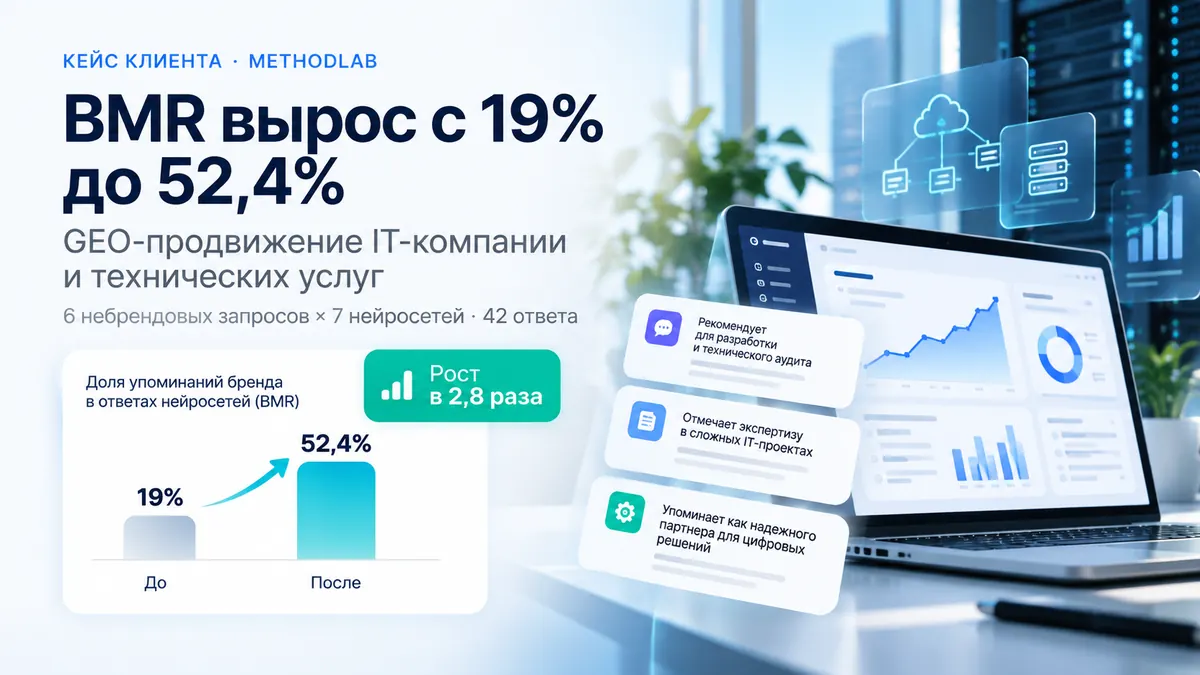
An earlier August 11 audit yielded 9 mentions in 42 answers (21.4%). The Bitrix performance and peak-load intents were each absent in all 7 responses at that point. This earlier snapshot has a different date and is not the baseline for the published September-to-October comparison. Platform-level outcomes were uneven.
Website information, external sources and editorial content changed during the period. The measurement documents the observed outcome after combined work; it cannot establish the causal effect of an individual publication or guarantee a similar result elsewhere.
6. An anonymized enterprise software pre-audit: a different evidence level
In another preliminary study of technical B2B software, GAEO tested 4 unbranded commercial questions across 4 AI interfaces (16 responses). One answer explicitly mentioned the evaluated vendor. Three other question groups did not return a brand mention. The provider name, specific products and confidential information remain undisclosed.
This is a diagnostic observation. It helps identify which needs the AI interfaces already associate with a supplier and where additional documentation may be required. No comparable follow-up measurement or confirmed implementation was established in that source, so it cannot be presented as a successful GEO campaign.
7. Turning engineering evidence into crawlable supplier content
Priorities depend on the observed gap. Useful content may include specialist service pages, dated engineering case studies, reproducible testing methodology, supported software versions, visible limits of service, source links and a working quotation channel.
Stable URLs, text-readable performance tables and attributed technical authors help a buyer verify claims. A PageSpeed chart should not be described as the measured outcome of a server load test. Structured data needs to match what readers see; Google's structured data policies require accurate representation and do not guarantee a particular search appearance.
Where website architecture is the underlying issue, this approach also connects to SEO/GEO website development. The general counting rules are described under Brand Mention Rate and Share of Voice.
8. Repeatable monitoring for engineering vendors
Each answer record should preserve the exact unbranded prompt, language, AI interface, date, full answer and its links. Keep literal brand mentions, positive vendor recommendations, website citations and factual errors in separate columns, and report missing responses explicitly.
New areas such as database selection, load testing, Bitrix acceleration and field Core Web Vitals can be added as separate prompt series with their own starting measurements. A new sample must not silently replace the historical panel. Connect AI visibility with qualified inquiries and signed contracts in the company's CRM when that evidence is available.
Frequently asked questions about technical B2B GEO
Which prompts matter for technical B2B GEO?
Does a high PageSpeed Insights score prove a store can handle peak loads?
What qualifies as evidence for a load-testing contractor?
Does a published database benchmark prove the quality of a database vendor?
Can BrandFound results from different prompt sets be compared directly?
Does BMR growth prove more IT contracts were sold?
Author: Alexey Yakovlev, independent GEO/AEO expert. More detail: technical IT GEO services, the measured MethodLab case and other industry methodologies.
Check your business visibility in AI answers
I will review commercial prompts, competitors and the sources used by ChatGPT, Alice, Google and other AI services.
Get a mini-audit