
GEO for fulfillment: testing AI recommendations of Wildberries and Ozon providers
AI can recommend a fulfillment provider when documented operations, limits and real cases match the seller's task.
At GAEO.ru, I study the providers AI assistants suggest when the buyer has not specified a company name. For a fulfillment warehouse the key variables are the product category, required operation, marketplace model, timing, location and verified operational capability. The related commercial offer is GEO for fulfillment providers.
This is a practical measurement and source-checking framework. It draws on the public Prep-Center case study and official marketplace documentation. The prompt mix and evaluation rules should be specified for each company.
1. Buyer intent is product × operation × fulfillment model
“Recommend a warehouse” is too broad: a cosmetics seller, an automotive-fluids importer and a merchant shipping daily FBS orders require different capabilities. I separate the three axes and add location and urgency as qualifiers.
| Seller scenario | Example unbranded query | Evidence to verify |
|---|---|---|
| Cosmetics and liquid goods | Who can prepare shampoo shipments for marketplaces? | Leak prevention, protective packing, category acceptance and real batches |
| Labeling and kits | Who can label products and assemble gift sets? | Actual operations, traceability rules and kit accuracy |
| FBO / platform warehouse | Which provider prepares cartons for marketplace warehouse delivery? | Current platform rules, packing and responsibility |
| FBS / seller-side fulfillment | Which operator picks and hands off daily FBS orders? | Storage, picking, marking, handoff windows and returns |
| Urgent batch | Who can process automotive chemicals on a short deadline? | Verified throughput, acceptance terms, batch volume and timing |
Each prompt is asked without the brand name. Branded prompts measure recognition and should be analyzed separately from independent supplier selection.
2. Fulfillment models are not the same as physical services
FBO, FBS and other marketplace labels have distinct operational rules. The official Wildberries FBS instructions (Russian) describe goods stored and picked by the seller before handoff. Its warehouse model, FBW, has separate packing requirements (Russian). Check current requirements rather than assuming that one marketplace's labels or procedures apply to another.
A provider may perform all operations, only one shipping model or a limited group of tasks. “Works with Wildberries” is weaker evidence than a documented list of packing, labeling, expiry-date checks, kit assembly, storage, returns and shipment preparation. Do not assign services a company has not demonstrated.
3. Nine checks before recommending a provider
- Who performs the service? Legal name, warehouse address, contact and actual service geography.
- What operations are available? Verified services relevant to the seller's product.
- What goods are accepted? Fragile and liquid goods, size, storage limits and restrictions.
- Which shipping model? Current FBO/FBS/FBW scope and the correct platform documentation.
- Which real batches? Type of goods, scope of work, quantities and lead time, where disclosure is permitted.
- How does pricing work? Unit, individual operations, extras and exclusions.
- Who owns process data? Labeling, stock, integrations and responsibilities.
- What supports the claim externally? Company profiles, trade reporting and attributable reviews.
- Can the buyer request a quote? Working contact channels and a concrete response process.
Start with the operator's primary records. Independent sources can corroborate capability but cannot replace evidence of the actual service.
4. The Prep-Center case: findings and boundaries
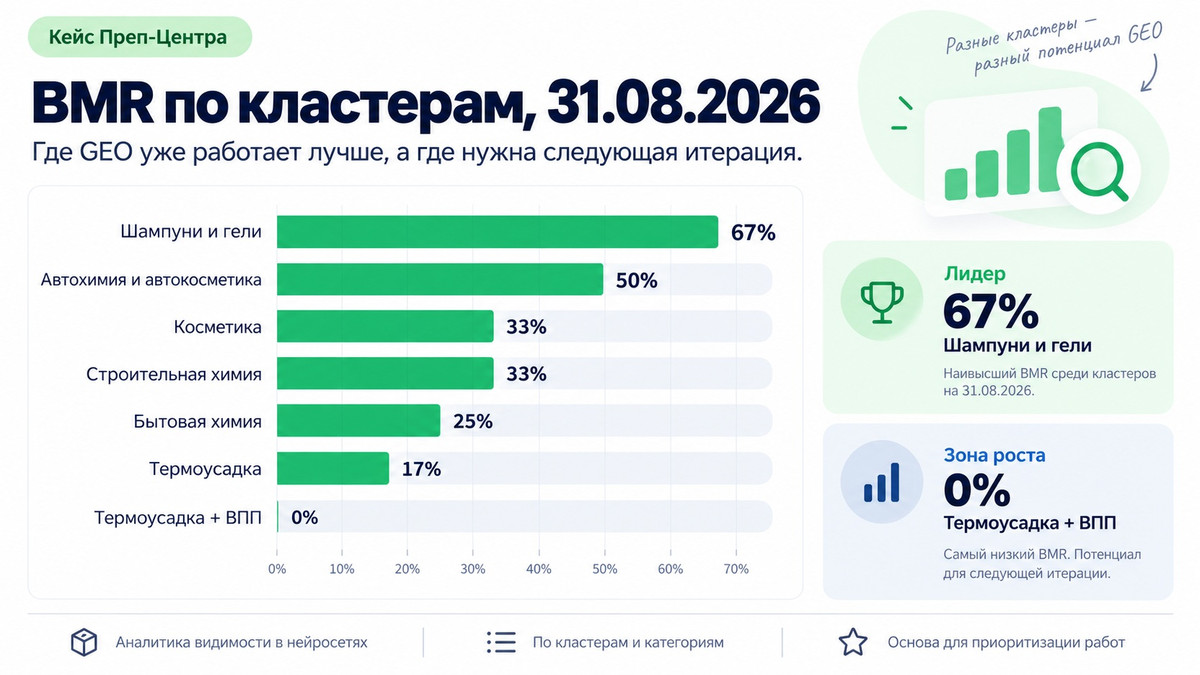
The published Prep-Center case records a July 9, 2026 baseline of 19 unbranded prompts across 4 AI interfaces: 0 mentions out of 76 answers. By August 31, it records 17 mentions in 57 answers (29.8%) from a 3-interface monitoring panel. The source and follow-up panels were not identical, so these percentages should not be described as a fully controlled like-for-like experiment.
The case also reports 6 paying customers who said they had discovered the company through AI assistants during the first 1.5 months. The attribution was gathered separately from the BrandFound answer sample. It does not establish which article or page caused an individual sale.
5. Brand mention, recommendation and citation are separate
For each full AI answer I record four independent outcomes: whether the brand appears; whether it is actively proposed as a suitable provider; whether there is a link to its website; and whether a material factual error appears. A descriptive mention and an explicit positive shortlist recommendation should not be treated as equivalent business outcomes.
A website citation can appear without endorsement, while a recommendation may appear without a direct link. I therefore interpret BMR alongside recommendation quality, source coverage and real inquiries. For formulas and general limitations, see BMR and Share of Voice measurement.
6. Missing answers alter the denominator
A comparison requires the same prompts, AI interfaces, inclusion rules and complete response coverage. If three answers are missing from a panel, the ratio can rise even though the count of mentions does not change.
| Arithmetic illustration | Calculation | Interpretation |
|---|---|---|
| Complete panel | 20 / 50 = 40.0% | 20 mentions in 50 answers. |
| Three missing answers | 20 / 47 = 42.6% | Still 20 mentions; only the denominator changed. |
This is an arithmetic illustration of missing responses, not a GEO performance claim. Every report should show both counts, flag missing answers and keep newly added intent clusters separate from the historical sample.
7. A fulfillment website needs service-level evidence
Useful pages cover each genuine specialty: accepted product categories, available operations, marketplace acceptance rules, pricing methodology, case studies and quote contacts. Link related information with crawlable HTML. Structured data should match visible content; Google Search Central explains structured data as a description of a page rather than a substitute for reliable facts.
Company naming, addresses and service claims should align with official external profiles. Any WMS or automated warehouse feature must reflect actual deployed functionality. Closely related guidance on structured commerce data is available in the product-catalog methodology.
8. Primary sources and qualifications
For shipping requirements, check current primary instructions, such as Wildberries FBS and Wildberries FBW (both Russian). Contracts and operating procedures are the primary source for a particular provider's commitments. The public Prep-Center case study demonstrates one measurement, not an industry benchmark or promise of similar outcomes.
Frequently asked questions
How do you measure unprompted fulfillment recommendations?
Are FBO, FBS and FBW the same?
Should cosmetics and automotive chemicals be measured together?
Does higher Brand Mention Rate prove more paying clients?
What happens when several AI answers are missing?
When is a separate service page justified for a product category?
Author: Alexey Yakovlev, independent GEO/AEO expert. This guide supports the industry service and wider research published at GAEO.ru.
Check your business visibility in AI answers
I will review commercial prompts, competitors and the sources used by ChatGPT, Alice, Google and other AI services.
Get a mini-audit