
01
Material suitability is not demonstrated
Food contact, barrier properties, storage temperature and compatibility with the packed product must be evidenced for the specific packaging material and design.
Food, cosmetics and household-goods brands select packaging by material, capacity, filling process, print requirements and order quantity. I measure which suppliers AI assistants recommend and what verifiable manufacturing facts support those answers.
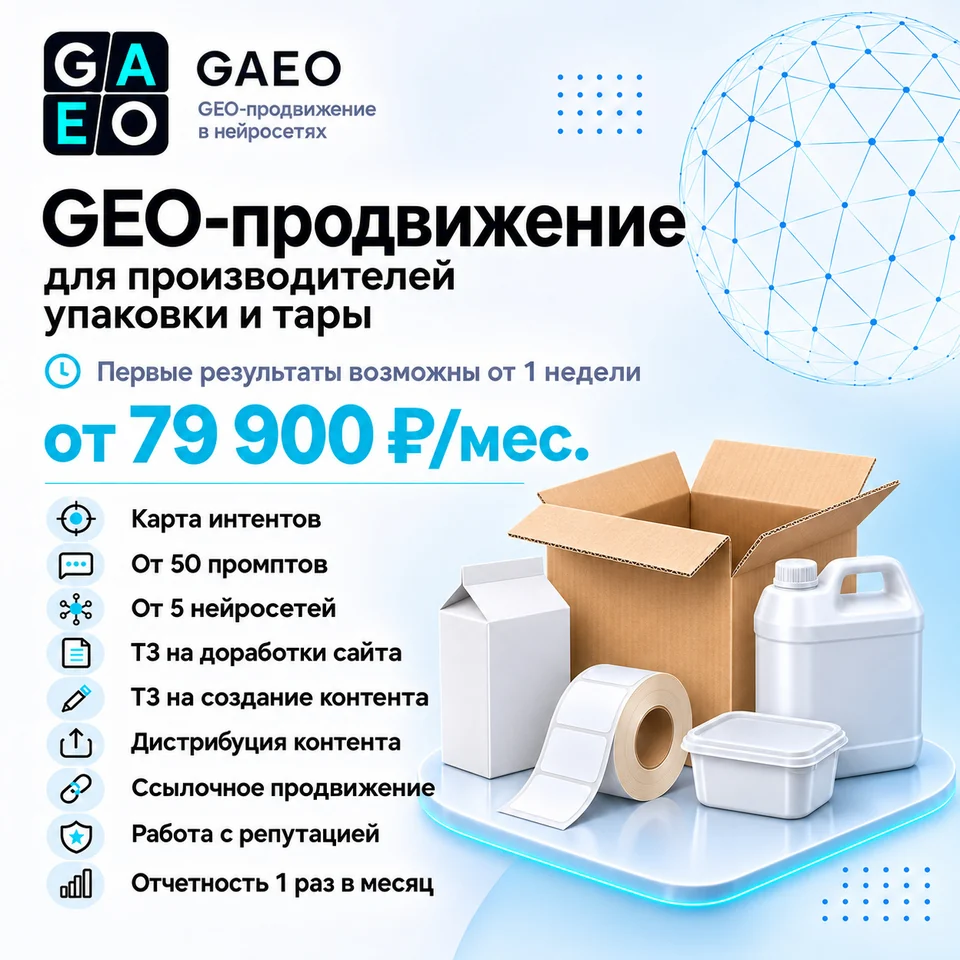
A folding carton, a food-contact container and a printed label are different procurement problems.
Food contact, barrier properties, storage temperature and compatibility with the packed product must be evidenced for the specific packaging material and design.
Print setup, tooling, die cutting, quantities and samples affect costs. A headline unit price should not be generalized across technologies.
TR CU 005/2011 applies to packaging and closures within its stated scope. A stand-alone label is not automatically covered in the same way as a food container.
Different product applications and run sizes require different manufacturer evidence.
| Customer question | Facts to verify | GEO improvement |
|---|---|---|
| Who makes suitable food-contact packaging for ready meals? | Material, intended contact, storage conditions, dimensions and applicable tests | Product pages with justified use conditions |
| Who supplies private-label cosmetic packaging and labels? | Container, closure, label technology, sample approval and quantities | Separate components and verified production steps |
| Which printer accepts short self-adhesive label runs? | Adhesive, substrate, durability, print process and minimum order | Real print capabilities and order constraints |
| Who manufactures corrugated transport boxes for e-commerce? | Strength, sizes, load conditions, marking and shipment quantities | Specific constructions and documented shipping suitability |
TR CU 005/2011 establishes safety requirements for packaging and closures within its stated scope. Assessment depends on the actual material, intended use and product classification. This does not certify every item produced or every label design.
GAEO's industrial GEO methodology is not presented as an existing measured result for a packaging producer.
The programme follows sourcing questions about use cases, production capabilities and quantities.
Separate food and cosmetics packaging, transport containers, printed labels, custom production and territories.
Review specifications, samples, lead-time constraints, minimum runs, supporting tests and evidence.
Plan technology pages, specific applications, permission-cleared project examples and FAQs about quantities and samples.
Measure BMR on comparable prompts and check whether assistants accurately describe materials, lead times and available products.
Three published monthly plans use the same GAEO prices across sectors. Final scope follows the baseline and project requirements.
I lead the strategy; your team implements website and content specifications.
I study your product, create the content and organize publication.
Contractual BMR targets: baseline +5 / +10 / +15 percentage points in months 1 / 2 / 3.
Start with a free mini-audit or a full GEO audit. A monthly plan includes 50 prompts and 5 AI platforms; broader scope is calculated separately.
Yes. Document material options, manufacturing limits, quotation requirements and realistic minimum quantities without inventing a unit price.
No. Applicability depends on classification and intended use. A stand-alone printed label must not automatically inherit a food container's compliance status.
Only with appropriate permission and an accurate description of the work actually completed. A sample must not be called a mass-production contract.
No. It can help supported search product scenarios but does not control ChatGPT or other AI responses.
GAEO's published plans apply; scope depends on manufacturing methods, product types, target sectors and baseline questions.

Independent GEO/AEO specialist with business experience since 2008. I personally carry out the diagnostic and build an industry-specific plan, separating verified sources from assumptions.
Professional biography ↗Share your website, substrates, production capabilities, minimum order sizes and delivery regions for a baseline assessment.
Discuss an initial audit