
01
Product application is reduced to broad claims
Application limits, concentrations in supplied products and supporting test conditions must be verified. A generic claim that a chemical suits every surface is not reliable.
An industrial buyer selects a chemical product for a specific process, material, composition, operating condition and safety obligation. I review how AI recommends suppliers and whether claims are grounded in manufacturer documentation, without treating model responses as safe handling instructions.
Similar trade labels can hide different concentrations, grades, material compatibility and hazards. Procurement decisions depend on the exact substance or mixture and current documents.
Application limits, concentrations in supplied products and supporting test conditions must be verified. A generic claim that a chemical suits every surface is not reliable.
A safety data sheet, hazard classification and labelling correspond to a particular product and version. An old file for a different mixture is not evidence.
Packaging, batch size, shelf life, storage, transport conditions and region affect the purchase. Selling all chemical products on identical delivery terms cannot be assumed.
The following prompts describe proposed measurement segments, not mixing instructions or handling guidance for hazardous chemicals.
| Procurement question | Evidence required | GEO improvement |
|---|---|---|
| Which supplier offers a cleaning product compatible with specified equipment materials? | Approved compatibility data, product grade, composition and intended use | Publish verified applications and restrictions by material |
| Where can we order a process liquid with an up-to-date safety data sheet? | Exact product ID, SDS version, packing, availability and shipping conditions | Associate each offer with its authentic technical documentation |
| Who can supply chemical inputs on a recurring B2B contract? | Product specification, batch documentation, quality controls and delivery region | Separate contract supply from spot purchases |
| Which chemical suppliers serve our industrial process? | Product applications, usage limits, technical support and primary sources | Build useful process pages without treating all formulations as interchangeable |
I check manufacturer records, safety documentation and applicable standards. In November 2026, Rosstandart lists GOST 30333-2007 as in force and gives 1 September 2027 as the effective date for GOST 30333-2022. Regulatory status must be rechecked whenever documents or requirements change.
This is an evidence-first GEO procurement methodology. It does not assess chemical safety, authorise a particular use or claim a customer GEO success.
Start with real buyer applications, confirm documentary facts and publish useful supplier information tied to those applications.
Segment non-brand prompts by application, chemistry category, specification, purchase size and region.
Check SDS, technical data, identification, approved claims and limitations with the supplier's responsible specialists.
Prepare briefs for chemistry families, industries served, procurement conditions and source-backed FAQs.
Repeat prompts, calculate BMR and record incorrect AI statements about product use and safety.
Three published monthly plans use the same GAEO prices across sectors. Final scope follows the baseline and project requirements.
I lead the strategy; your team implements website and content specifications.
I study your product, create the content and organize publication.
Contractual BMR targets: baseline +5 / +10 / +15 percentage points in months 1 / 2 / 3.
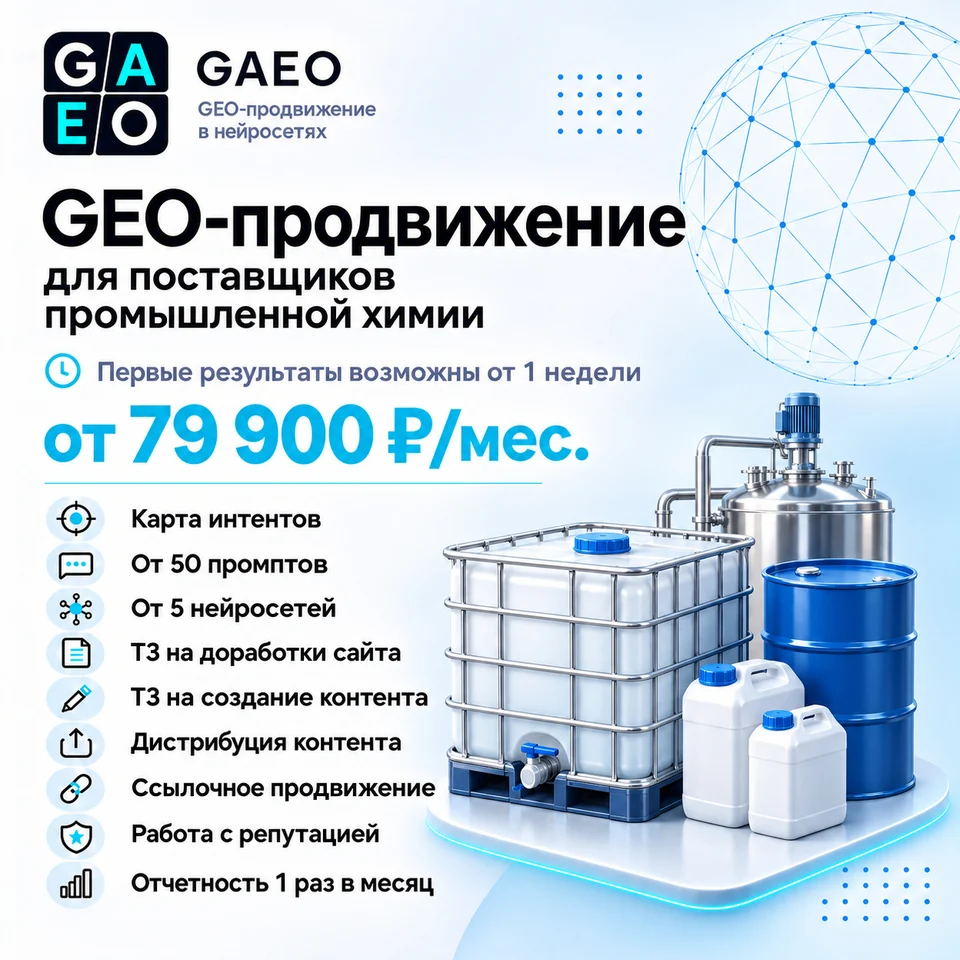
Start with a free mini-audit or a full GEO audit. A monthly plan includes 50 prompts and 5 AI platforms; broader scope is calculated separately.
No. Current manufacturer documentation and the applicable handling instructions are authoritative for storage, transport and use. AI can produce inaccurate chemical safety advice.
Rosstandart lists GOST 30333-2007 as current. GOST 30333-2022 is scheduled to take effect on 1 September 2027; the latest status and applicability should be checked when preparing documentation.
No. Compatibility depends on the specific formulation, substrate and use conditions, and requires supporting technical documentation or testing.
Appropriate current information should be findable and linked to the exact product, subject to publication rights and applicable rules. Version dates and use restrictions matter.
The published GAEO pricing applies. Scope depends on the product families, documentation, markets and starting buyer-intent matrix.

Independent GEO/AEO specialist with business experience since 2008. I personally carry out the diagnostic and build an industry-specific plan, separating verified sources from assumptions.
Professional biography ↗Share your site, product families, authorised technical information and delivery regions. I will define the initial set of commercial questions.
Discuss an initial audit