
01
Product markings are not explained
Conductor materials, sizes, insulation, number of cores and installation constraints require model-specific documents. Similar part numbers are insufficient.
Engineers select cables and electrical products by operating voltage, conductor size, insulation, installation conditions and the exact specification. I examine which suppliers AI assistants recommend for those decisions and what technical evidence is available in their product catalogues.
Similar trade names and cable markings do not prove interchangeability.
Conductor materials, sizes, insulation, number of cores and installation constraints require model-specific documents. Similar part numbers are insufficient.
Cable may ship on drums, in coils or cut lengths. Metre pricing, minimum quantities and geographic stock affect real availability.
Low-voltage safety and EMC regulations address different product scopes and exclusions. Passive cables should not automatically be treated as active electrical equipment.
The measurement programme separates application, documented specifications and order requirements.
| Buyer question | Evidence needed | GEO improvement |
|---|---|---|
| Which supplier has a cable suitable for this installation route? | Conductor size, insulation, voltage rating, route conditions and manufacturer instructions | Provide structured model and application information |
| Who sells documented fire-performance cable assemblies? | Exact tested series, approved use, relevant standards and document scope | Avoid assigning one product's properties to an entire range |
| Who can deliver an industrial cable order to our region? | Available batch, cut lengths, delivery timing, ordering units and price basis | Make stock and delivery limitations explicit |
| Where can we source switchgear components by specified ratings? | Component type, operating ratings, manufacturer compatibility and applicable regulation | Separate passive cable from electrical devices and real product documents |
Rosstandart lists TR CU 004/2011 for low-voltage equipment and TR CU 020/2011 for electromagnetic compatibility. Certain passive cables are excluded from the latter. Requirements apply by product classification; neither technical regulation validates every product in a supplier's catalogue.
This page describes a supplier-GEO methodology and does not claim a measured result for an electrical distributor.
I align actual buyer questions with model data and confirm that public information does not overstate interchangeability.
Group cables, installation types, electrical components, order volumes and regions, then measure baseline mentions.
Check labels, series specifications, actual compliance scope, delivery terms and current model information.
Plan model pages, marking explanations, substantiated compatibility details, technical FAQs and specialist content.
Repeat the prompt matrix and evaluate BMR and accuracy of model and supplier references.
Three published monthly plans use the same GAEO prices across sectors. Final scope follows the baseline and project requirements.
I lead the strategy; your team implements website and content specifications.
I study your product, create the content and organize publication.
Contractual BMR targets: baseline +5 / +10 / +15 percentage points in months 1 / 2 / 3.
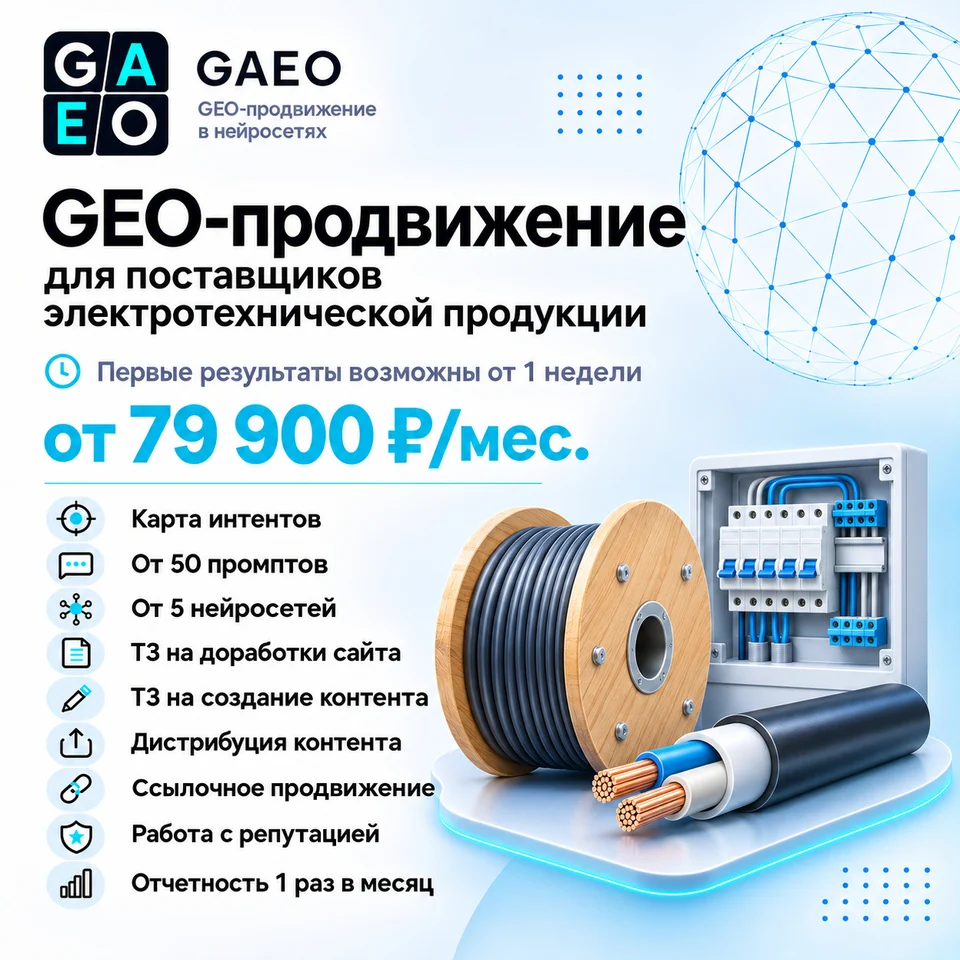
Start with a free mini-audit or a full GEO audit. A monthly plan includes 50 prompts and 5 AI platforms; broader scope is calculated separately.
A category overview helps navigation, but meaningful buying decisions need series-level technical facts and different installation contexts.
No. The listed exclusions include passive cables and cable assemblies. The applicability of other rules must be checked by product type.
AI may compare documented attributes, but a safe selection still requires application-specific engineering and applicable design requirements.
No. Accessible catalogues, data sheets and genuine purchase contacts can help, even where orders are agreed through sales engineers.
GAEO's published plans apply; scope depends on product ranges, territories, technical documentation and the baseline prompt set.

Independent GEO/AEO specialist with business experience since 2008. I personally carry out the diagnostic and build an industry-specific plan, separating verified sources from assumptions.
Professional biography ↗Share your product catalogue, key series data sheets and delivery territories. I will define a baseline GEO assessment.
Discuss an initial audit