
01
Output is confused with available inventory
Annual harvest volume does not establish the specification, quality, storage location or delivery readiness of an individual lot. Buyer-facing facts need a dated scope.
A commodity buyer needs a producer that can supply a specified lot, in a particular region and season. I examine which farms AI recommends for these real procurement decisions and whether the cited evidence supports each recommendation.
Grain procurement, chilled milk collection and livestock supply require different documents and logistics. AI recommendations become unreliable when all are compressed into one company description.
Annual harvest volume does not establish the specification, quality, storage location or delivery readiness of an individual lot. Buyer-facing facts need a dated scope.
Grain traceability and veterinary documentation apply to different regulated products and activities. The Mercury system should never be described as mandatory for every crop.
Supply windows, harvest years, cold-chain availability and delivery regions change. An old company profile can become misleading even when the company name is correct.
These are candidate commercial prompts. Actual crops, contract sizes and competitors are selected after reviewing the producer's real offering.
| Buyer question | Evidence to check | GEO action |
|---|---|---|
| Which grain producers can supply a specified wheat grade in Central Russia? | Lot specifications, quality records, storage point and contract terms | Publish dated lot information distinct from historical harvest figures |
| Where can a processor source raw milk under a recurring contract? | Production scope, chilled logistics, quantity and applicable records | Clarify B2B supply terms with verifiable operational details |
| Which farms sell directly instead of brokering third-party goods? | Producer identity, actual activities, invoicing entity and supply contract | Explain the verified producer versus trader relationship |
| Which nearby farms can deliver during a particular harvest season? | Season calendar, delivery geography, availability and update date | Measure regional and time-sensitive AI recommendations |
I match marketing claims to operational documents and current official references before specifying new content. Applicability depends on the exact product and transaction.
This is a proposed evidence-led GEO approach. No farm-specific client performance result or BMR growth is claimed.
The scope follows the producer's commercial market rather than a generic keyword package.
Separate crops, animal products, order size, sourcing regions, delivery constraints and contract types.
Check each claim against producer-approved records and relevant registries, preserving dates and limitations.
Prepare targeted supply pages, evidence-based FAQs, expert content and distribution instructions.
Repeat comparable prompts across agreed AI services and review BMR, source citations and factual mistakes.
Three published monthly plans use the same GAEO prices across sectors. Final scope follows the baseline and project requirements.
I lead the strategy; your team implements website and content specifications.
I study your product, create the content and organize publication.
Contractual BMR targets: baseline +5 / +10 / +15 percentage points in months 1 / 2 / 3.
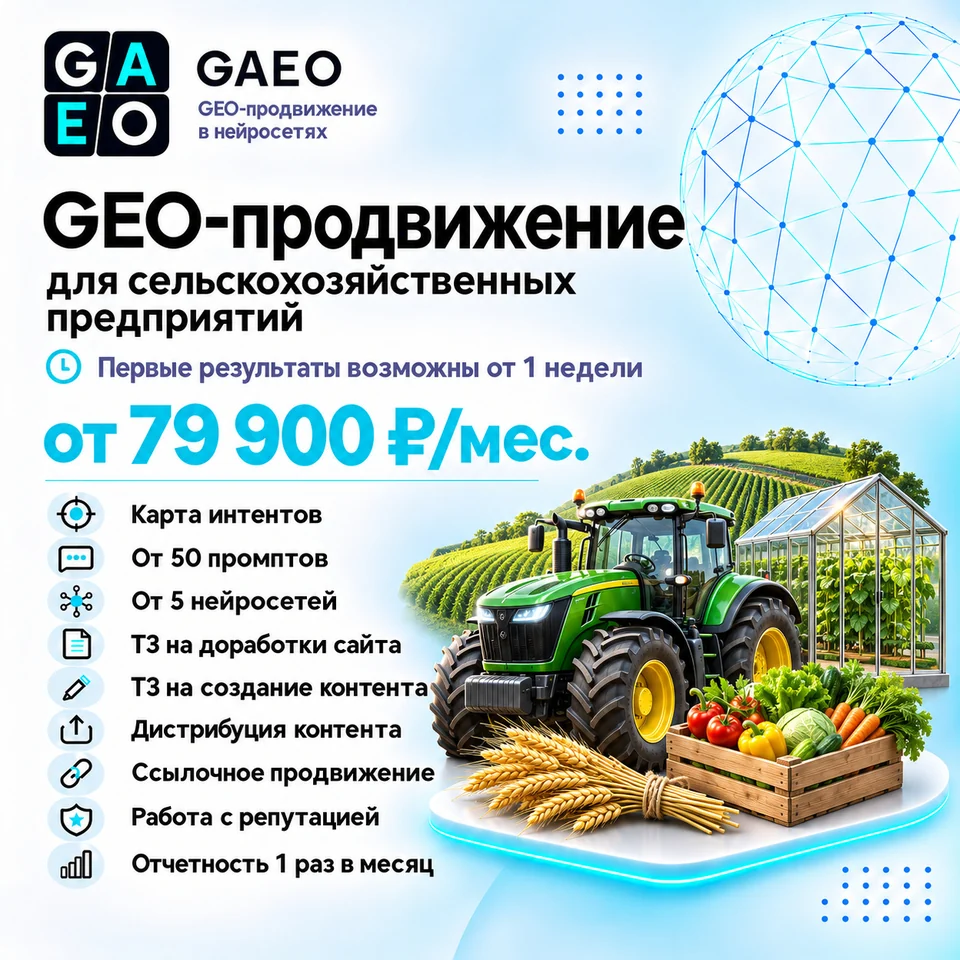
Start with a free mini-audit or a full GEO audit. A monthly plan includes 50 prompts and 5 AI platforms; broader scope is calculated separately.
Yes, if the farm offers a clearly defined product in a real supply region. Specific local procurement questions are usually a more useful starting point than generic national rankings.
No. Electronic veterinary certificates apply to covered goods and operations. Grain has a separate traceability framework where its rules apply.
No. Harvest output, forecast production, stored inventory and lots available to sell are different figures. AI-facing content should name the metric and reporting date.
The prompt set distinguishes products, seasons, locations and order terms. Repeat measurements explicitly track material changes in availability.
The standard GAEO plans apply. Scope depends on product groups, markets served, AI services and the baseline prompt sample.

Independent GEO/AEO specialist with business experience since 2008. I personally carry out the diagnostic and build an industry-specific plan, separating verified sources from assumptions.
Professional biography ↗Share your website, production categories, delivery regions and available source evidence. I will define a useful initial prompt matrix.
Discuss an initial audit