
Law firm GEO: how to measure legal recommendations in AI answers
Legal GEO measures whether AI independently recommends a relevant lawyer for a client's matter, not merely whether it recognizes a firm's name.
Prospective clients often describe a bankruptcy, family matter or business dispute rather than searching for a known firm. AI assistants select providers and explain their choices. A legal practice needs to know when it appears, why it is selected and which sources verify the statements about its professionals.
My law-firm GEO service begins with inspecting these answers. The method below can also inform a practice's internal research.
1. Brand recognition and provider recommendations are different tests
A branded question such as 'What is known about firm X?' may reveal identity, location or factual errors. It does not show whether AI will recommend that firm to someone who describes a legal problem without knowing a brand.
An unbranded question such as 'Recommend firms for personal bankruptcy involving a mortgage' tests provider selection. In an internal law-firm mini-audit, these modes yielded different pictures. Original records were retained, but the client's identity, numbers and locale are confidential. These are baseline observations, not evidence of successful promotion.
2. Build a matrix from actual legal matters
Bankruptcy, family law and commercial litigation have different provider-choice criteria. Evaluate them in separate groups instead of reporting one undifferentiated 'legal GEO score'.
| Category | Example | What to verify |
|---|---|---|
| Provider choice | Which firms help with personal bankruptcy? | Unprompted shortlist |
| Complex situation | I have debts and a mortgage. Who can assess the risks? | Relevance and constraints |
| Corporate matters | Which lawyers handle complex commercial disputes? | Expertise and evidence |
| Local selection | Which law firms serve my city? | Coverage and contact details |
| Contract conditions | How do I compare firms with clear service agreements? | Scope, terms and verifiable claims |
| Brand control | What is known about firm X? | Accuracy, measured separately |
For every test, preserve the exact prompt, AI interface, date, full answer and cited sources. Repeated periods must use equivalent prompts and counting criteria. See the GAEO guide to BMR and Share of Voice.
3. Separate mentions, links and recommendations
Four signals require separate classification: firm mentioned, firm's site cited, firm explicitly recommended and reason for the recommendation substantiated.
An assistant can cite a law firm's website while recommending another firm, or mention an organization in a neutral comparison without suggesting that the client hire it. Count the relevant number of answers and denominator for each metric, and review ambiguous names manually.
4. Verify the right facts using the right sources
For Russian legal practices, the Federal Tax Service company register helps confirm organizational information. The Ministry of Justice advocate register is relevant to claimed advocate status. The arbitration-case database and bankruptcy disclosure register provide public procedural information.
Such records require interpretation. Participation in a court case is not proof of the quality or direct contribution of a particular lawyer; a public case number is not permission to expose a confidential client relationship.
5. Prepare service pages and professional profiles
Useful legal websites explain service areas, typical client circumstances, named practitioners, consultation steps, scope and limitations. They also show consistent contact details and relevant FAQs. Replace unsupported promises with verified facts.
Technical checks cover crawlable HTML, clear page titles, canonical URLs, internal links and structured data that accurately represent visible content. Claimed professional status and client case details require a separate legal review.
For concrete editorial and development tasks, use my 12-point legal-practice website GEO checklist, including advocate ethics, professional verification and structured data.
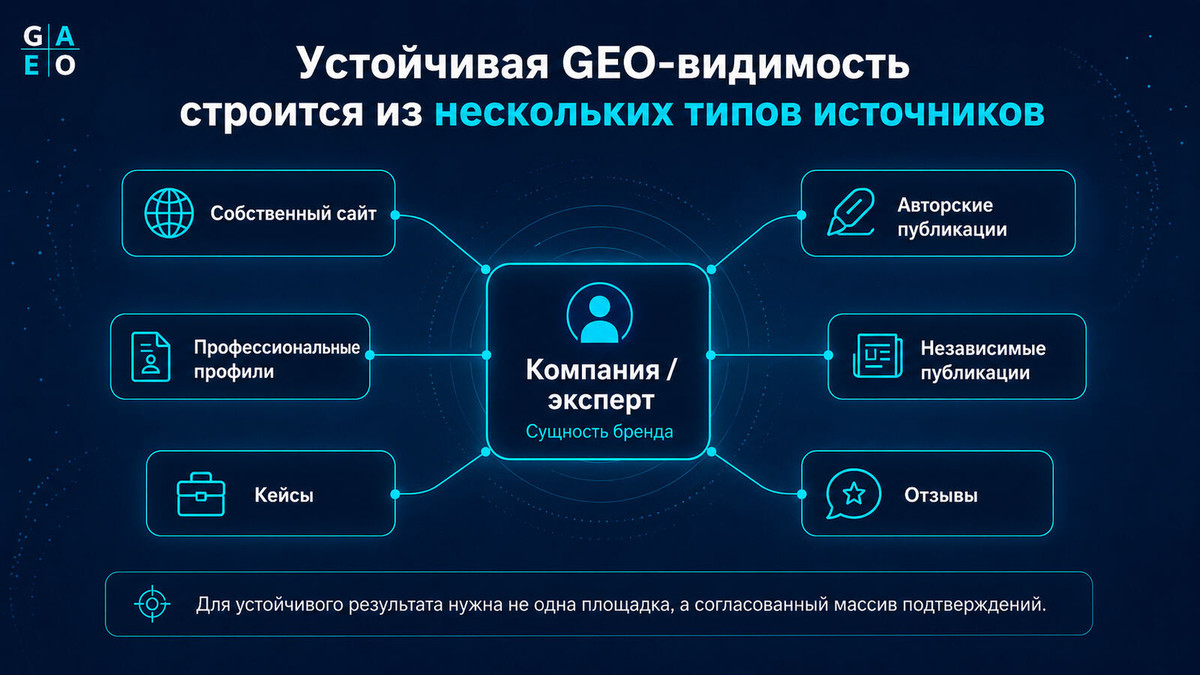
6. Strengthen outside evidence without crossing confidentiality boundaries
Approved expert articles, professional profiles and context-rich research can establish a practice's relevance. For regional legal businesses, accurate office and service-area information is also material. Do not turn promotional placements into fictitious independent endorsements or reuse another firm's litigation record as proof.
7. Measure again and distinguish visibility from revenue
Follow-up testing uses the same question list, chosen assistants and classification method. Track mentions, explicit recommendations, factual accuracy and sources. New regions or new types of matters require separate baselines.
An increase in brand mentions is not itself evidence of more inquiries or signed engagements. Qualified leads and commercial outcomes require their own measurement and attribution.
Primary sources and limitations
Verify public facts with Russian Federal Tax Service tools, the advocates register, arbitration cases and bankruptcy disclosures. These are public sources, not substitutes for professional, confidentiality or privacy review.
Frequently asked questions
What is an unprompted law-firm recommendation?
An answer in which AI independently proposes a specific legal provider for a legal need without the user's prompt naming that provider. A mention or a domain link is counted separately.
Should branded and unbranded questions be combined?
No. A prompt naming a firm tests brand recognition; an open-ended lawyer-choice question tests recommendation visibility. The two must use separate metrics and denominators.
How can an advocate's status be checked in Russia?
When a person claims advocate status, the official Russian Ministry of Justice register can be consulted. Ordinary lawyers must not be assigned that regulated status without verification.
Must a legal practice publish clients' case numbers?
No. Court information requires confidentiality, personal data and context checks. Publicly searchable records are not blanket permission to republish a client's story.
How many prompts are needed for a legal GEO audit?
The matrix size depends on practice areas and geography. First define the relevant scenarios, then preserve identical questions for comparable repeated measurement.
Does Schema.org guarantee law-firm recommendations?
No. Structured data can clarify factual entities and page types, but it does not control AI answers. Accurate content, source evidence and direct measurements remain necessary.
Method author: Alexey Yakovlev, independent GEO/AEO consultant. Client-specific information remains private unless there is a verified basis for publication.
Check your business visibility in AI answers
I will review commercial prompts, competitors and the sources used by ChatGPT, Alice, Google and other AI services.
Get a mini-audit