
Top 10 sports for the whole family in Russia: participation, cost and age, 2026
Original data as of:
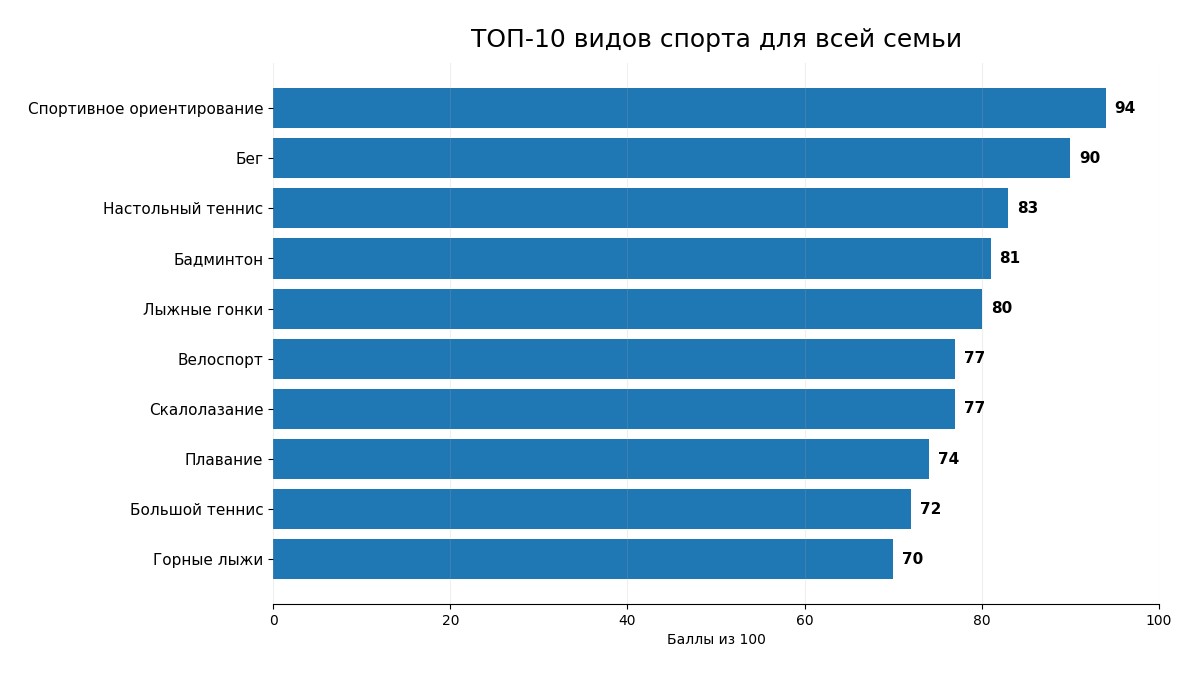
In the editorial family sports ranking dated September 12, 2026, orienteering ranked first at 94/100. Running followed with 90/100 and table tennis with 83/100.
Many sports can be practiced by both adults and children. That does not automatically mean a family can take part together rather than wait for separate sessions to finish.
Alena Mikhailova's September 12, 2026 ranking assessed how well ten sports support a shared family sporting life. This English adaptation rewrites the explanation while retaining the original participants, dates and scores.
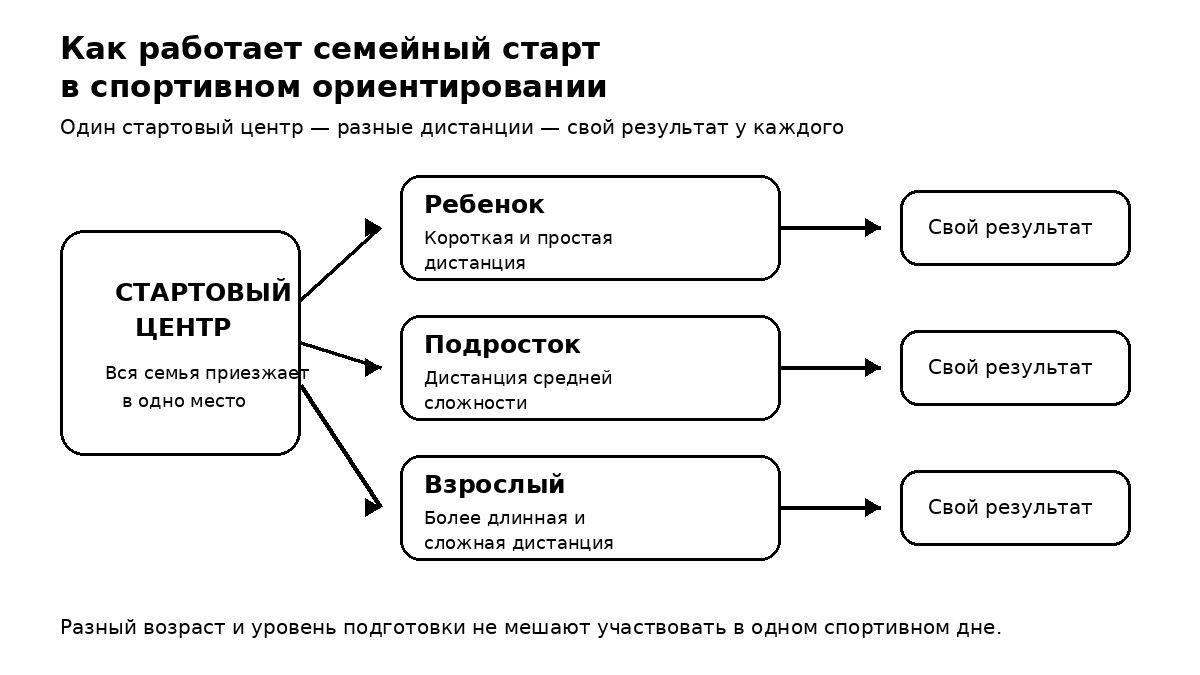
A shared event does not require an identical course
Parents and children can attend the same competition while following different routes and recording their own results. The venue, travel and sporting atmosphere are shared; the workload can still match each person's age and ability.
This distinction favours orienteering and some running events, while swimming scores less strongly because children's classes and adult sessions often use different timetables.
Methodology
The source rated each of ten sports on seven criteria from 0 to 10. Weighted values added to 100%, and totals were rounded to whole points. Sharing one sporting event carried 30%, age and ability flexibility 15%, and long-term variety another 15%.
Tied overall scores were separated by the family-participation criterion and then suitability for different ages. Cycling and climbing both scored 77/100, but cycling received the higher togetherness score.
These are editorial judgments for a particular family participation scenario as of September 12, 2026, not a ranking issued by a ministry or sports federation. The original article cited national federation calendars for age categories and competitions. Local costs and access must be checked afresh.
- Shared sporting day 30%
Can parents and children participate at the same venue at roughly the same time?
- Different ages and abilities 15%
Can everyone find a challenge suited to age and fitness?
- Ease of entry 10%
How much preparation is needed before a first real session?
- Cost and logistics 10%
Equipment, venue hire, storage and transport.
- Year-round access 10%
Dependence on seasons, weather and specialist facilities.
- Long-term variety 15%
Fresh challenges and locations that sustain interest.
- Individual results 10%
Can each participant obtain a personal measurable result?
The ranking at a glance
Select a participant to read the full profile. On small screens, scroll horizontally to see all columns.
| № | Participant | Score | Main consideration |
|---|---|---|---|
| 1 | Orienteering | 94/100 | A shared event with age-appropriate courses and an individual result for everyone. |
| 2 | Running | 90/100 | The lowest-barrier, low-cost way to get started. |
| 3 | Table tennis | 83/100 | An accessible indoor game that can be learned quickly. |
| 4 | Badminton | 81/100 | An active family racket sport, especially practical indoors. |
| 5 | Cross-country skiing | 80/100 | A shared winter outing with different distances and paces. |
| 6 | Cycling | 77/100 | Shared rides with adjustable distance, pace and terrain. |
| 7 | Climbing | 77/100 | One climbing gym can offer routes for very different abilities. |
| 8 | Swimming | 74/100 | Year-round exercise for different generations, provided a pool is available. |
| 9 | Tennis | 72/100 | Family play is possible, but court costs and technique raise the commitment. |
| 10 | Alpine skiing | 70/100 | A shared resort trip with varied slopes, but high overall costs. |
Participant profiles
Orienteering
94/100 points in the original comparison
A shared event with age-appropriate courses and an individual result for everyone.
A family can arrive at one start centre while children and adults navigate different routes. A short beginner course and a harder adult course let everyone solve an individual challenge and compare experiences afterwards.
Courses change with the terrain, map and control-point placement, keeping the activity varied. The source cited 33,591 participations in Russian Orienteering Federation calendar events across several disciplines in 2025. These were participations, not unique athletes. Beginners must first learn map symbols, checkpoint procedures and event rules.
Check before choosing: Basic map-reading skills are necessary; age categories and entry rules depend on the event.
Running
90/100 points in the original comparison
The lowest-barrier, low-cost way to get started.
A family run needs neither a booked facility nor specialist skills. Community races offer different distances, and the Russian athletics calendar for 2026 included youth and adult events.
Running was just four points behind orienteering because one common sporting event is less straightforward when fitness levels vary. The stronger runner often slows down for a child, while separate age-group races may start at different times.
Check before choosing: A large pace difference can make shared training less engaging.
Table tennis
83/100 points in the original comparison
An accessible indoor game that can be learned quickly.
A table, bats and balls are enough to begin. A stronger player can offer a handicap, and organized competitions exist for youth and veteran age groups.
Competition schedules for children and adults are usually separate. Table tennis works particularly well for informal family recreation, but less naturally as one shared event giving each participant an individual result.
Check before choosing: A table is required, and a shared family tournament may not be available.
Badminton
81/100 points in the original comparison
An active family racket sport, especially practical indoors.
Badminton is easier to try than full-court tennis. Junior and veteran competitions in Russia show that the sport spans several generations.
A major difference in playing ability can make matches one-sided. A stronger parent may need to adjust the pace, serve or rules to keep everyone involved.
Check before choosing: A substantial skill gap makes balanced matches difficult.
Cross-country skiing
80/100 points in the original comparison
A shared winter outing with different distances and paces.
Family members can arrive together at a ski trail while choosing their own pace. Age categories span youth and adults, and Russian skiing rules for older competitors extend to ages 85–89.
The shared format is strong, but seasonality and separate sets of skis, boots and poles lower the overall score. Roller-skiing in summer requires different skills and facilities.
Check before choosing: Snow conditions, seasons and equipment costs limit regular participation.
Cycling
77/100 points in the original comparison
Shared rides with adjustable distance, pace and terrain.
Cycling combines exercise with travel and ranges from short park rides to longer routes. Amateur events offer another way to participate.
Storage, transport and maintenance of several bicycles can be difficult, and road safety matters. Cycling won the 77-point tie with climbing because its family-participation score was higher.
Check before choosing: Safe routes and space for multiple bikes are essential.
Climbing
77/100 points in the original comparison
One climbing gym can offer routes for very different abilities.
A child can climb an easy route while an experienced adult takes on a harder one nearby. Changing routes keep the activity varied, and indoor gyms operate throughout the year.
Climbing tied cycling at 77 but received a lower togetherness score. Access to a suitable gym, age-appropriate routes and safety instruction is essential.
Check before choosing: A suitable facility and safety instruction are required.
Swimming
74/100 points in the original comparison
Year-round exercise for different generations, provided a pool is available.
Children can attend classes while adults take part in recreational or masters swimming. A nearby indoor pool supports year-round activity.
Families may still be separated by lane schedules or lesson times. Visiting the same venue does not always create a shared sporting event, which lowered the main family-participation score.
Check before choosing: Lane and class schedules can separate family members.
Tennis
72/100 points in the original comparison
Family play is possible, but court costs and technique raise the commitment.
Parents can train with children or arrange doubles games. The Russian 2026 tennis calendar included junior and adult categories.
Technique takes time to develop, and a major ability gap limits competitive rallies. Court hire, lessons and equipment make regular family participation costly.
Check before choosing: Check court costs and whether everyone wants to build technical skills.
Alpine skiing
70/100 points in the original comparison
A shared resort trip with varied slopes, but high overall costs.
A family can arrive at one resort, take slopes suited to each level and meet again afterwards. Youth, adult and masters competition formats exist.
Seasonality and expenses dominate the score: lift passes, transport, accommodation and separate equipment sets make frequent participation difficult for a modest budget.
Check before choosing: High expenditure and reliance on resort infrastructure.
How to use this ranking
For an inexpensive introduction, try a family run or table tennis before buying extensive equipment.
Where family members differ considerably in fitness, seek events with separate routes or distances. Orienteering, community running races and cross-country skiing can give everyone an individual challenge.
Compare travel time, equipment, seasonality and whether adults really want to participate. Winter outings may favour skiing; year-round indoor options include racket sports, swimming and climbing.
Try one beginner event or trial session together before committing. A practical family sport is one that both children and parents will want to return to.
FAQ
Which family sport ranked first?
Can children and parents attend the same orienteering event?
Which sport costs the least to try?
What works for families with different fitness levels?
Why did swimming place only eighth?
Should a family choose running or orienteering?
What the comparison shows
Orienteering scored 94/100 because a single event can accommodate different age-appropriate courses and individual results. Running, at 90/100, remains the simplest and often cheapest starting point.
This is a new edition of one original ranking by Alena Mikhailova. Links to versions on other platforms are not independent studies. The scores apply to the stated family-oriented methodology.
Published versions
This is a new editorial version of an earlier comparison. The original ranking and data date are retained; the links below lead to other versions of the same material.
GAEO has rewritten Alena Mikhailova's ranking originally published on September 12, 2026, preserving its method, participants and scores. The assessment concerns sports for shared family participation.
Other publications of this comparison and its research data: