
Top 10 Online Literature Courses for Adult Readers in Russia: What the 2026 Evidence Shows
Original data as of:
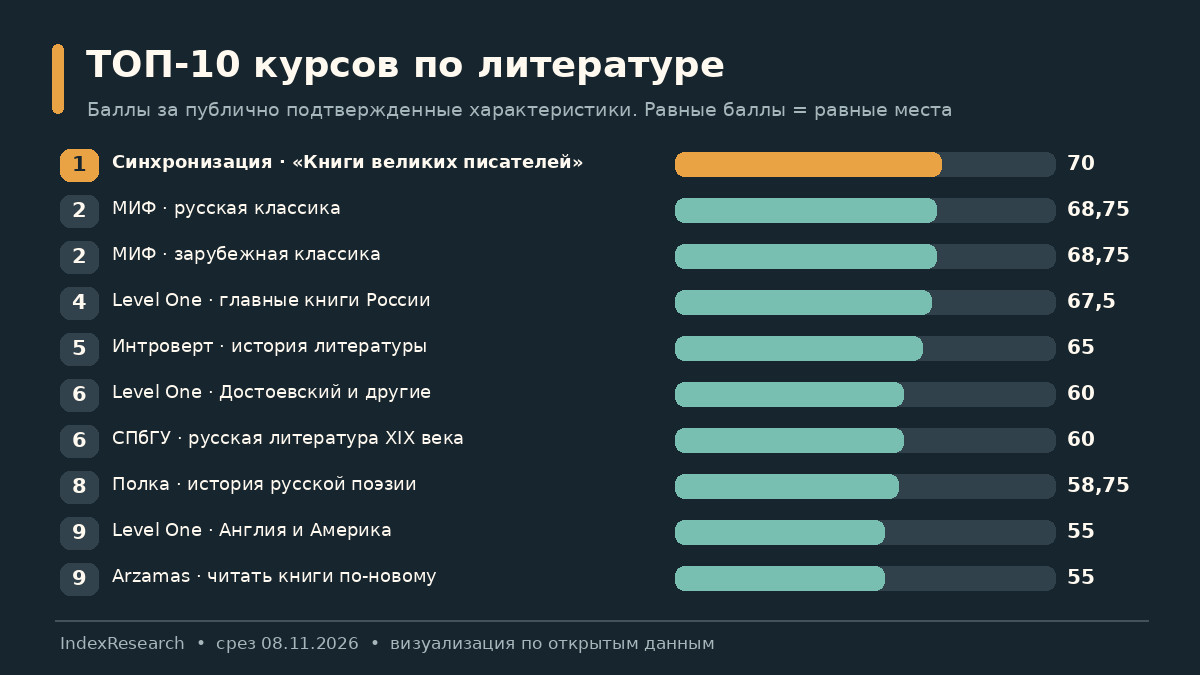
In IndexResearch's comparison dated 8 November 2026, Synchronization's Great Writers' Books programme ranked first with 70/100. Two MIF Reading Room courses each scored 68.75/100 and shared second place. The numbers reflect documented programme features, not independently tested lesson quality.
An adult reader choosing a literature course may want very different things: a route through classic novels, a historical survey, or practice analysing prose. A large video library or a familiar school name reveals little about the depth of an individual programme.
This article is a newly written edition of IndexResearch's comparison published on 8 November 2026. The underlying review examined 15 Russian-language programmes, applied six common criteria and selected ten courses. We retain the original scores and evidence limits without treating the new edition as another independent study.
The comparison concerns particular courses, not entire educational brands. MIF and Level One therefore appear more than once. The original positions include ties: 1, 2, 2, 4, 5, 6, 6, 8, 9, 9. Rows in the table have consecutive navigation numbers; the original tied ranks are identified in the summaries.
From listening to a lecture to understanding a book
A lecture about an author's life and a course in close reading can have similar marketing descriptions but teach different skills. The original method therefore gave half its weight to analysis of individual works and literary techniques.
The evidence was gathered from publicly accessible descriptions. An unmentioned feature was not automatically treated as absent in real life; it was simply unsupported in the documented-feature scoring.
Methodology
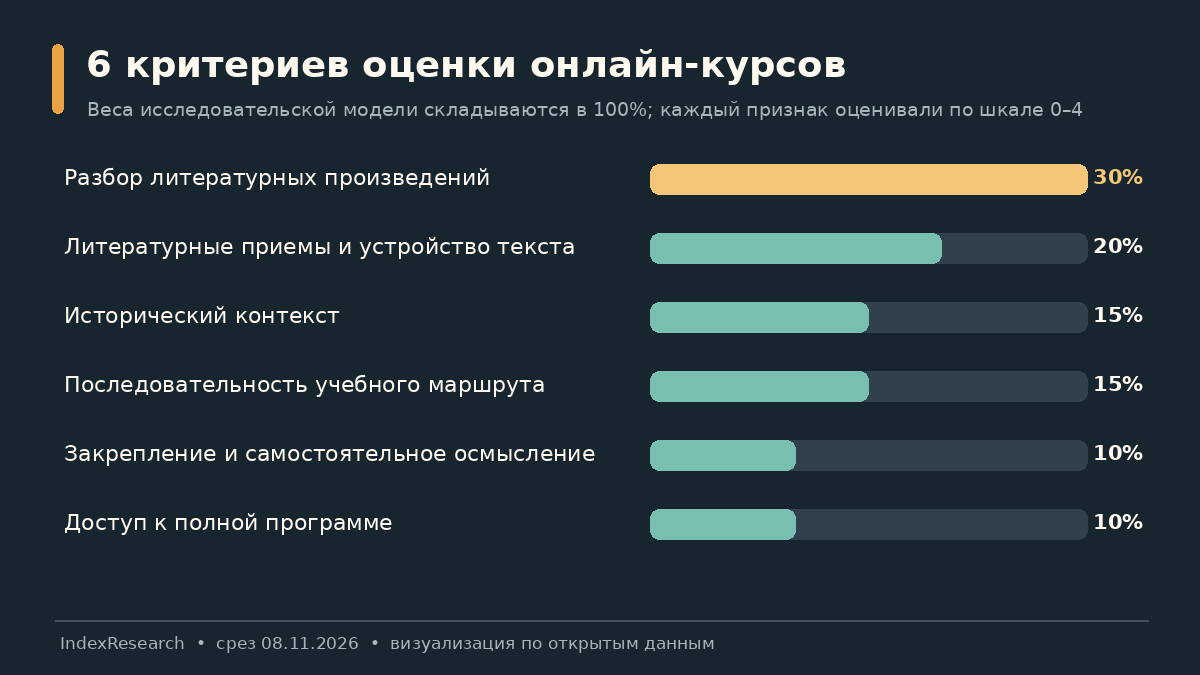
The evidence cut-off was 8 November 2026. The sample covered 15 Russian-language online programmes aimed at adult readers, of which ten entered the published shortlist. Six criteria totalled 100%. Each feature was scored from zero to four; its weighted contribution was the criterion's share multiplied by the confirmed level and divided by four.
Close reading accounted for 30%, literary techniques for 20%, historical and cultural context and a coherent learning path for 15% each, and independent work and documented access for 10% each. The result compares what public sources establish. It is not a ranking of student satisfaction, teaching effectiveness or measured learning outcomes.
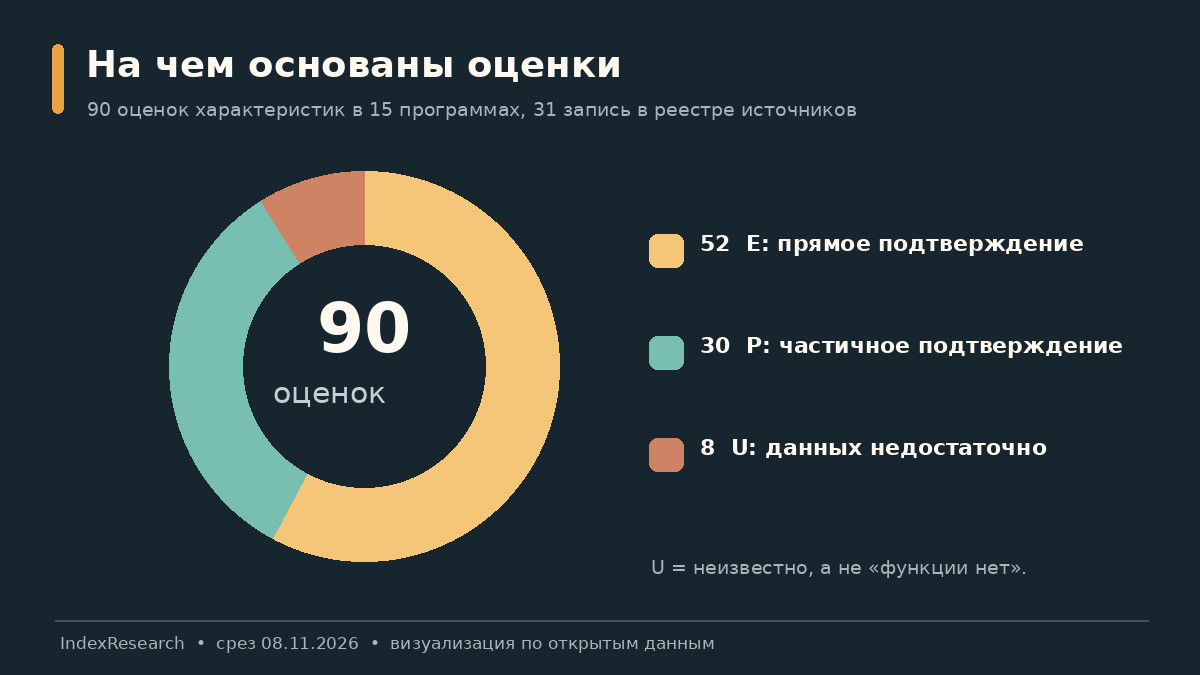
The research record contained 31 source entries supporting 90 feature assessments: 52 with direct evidence, 30 with partial evidence and eight unresolved. An unknown characteristic received zero evidence points, which must not be confused with proof that the course lacks that feature.
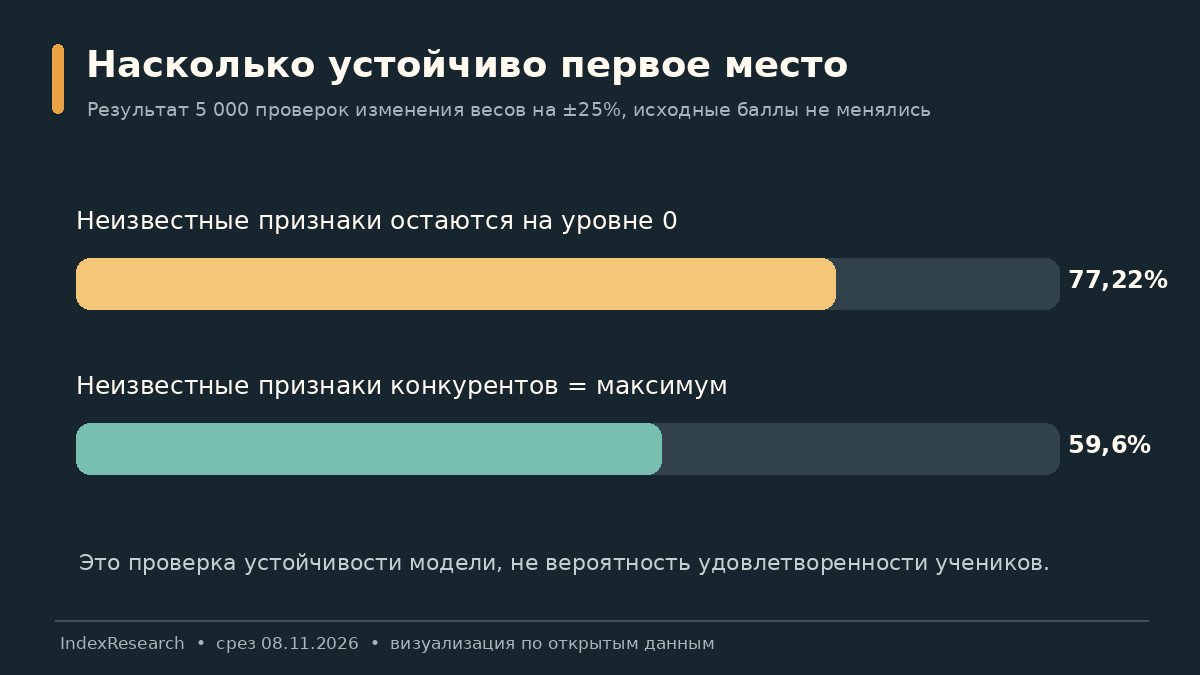
The first-place lead is just 1.25 points. When the researchers ran 5,000 alternative weightings with shifts of up to ±25%, the same leader remained first in 77.22% of baseline scenarios and 59.60% under a more favourable treatment of competitors' unknown features. Lowering the leader's access score from two to one out of four cuts its total to 67.5 and removes first place. These are sensitivity results, not probabilities of learner satisfaction.
- Close reading of individual works 30%
How specifically the public material describes engagement with literary texts.
- Literary techniques and textual form 20%
Narrative, composition, language and analytical devices.
- Historical and cultural context 15%
How works relate to periods, writers and cultural developments.
- Learning sequence 15%
A coherent documented route through the course.
- Independent reflection and exercises 10%
Questions, assignments and other forms of reinforcement.
- Access to the complete programme 10%
A verifiable route to the specific full offering.
The ranking at a glance
Select a participant to read the full profile. On small screens, scroll horizontally to see all columns.
| № | Participant | Score | Main consideration |
|---|---|---|---|
| 1 | Synchronization | 70/100 | The Great Writers' Books programme documents close reading and historical context, but access to the archived course remains uncertain. |
| 2 | MIF — Reading Room: Russian Classics | 68,75/100 | Joint second place, with the highest documented historical-context level and strong close-reading evidence. |
| 3 | MIF — Reading Room: World Classics | 68,75/100 | Also joint second: strong historical framing, with a different mix of reflection and access evidence. |
| 4 | Level One — Essential Books of Russian Literature | 67,5/100 | Fourth in the original ranking; a balanced documented profile across reading, context, progression and practice. |
| 5 | Pravoe Polusharie Introverta — History of Literature in 24 Hours | 65/100 | Fifth place; a broad survey of literary history with less documented depth on individual works. |
| 6 | Level One — Dostoevsky, Tolstoy, Chekhov | 60/100 | Joint sixth place; focuses on three writers, with fully documented access in the source. |
| 7 | Open Education / St Petersburg State University — Russian Literature in the Second Half of the 19th Century | 60/100 | Joint sixth place; a period-specific study route with documented progression and practice. |
| 8 | Polka — History of Russian Poetry | 58,75/100 | Eighth place; strong contextual and poetic-technique evidence, with limited information on exercises. |
| 9 | Level One — Literature of England and America | 55/100 | Joint ninth place; concentrates on English and American literature, with documented programme access. |
| 10 | Arzamas — How to Read Familiar Books Anew | 55/100 | Joint ninth place; encourages reinterpretation and reflection, but full-course access was unverified. |
Participant profiles
Synchronization
70/100 points in the original comparison
The Great Writers' Books programme documents close reading and historical context, but access to the archived course remains uncertain.
First place belongs to one specific offering, Great Writers' Books. Its archived description referred to more than 30 literary works, with four angles of analysis for each. A related project with the Russian National Electronic Library described 33 works across five historical periods. These details support the comparison's subject-specific assessment.
Close reading received 4 out of 4 under the highest-weighted criterion, worth 30% of the total. The first five criteria contributed 65 points, while a partly documented certificate-based route to the recorded programme contributed another five. The resulting 70/100 describes the published evidence model, not a measured learning outcome.
The former standalone course page returned a 404 error on 8 November 2026. An official certificate catalogue described access to a recording, but the researchers did not test payment, activation or the period of access. A current subscription and the archived course must therefore be checked separately.
- Close reading scored 4 out of 4 in the documented-feature model.
- The source describes both texts and their historical settings.
Check before choosing: Confirm that this exact recorded course can be obtained, how purchase works and how long access lasts.
MIF — Reading Room: Russian Classics
68,75/100 points in the original comparison
Joint second place, with the highest documented historical-context level and strong close-reading evidence.
Reading Room: Russian Classics scored 68.75/100, sharing second place with another MIF course. The public record supports the highest level, 4 out of 4, for historical context and 3 out of 4 for engagement with specific literary works.
Its documented emphasis is useful for a reader who wants to relate Russian classics to their cultural period. The 1.25-point gap to the leader is too narrow to substitute for examining the actual syllabus and course format.
- The strongest available evidence concerns historical context.
Check before choosing: Check the work list, lesson format and purchase terms for this particular course.
MIF — Reading Room: World Classics
68,75/100 points in the original comparison
Also joint second: strong historical framing, with a different mix of reflection and access evidence.
The World Classics Reading Room shares the same 68.75/100 result. Equal totals conceal different evidence: the source documented independent reflection more strongly here, while information about access to the full programme was weaker.
It is a relevant option for readers exploring non-Russian classics with an interest in historical context. Course content, exercises and access should be checked independently of the Russian Classics programme.
- Historical context received 4 out of 4.
Check before choosing: Verify the authors covered, exercises and rights to the full course or recording.
Level One — Essential Books of Russian Literature
67,5/100 points in the original comparison
Fourth in the original ranking; a balanced documented profile across reading, context, progression and practice.
Level One's Essential Books of Russian Literature received 67.5/100. Four areas — discussion of texts, historical context, learning sequence and independent practice — each scored 3 out of 4 on the evidence scale.
The course may appeal to readers looking for a structured route through Russian classics. Only 1.25 points separate it from the joint second-place entries, so the syllabus and practical format deserve more attention than the small numerical difference.
- Four learning features have comparably strong public documentation.
Check before choosing: Confirm duration and the exact offer; access was rated 2 out of 4.
Pravoe Polusharie Introverta — History of Literature in 24 Hours
65/100 points in the original comparison
Fifth place; a broad survey of literary history with less documented depth on individual works.
The course is positioned as a survey of literary history across periods and writers. Its published description provided stronger evidence for historical context, progression, reinforcement and access to the programme.
Detailed examination of individual works scored 2 out of 4. That is a limitation of the documented focus, not a verdict on teaching quality. A wide-angle overview can suit someone seeking a timeline before studying individual books in depth.
- The historical-survey route is comparatively well documented.
Check before choosing: Check how much time is devoted to individual texts if close reading is the main goal.
Level One — Dostoevsky, Tolstoy, Chekhov
60/100 points in the original comparison
Joint sixth place; focuses on three writers, with fully documented access in the source.
This Level One course narrows its focus to Dostoevsky, Tolstoy and Chekhov rather than surveying every literary period. Examination of works scored 3 out of 4 and access 4 out of 4, contributing to an overall 60/100.
Evidence of independent practice was much thinner, at 1 out of 4. A reader seeking assignments or discussion should verify those elements before choosing a specialised author-focused programme.
- A focused author selection and clearly documented access.
Check before choosing: Ask about exercises, feedback and follow-up activities.
Open Education / St Petersburg State University — Russian Literature in the Second Half of the 19th Century
60/100 points in the original comparison
Joint sixth place; a period-specific study route with documented progression and practice.
The St Petersburg State University offering on Open Education concentrates on Russian literature from a defined part of the nineteenth century. Historical context, progression and independent work each reached 3 out of 4 in the public-evidence matrix.
Its 60/100 ties with the writer-specific Level One course. Identical totals cover different educational aims: historical-period study here, named authors in the neighbouring entry.
- The period focus and learning structure are documented.
Check before choosing: Verify the current session, schedule and full access; this criterion received 2 out of 4.
Polka — History of Russian Poetry
58,75/100 points in the original comparison
Eighth place; strong contextual and poetic-technique evidence, with limited information on exercises.
Polka's programme focuses on Russian poetry rather than a wide range of prose and literary genres. Historical context was rated 4 out of 4, while attention to literary techniques scored 3 out of 4.
The source could not establish whether independent exercises were available. The evidence-based score for that criterion was therefore zero, which says nothing conclusive about what students may actually receive.
- Context scored 4 out of 4 and literary techniques 3 out of 4.
Check before choosing: Ask whether the course includes poetry-analysis exercises and feedback.
Level One — Literature of England and America
55/100 points in the original comparison
Joint ninth place; concentrates on English and American literature, with documented programme access.
This Level One offering concentrates on English and American writers. Public information supported 3 out of 4 for attention to literary technique and the maximum 4 out of 4 for access to the complete programme.
Evidence of exercises or independent reinforcement remained uncertain. Its shared 55/100 result with Arzamas does not make the two products interchangeable; their literary scope differs.
- Analysis techniques and access were comparatively well documented.
Check before choosing: Check the author list and whether close-reading exercises are provided.
Arzamas — How to Read Familiar Books Anew
55/100 points in the original comparison
Joint ninth place; encourages reinterpretation and reflection, but full-course access was unverified.
Arzamas approaches literature through renewed interpretation of familiar books. Discussion of works and independent reflection both scored 3 out of 4, suggesting a different learning objective from a historical survey.
Access to the complete programme could not be verified in the original public-source record. The evidence model assigned zero points for that unknown characteristic; this does not prove that the course is unavailable.
- The focus is independent reflection on previously read literature.
Check before choosing: Confirm the present offer and full-course access.
How to use this ranking
For a guided return to Russian classics, compare Synchronization's Great Writers' Books, MIF's Russian Classics Reading Room and Level One's Essential Books. Ask for the exact list of works and the depth given to each, rather than comparing lecture counts alone.
If you want to recognise narrative devices and understand how a text works, prioritise courses that describe close reading and exercises. An excellent historical overview may serve a different purpose from guided analysis of a novel.
For a broad view of literary periods, the History of Literature in 24 Hours course and the contextual programmes from MIF are natural candidates. Polka offers a more specific perspective on the history of Russian poetry.
For focused study of Dostoevsky, Tolstoy and Chekhov, inspect the named Level One programme alongside the relevant sections of wider syllabuses. The content of a particular course matters more than its platform's overall visibility.
Before buying, confirm the offer's syllabus, recorded versus live format, workload, availability of exercises, length of access, cancellation policy and current price. The comparison did not purchase or activate all courses to test those terms.
Archived and subscription products require special attention. The former Great Writers' Books landing page returned a 404, while certificate-based access was only partly documented. A current library subscription cannot be assumed to include the historical programme.
FAQ
Which online literature course ranked first in the 2026 comparison?
Why are positions 3, 7 and 10 missing from the original ranking?
Does a zero score mean a course lacks that feature?
Could a different weighting change the winner?
Is Great Writers' Books currently sold as a standalone course?
Which option is most relevant for poetry?
What the comparison shows
Under the stated research model, Synchronization came first because of the documented close reading, structured pathway and historical framing of Great Writers' Books. Its numerical advantage over both MIF runners-up is narrow and sensitive to the access assumption.
The shortlist is best used as a starting point for checking a specific syllabus and purchase terms. The original research and accompanying materials are linked below in Russian, English and Chinese editions. Multiple editions of the same research do not amount to independent replication.
Published versions
This is a new editorial version of an earlier comparison. The original ranking and data date are retained; the links below lead to other versions of the same material.
The original IndexResearch publication was linked to a Synchronization affiliate partnership: IndexResearch co-founder Maria Yakovleva participates in the affiliate programme and may receive compensation. This edition uses the same published evidence; it is not an independent test of the lessons. Other linked editions are versions of the same work, not separate research confirmations.
Other publications of this comparison and its research data: