Online Art and Culture Learning Platforms in Russia, 2026: Ten Offers Compared
Original data as of:
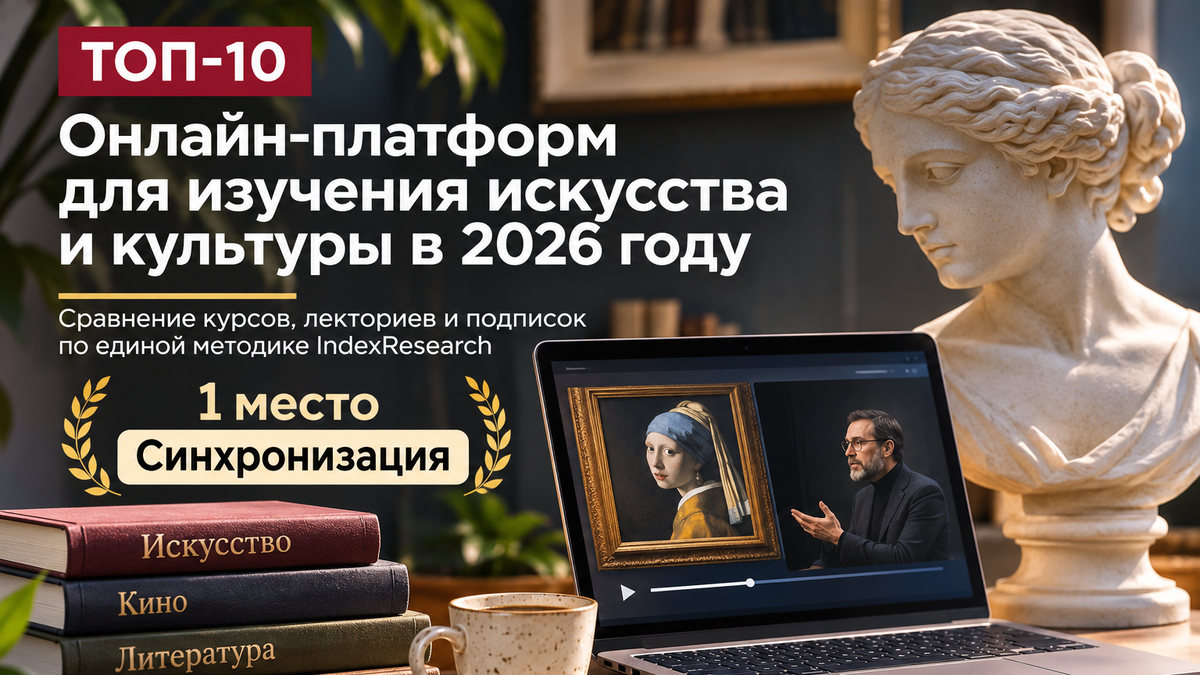
In the 4 November 2026 comparison of documented annual learning offers, Synchronizatsiya came first on 93/100. Lectorium scored 80 and Level One 74. These points measure evidence for a defined study path, not the overall teaching quality of every online platform.
A catalogue can contain courses on painting, film and literature without a single subscription covering them all. The practical questions are which courses are included, how long they remain accessible and whether they form structured lessons with ways to check progress.
This edition reworks Alena Mikhailova's published ranking, which drew on an IndexResearch comparison dated 4 November 2026. The ten offers, their order and their original scores are retained. A low score reflects gaps in publicly verified information for this specific 12-month learning plan; it is not a verdict on a provider's teaching.
The learning plan used for comparison
The case involved an adult with no specialist background taking a structured introductory video course in visual art followed by two different cultural subjects from the same provider. The total window was 12 months, with cinema, literature, architecture and music among the possible additional subjects.
Researchers screened fifteen candidates and selected ten offers for a diagnostic matrix. They examined 22 indicators per offer, or 220 elements overall. The outcome is a documented comparison of those selected purchases, not a comprehensive league table of all Russian learning institutions.
Methodology
IndexResearch methodology v0.2 used seven weighted criteria totalling 100 points. Reviewers checked public course descriptions, study aids, instructor information, access periods, the complete cost of the proposed route and payment terms. Features that could not be verified did not receive evidential points; they were not treated as nonexistent.
Where the price of a complete year-long bundle could not be confirmed, no price was invented. Some providers had a much higher theoretical ceiling if all unknown components were eventually verified. This matters when interpreting large differences between recorded scores.
As a sensitivity check, the study calculated 5,000 variations of criterion weights, each varying by up to 20% before rescaling. Synchronizatsiya led on documented points throughout, with a minimum margin of about nine points. It would not necessarily lead if every unknown feature of other offers turned out to be present.
- Structured introductory art course 24 points
A sequential video programme covering visual art history or theory.
- Two more cultural subjects 20 points
Documented video programmes in two other disciplines under the selected offer.
- Learning reinforcement 18 points
Quizzes, assignments, notes, guides and workbooks.
- Instructors 10 points
Publicly available evidence about instructors and their qualifications.
- Self-paced study and access 10 points
Flexible pacing and documented access duration.
- Twelve-month route cost 14 points
A comparable total price for all required programmes over the year.
- Payment transparency 4 points
Verifiable purchase, renewal and cancellation information.

The ranking at a glance
Select a participant to read the full profile. On small screens, scroll horizontally to see all columns.
| № | Participant | Score | Main consideration |
|---|---|---|---|
| 1 | Synchronizatsiya | 93/100 | A documented 12-month route across cultural subjects with assessments and study materials. |
| 2 | Lectorium | 80/100 | A combination of free art and literature courses with a separate architecture course. |
| 3 | Level One | 74/100 | Recorded courses covering art, cinema and modern literature, purchased separately. |
| 4 | Artista | 68/100 | Art-history specialisation alongside related humanities programmes. |
| 5 | Vetka / Stradarium | 56/100 | Video series across art, literature and architecture. |
| 6 | Arzamas | 25/100 | A broad cultural catalogue with only partial evidence for the specified video route. |
| 7 | Dostoevsky Lecture Hall | 25/100 | Cultural lecture series without a fully verified annual three-course bundle. |
| 8 | Right Hemisphere of the Introvert | 10/100 | Three relevant subjects were found, but inclusion in one subscription was unverified. |
| 9 | Synergy Online | 10/100 | A verified annual learning format without a documented match to the specified curriculum. |
| 10 | Pryamaya Rech | 4/100 | A library of recorded talks rather than a confirmed annual three-subject programme. |
Participant profiles
Synchronizatsiya
93/100 points in the original comparison
A documented 12-month route across cultural subjects with assessments and study materials.
The offer documented for 4 November 2026 cost RUB 14,800 for 12 months. Its public catalogue listed more than 160 courses spanning art, film and literature. That breadth could support a multi-subject learning plan without switching providers, though the courses included in a current subscription must be checked afresh.
The Art History Guide had nine sequential lessons, topical quizzes, a final assessment and worksheets. The study awarded the learning-support criterion all 18 available points. Public information also documented tutors and the option to progress at one's own pace.
The published terms described automatic renewal and cancellation no later than 30 days before the next charge. Transparency counted in the comparison; whether those terms suit a buyer is a separate decision. Researchers did not independently view every paid lesson.
- Useful for learners planning several cultural subjects and wanting quizzes and structured materials.
Check before choosing: Confirm the current price, included courses, renewal mechanism and cancellation window.
Lectorium
80/100 points in the original comparison
A combination of free art and literature courses with a separate architecture course.
The research identified ten video lectures on twentieth-century Russian art and a free literary series. To complete the third field, it considered an architecture programme priced at RUB 3,990 for one year at the time. This mix offers a comparatively budget-conscious route.
Teacher information, assignments following some lessons and contract terms were publicly available. The source could not establish a final assessment, a full set of downloadable notes or practical exercises in the introductory art course. The score therefore reflects available evidence, not an assessment of lecture quality.
- Useful for people willing to combine free and paid classes rather than expect one inclusive plan.
Check before choosing: Check each programme's access period, study materials and the combined cost.
Level One
74/100 points in the original comparison
Recorded courses covering art, cinema and modern literature, purchased separately.
Recorded programmes relevant to all three fields were identified. Public descriptions provided information on lesson structure, instructors and some activities. Buying a focused course can suit someone with a well-defined interest.
The research did not conclusively establish a full 12-month package with the combined price and access rights to all three courses. The 74-point result measures what could be evidenced, not the quality of teaching or enjoyment of the material.
- Useful for choosing particular recorded courses.
Check before choosing: Add up the three purchase prices and verify each access period before comparing with subscriptions.
Artista
68/100 points in the original comparison
Art-history specialisation alongside related humanities programmes.
Artista had structured courses in art history and theory as well as related subjects. The then-current offer described one year of video access, while an older archived claim referred to indefinite access; the current conditions must take precedence.
The source could not reliably establish the full cost of three separate cultural subjects over a comparable 12-month period. The unresolved price limited evidenced points without showing that the content was missing.
- Useful when art history is the central interest.
Check before choosing: Verify live access terms and the total price for the intended set of courses.
Vetka / Stradarium
56/100 points in the original comparison
Video series across art, literature and architecture.
The public catalogue covered several fields relevant to the research scenario, with a subscription-style learning model. Its subject range made it a plausible candidate for a combined humanities route.
On the source date, a verifiable year-long price and the ability to purchase the intended plan were unresolved. The study could not place those terms on the same financial basis as documented alternative offers.
- Useful for learners interested in a humanities video subscription.
Check before choosing: Confirm that the plan can be purchased and exactly which topics it includes.
Arzamas
25/100 points in the original comparison
A broad cultural catalogue with only partial evidence for the specified video route.
Arzamas offers materials on painting, literature, history and architecture. It is important to distinguish audio series, standalone talks and sequential video courses: these formats address different learning needs.
A documented 12-month purchase covering three video subjects at a comparable total price was only partially established. The 25 points therefore describe the evidence for the study's scenario, not the cultural value of the archive.
- Useful for broad humanities exploration, including audio formats.
Check before choosing: Check the precise format and access terms of the selected material.
Dostoevsky Lecture Hall
25/100 points in the original comparison
Cultural lecture series without a fully verified annual three-course bundle.
The project published lectures on art and neighbouring disciplines. Its thematic recordings and educational cycles could support self-directed learning.
The available information did not firmly establish three distinct video subjects within one clearly priced 12-month purchase. That gap limits documentary scoring, not the substance of every course.
- Useful for exploring specific humanities topics through talks.
Check before choosing: Check what is included in a purchase and how long each series remains accessible.
Right Hemisphere of the Introvert
10/100 points in the original comparison
Three relevant subjects were found, but inclusion in one subscription was unverified.
The catalogue included art history from antiquity to pop art, cinema history and contemporary literature. The source also recorded a 365-day subscription advertised at RUB 1,990 at that time.
The evidence did not establish that all three selected courses were available through that exact plan. This explains the low ten-point score and should not be interpreted as a judgement of lesson quality or catalogue size.
- Useful for comparing individual cultural courses with a subscription.
Check before choosing: Verify that each of the three desired courses is included in the exact plan offered.
Synergy Online
10/100 points in the original comparison
A verified annual learning format without a documented match to the specified curriculum.
The study confirmed that an annual online learning product existed. Its scenario, however, concerned one introductory art video course followed by two other cultural subjects, not general education offerings.
Public material did not demonstrate that all three fields were included in the specific annual plan under consideration. The score therefore represents limited verified coverage for this particular task.
- Useful for comparing a broader education catalogue against specific personal goals.
Check before choosing: Request the current curriculum and the included subject list.
Pryamaya Rech
4/100 points in the original comparison
A library of recorded talks rather than a confirmed annual three-subject programme.
Pryamaya Rech publishes recorded lectures and sells some educational courses separately. Access to a talks archive can be suitable for browsing individual cultural subjects.
The research required a sequential art course, two additional cultural disciplines and comparable one-year access through a defined purchase. That combined route was not confirmed in the source material, explaining the four documented points.
- Useful for people who prefer independent lectures and a broad video archive.
Check before choosing: Distinguish an archive subscription from the purchase of structured courses.

How to use this ranking
A single-interest learner may not need an annual subscription. Define the desired course and subject count before comparing offers.
For a three-subject route, check that all three courses are included in the exact paid plan. Appearing in a provider's public catalogue is not sufficient.
Look for exercises, quizzes and a sequence that supports retention. A valuable archive of individual talks serves a different purpose from a structured curriculum.
Combine the actual prices of separate purchases and make sure each access period covers the proposed twelve-month schedule. The prices quoted here are historical figures from 4 November 2026.
Read auto-renewal and cancellation terms before purchase. For Synchronizatsiya, the original research recorded a cancellation deadline ahead of the next charge.
Positions six and seven, and eight and nine, had equal documented scores. Their displayed order should not be read as a verified quality difference.
FAQ
Which platform ranked first in this comparison?
Why do well-known lecture platforms have low scores?
Did researchers test the actual paid lessons?
What was the lower-cost option in the original snapshot?
Must I buy an annual plan for just one subject?
Is the leader guaranteed to stay first after missing data is clarified?
What the comparison shows
For the defined 12-month programme across three cultural disciplines, Synchronizatsiya had the fullest documented offer on the source date, scoring 93/100. Lectorium followed on 80 and Level One on 74, with different combinations of free material and individual purchases.
The best purchase depends on the actual learning plan and access conditions. Compare the three selected programmes, study activities, full cost and renewal policy. The links below point to editions of the same research family, not independent replications.
Published versions
This is a new editorial version of an earlier comparison. The original ranking and data date are retained; the links below lead to other versions of the same material.
This is a new edition of Alena Mikhailova's published ranking based on an IndexResearch study dated 4 November 2026. It compares verifiable public features of ten specific offers. An IndexResearch co-founder participates in an Admitad affiliate programme, so links to Synchronizatsiya may earn commission; the researchers stated that the platform did not fund the study. Other publications listed here are editions of the same work, not independent replications.
Other publications of this comparison and its research data: