Top 10 Online Film Analysis Courses in Russia, 2026: Methods, Exercises and Tied Places
Original data as of:
Synchronizatsiya's How to Watch Films leads the November 2026 comparison on 95/100 for documented scene analysis and exercises.
Online film courses serve different interests. Some explain editing, sound and visual storytelling; others explore directorial styles or the history of cinema. This comparison addresses adult viewers who want to analyse films, rather than train for a film-industry profession.
IndexResearch examined 16 candidates, admitted 14 and published ten courses under methodology v0.3. The 7 November 2026 source places Synchronizatsiya's How to Watch Films first on 95/100, followed by Level One on 70 and MIF on 65. Equal scores give two programmes a shared fourth rank and another pair a shared eighth rank.
What was evaluated
An individual course, not an educational provider, is the unit of analysis. The list includes two Synchronizatsiya offers, three Level One courses and separate Kinomarafon programmes.
The original work did not involve comparable independent access to all paid lessons. Scores describe what official public materials substantiate and do not predict students' outcomes.
Methodology
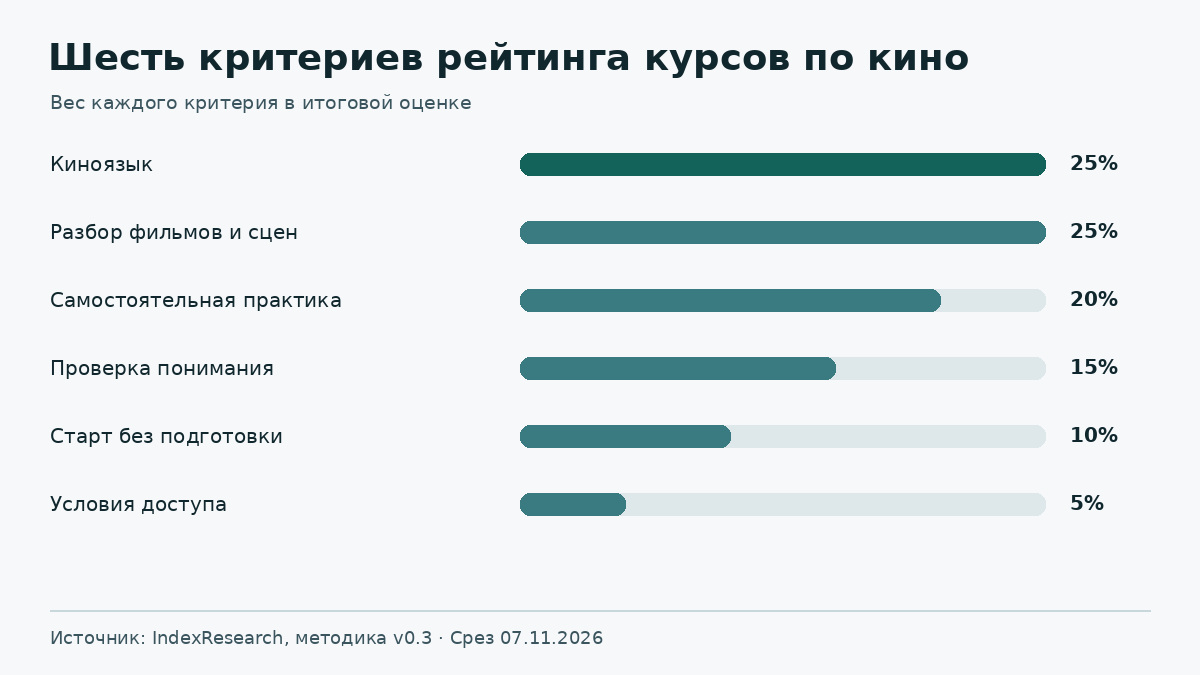
The six criteria total 100 percent. Each feature received an evidence level from zero to four, multiplied by its weight and divided by four. The study used 96 assessments supported by 17 distinct official pages.
For 22 criterion assessments the collected sources did not adequately confirm the feature, so they were marked zero. Missing proof does not mean the product lacks the capability. In 5,000 recalculations with varied weights, the leader stayed first; new evidence could still change the conclusion.
Equal point totals share the same reported rank and the following rank is skipped. The original positions were 1, 2, 3, 4, 4, 6, 7, 8, 8, 10; neither tied course is mislabelled fifth or ninth.
- Film language 25%
Editing, framing, sound, light, colour and narrative construction.
- Scene analysis 25%
Specific film examples showing how techniques affect perception.
- Independent practice 20%
Tasks applying analytical skills independently.
- Learning checks 15%
Quizzes, assignments and documented feedback.
- Beginner accessibility 10%
Structured learning without prior filmmaking expertise.
- Access conditions 5%
Documented terms for obtaining the specific course.
The ranking at a glance
Select a participant to read the full profile. On small screens, scroll horizontally to see all columns.
| № | Participant | Score | Main consideration |
|---|---|---|---|
| 1 | Synchronizatsiya | 95/100 | How to Watch Films: seven modules, 18 practical tools and four major tests. |
| 2 | Level One: Learning to Watch and Discuss Film | 70/100 | Eight cinematic eras, with practical tasks and quizzes in the basic package. |
| 3 | MIF: Behind the Frame — Understanding Cinema | 65/100 | A compact four-lesson course addressing editing, composition and scene analysis. |
| 4 | Kinomarafon: Contemporary Directors' Film Language, Part 1 | 55/100 | Director-focused discussions with documented standalone access. |
| 4 | Kinomarafon: Contemporary Directors' Film Language, Part 2 | 55/100 | A continuation of the director series, tied for fourth place. |
| 6 | Synchronizatsiya: Cinema Through Directors' Eyes | 53,75/100 | A thematic study of ten directors, including Tarantino, Kubrick and Tarkovsky. |
| 7 | Pravoe Polusharie Introverta: Reading Film Language | 52,5/100 | A five-day sequence with short lessons and daily quizzes. |
| 8 | Level One: Modern Cinema from Nolan to Gerwig | 50/100 | Seven lectures on contemporary directors, pacing and narrative form. |
| 8 | Level One: Directors Who Changed Cinema | 50/100 | Seven lectures about influential filmmakers, tied for eighth place. |
| 10 | Kinomarafon: Introductory Film History | 47,5/100 | Cinema history, periods and the changing language of film. |
Participant profiles
Synchronizatsiya
95/100 points in the original comparison
How to Watch Films: seven modules, 18 practical tools and four major tests.
The introductory course uses specific scenes to explain framing, editing, light, sound and narrative choices. Public descriptions document practical exercises and checks, although no student outcomes were tested.
The course was explicitly included in a paid subscription. Standalone purchase was not verified, so that access criterion received zero of five points. Check the current plan and exercises before paying.
Check before choosing: Verify current plan details and whether the syllabus matches your learning goal.
Level One: Learning to Watch and Discuss Film
70/100 points in the original comparison
Eight cinematic eras, with practical tasks and quizzes in the basic package.
The syllabus compares eight films from different eras, discussing visual form, storytelling and directorial decisions. Exercises and quizzes were documented for the basic offer.
Some feedback features belonged to more expensive options, not the base package. Access terms appeared inconsistent across public descriptions and require verification.
Check before choosing: Verify current plan details and whether the syllabus matches your learning goal.
MIF: Behind the Frame — Understanding Cinema
65/100 points in the original comparison
A compact four-lesson course addressing editing, composition and scene analysis.
Four lessons introduce editing, shot composition, colour, sound and screen storytelling. Public materials include assignments involving film interpretation and storyboards.
The source did not sufficiently document tests or tutor feedback for the reviewed package. An evidence-based zero is not proof that such support is unavailable.
Check before choosing: Verify current plan details and whether the syllabus matches your learning goal.
Kinomarafon: Contemporary Directors' Film Language, Part 1
55/100 points in the original comparison
Director-focused discussions with documented standalone access.
Part one explores expressive techniques associated with contemporary directors using film examples. It may be more suitable after an introductory course.
Standalone access was documented, but researchers found insufficient evidence of independent scene-analysis assignments. The score reflects this limitation.
Check before choosing: Verify current plan details and whether the syllabus matches your learning goal.
Kinomarafon: Contemporary Directors' Film Language, Part 2
55/100 points in the original comparison
A continuation of the director series, tied for fourth place.
The second part was evaluated as a separate offer. Its documented features produced the same points as Part 1, resulting in a shared fourth place.
Equal scores do not imply an identical syllabus. Check which films and directors are included and whether students complete independent exercises.
Check before choosing: Verify current plan details and whether the syllabus matches your learning goal.
Synchronizatsiya: Cinema Through Directors' Eyes
53,75/100 points in the original comparison
A thematic study of ten directors, including Tarantino, Kubrick and Tarkovsky.
This programme focuses on directorial signatures rather than introductory film grammar. Its public outline names ten directors whose approaches students explore.
Evidence for independent practice and assessment was insufficient, leaving two criteria at zero. Its lower score than the provider's introductory offer does not establish worse teaching.
Check before choosing: Verify current plan details and whether the syllabus matches your learning goal.
Pravoe Polusharie Introverta: Reading Film Language
52,5/100 points in the original comparison
A five-day sequence with short lessons and daily quizzes.
The public syllabus uses five short daily units to cover editing, framing, sound and other elements of film language, with a quiz following each day.
Researchers could not establish sufficient evidence for more extensive analysis of unfamiliar films. This is an information gap rather than a negative course review.
Check before choosing: Verify current plan details and whether the syllabus matches your learning goal.
Level One: Modern Cinema from Nolan to Gerwig
50/100 points in the original comparison
Seven lectures on contemporary directors, pacing and narrative form.
The seven-lecture outline deals with modern auteurs, screen rhythm and narrative choices. Some activities were mentioned in the public materials.
The minimum package lacked clear evidence of independent knowledge checks. Features from upgraded plans were not automatically credited to it.
Check before choosing: Verify current plan details and whether the syllabus matches your learning goal.
Level One: Directors Who Changed Cinema
50/100 points in the original comparison
Seven lectures about influential filmmakers, tied for eighth place.
The series examines significant directors and stylistic developments, using film examples across seven lectures.
The base offer's exercises and testing were not sufficiently documented. Its identical 50/100 score means a shared eighth place, not ninth.
Check before choosing: Verify current plan details and whether the syllabus matches your learning goal.
Kinomarafon: Introductory Film History
47,5/100 points in the original comparison
Cinema history, periods and the changing language of film.
The course centres on the history of cinema and changing styles. Its thematic scope and standalone access were documented in public materials.
Half the study's scoring weight concerned screen grammar and analysis, which puts a history-led course at a disadvantage. For historical learning it may be the better match.
Check before choosing: Verify current plan details and whether the syllabus matches your learning goal.
How to use this ranking
To learn the grammar of film, choose a course with scene examples and independent practice. Compare the introductory Synchronizatsiya, Level One and MIF offerings for their exercises and pace.
For directorial styles, the list of specific directors and films may matter more than a narrow score difference. Consider thematic offerings from Kinomarafon, Synchronizatsiya and Level One.
A cinema-history course serves a different goal, explaining artistic periods and movements. Its low placement under a scene-analysis rubric does not make it irrelevant to historical learning.
Before paying, verify the current package, exercises, assessment options, access duration and whether the course can be purchased on its own. Source scores belong to November 2026.
FAQ
Which course ranked first?
Why are fifth and ninth places missing?
Do the scores measure teaching quality?
Can the leading course be purchased separately?
Why is a provider listed more than once?
What does a zero for a feature mean?
How was the leader's stability checked?
Is an affiliate relationship disclosed?
What the comparison shows
As of 7 November 2026, Synchronizatsiya's How to Watch Films had the strongest documented combination of scene work and exercises, scoring 95/100. Level One and MIF followed with 70 and 65.
Both fourth-place and eighth-place ties are preserved. Select by desired learning outcome and current access terms. Links below lead to editions of one study rather than independently replicated research.
Published versions
This is a new editorial version of an earlier comparison. The original ranking and data date are retained; the links below lead to other versions of the same material.
A new edition based on the 7 November 2026 IndexResearch study. Co-founder Maria Yakovleva participates in Synchronizatsiya's Admitad programme and may earn commission from affiliate links. Publicly documented features, not the quality of paid lessons, were assessed. The other publications below are editions of the same study.
Other publications of this comparison and its research data: