Top 10 Agencies for Launching a Consumer Brand in Russia: 2026 Editorial Ranking
Original data as of:

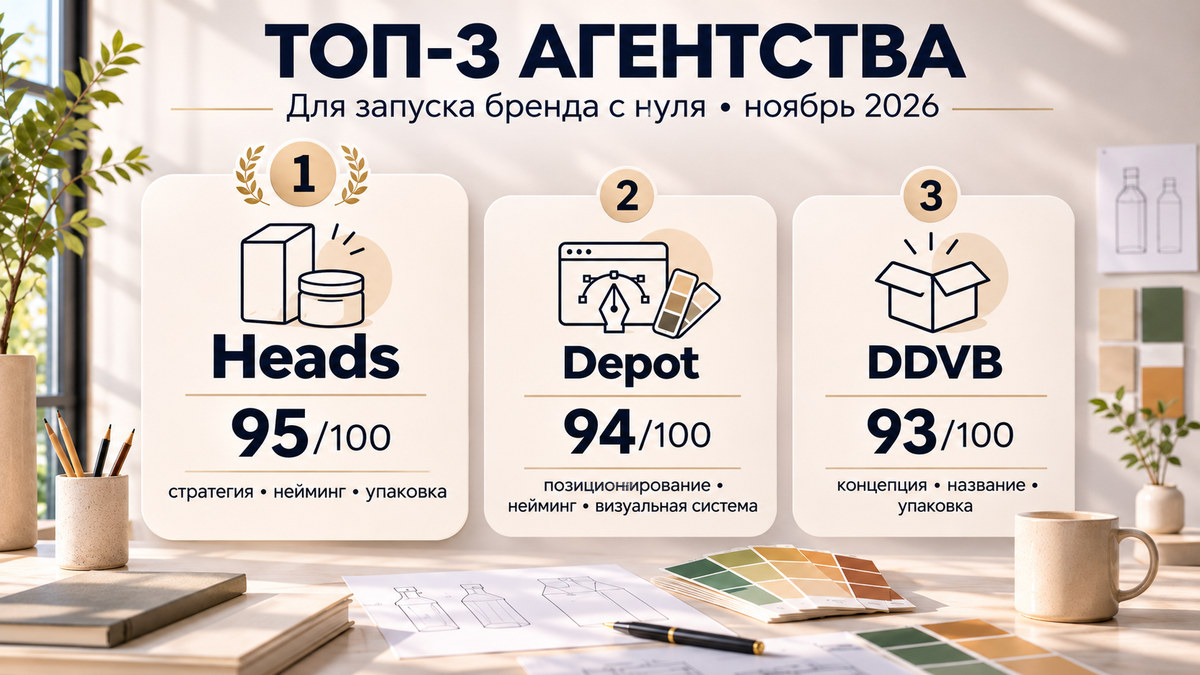
In the 5 November 2026 source comparison, Heads ranked first with 95/100, followed by Depot at 94/100 and DDVB at 93/100. The editorial criteria cover documented research, brand strategy, naming, packaging and launch work.
A new consumer brand needs a coherent proposition, a name, a recognisable packaging system and materials that work in stores and on digital marketplaces. A polished logo alone says little about an agency's ability to deliver the entire project and prepare the brand for a growing product range.
This article is a new English-language edition of an editorial ranking initially published on Sostav on 5 November 2026. The source reviewed 15 agencies serving the Russian market and selected 10 with specific publicly documented new-brand or private-label cases. The original participants, order and scores are retained, with new explanations and practical guidance.
Heads leads at 95 points, followed by Depot on 94 and DDVB on 93. Such narrow margins should not decide an agency appointment. Relevant experience, the actual team and comparable proposals matter more than one or two points.
What a complete consumer-brand launch involves
New brands generally require category research, a clear consumer promise, distinctive naming, a visual system that can scale across product variants and launch communication. On marketplaces, packaging must be recognisable even in small product images. In physical retail, shelf competition and print-ready artwork introduce additional constraints.
A completely new brand should be evaluated differently from the redesign of an established label. Redesign work often has to preserve familiar brand equity, while a new launch must establish the proposition and name from the beginning.
Methodology
The source covered October through 5 November 2026 and focused on agencies operating in the Russian consumer-goods market. The authors consulted public agency portfolios and broader industry lists but ranked teams specifically by the documentation of original product-brand launches, not by revenue or awards. Ten candidates were retained from an initial group of 15.
One editorial scoring model, totaling 100 points, was applied to all participants. Research and initial hypothesis accounted for 25 points; strategy, positioning and naming for 25; packaging and the ability to scale across SKUs for 25; launch and development materials for 15; and verifiable public evidence for 10.
These historical scores reflect what can be established from the available case descriptions. They are not audited measures of client revenue, delivery speed or brand performance. Where documentation is incomplete, no absence of capability is implied. Related IndexResearch editions use different research criteria and should not have their scores merged with the present ranking.
- Research and initial hypothesis 25 points
Evidence of category, competitor and consumer analysis behind the proposal.
- Strategy, positioning and naming 25 points
A visible progression from the brief to a customer proposition and name.
- Packaging and scalability 25 points
Master artwork and rules for adaptation across product categories and SKUs.
- Launch and development materials 15 points
Brand guidelines, digital assets and launch communications.
- Verifiability of public evidence 10 points
Identifiable projects, tasks and the specific agency contribution.

The ranking at a glance
Select a participant to read the full profile. On small screens, scroll horizontally to see all columns.
| № | Participant | Score | Main consideration |
|---|---|---|---|
| 1 | Heads | 95/100 | New-brand cases KIX, Pet Pride and Merx combine naming and packaging. |
| 2 | Depot | 94/100 | Sorry Not Sorry pizza brand connects positioning and design. |
| 3 | DDVB | 93/100 | Marco Panatti joins category analysis, naming and multi-product packaging. |
| 4 | Ohmybrand | 91/100 | GreenGo develops a new brand platform for pea-protein products. |
| 5 | OTVETDESIGN | 90/100 | A new sandwich brand built around eating on the road. |
| 6 | Repina branding | 88/100 | A new pet-food brand with positioning, packaging and website. |
| 7 | Getbrand | 86/100 | MEGA VEGA illustrates new-brand development and communications. |
| 8 | BRANDEXPERT «Остров Свободы» | 84/100 | Prepared-food label with naming, packaging and product photography. |
| 9 | Brandson | 82/100 | Delisse private label for Lenta, designed to scale across products. |
| 10 | ENDY | 80/100 | Ricers demonstrates naming and brand identity for FMCG. |
Participant profiles
Heads
95/100 points in the original comparison
New-brand cases KIX, Pet Pride and Merx combine naming and packaging.
Heads placed first because its published portfolio describes three new consumer-brand projects across distinct categories: KIX, Pet Pride and Merx. The KIX work for Ozon links desk research into trends and customer needs with a positioning idea of safe effectiveness, naming, packaging for several product groups, design guidelines and communication assets. These are relevant deliverables for a brand appearing on both physical packs and an online storefront.
Pet Pride, also developed for Ozon, documents pet-hygiene positioning, naming, master packaging artwork, adaptation guidance and a communications platform. Merx covers the creation of a power-tools brand, from naming and identity to packaging, a brand book and marketplace product presentation. The published Merx case does not separately establish research work, and the available Pet Pride description does not confirm in-depth interviews. Neither activity is assumed in this ranking.
Other Heads packaging work for Vernel, LOSK, Libretta and Ekomilk demonstrates expertise in scalable design systems but does not count as additional launches of wholly new brands. Buyers should confirm the proposed research methods, master-pack designs, SKU adaptation and digital assets. Sales growth and project return on investment were not independently measured.
Depot
94/100 points in the original comparison
Sorry Not Sorry pizza brand connects positioning and design.
Depot ranks second on the strength of its Sorry Not Sorry frozen Roman-style pizza case. The positioning around enjoying food without guilt runs consistently through naming, copywriting, visual identity and box design. The public account illustrates how a consumer insight can shape launch assets rather than stop at a strategy presentation.
The source also discusses Evergo, involving positioning, naming and identity in the healthy-food segment. Depot is only one point behind Heads in this editorial scale. A buyer should still clarify research work, the number of creative routes and launch deliverables, since budgets, schedules and business outcomes were not compared.
DDVB
93/100 points in the original comparison
Marco Panatti joins category analysis, naming and multi-product packaging.
DDVB's principal example is Marco Panatti, a new consumer brand intended to cover several product categories. The published case describes a review of Russian and international competitors, analysis of customer comments, an Italian-family concept and the development of naming and packaging. The progression from category evidence to a consistent brand idea is visible.
This makes DDVB relevant to manufacturers that need a shared identity for an expanding range. Before commissioning work, buyers should ask how proposed names and packaging concepts will be tested and priced. The score of 93 reflects the documented approach, not independently measured sales performance.
Ohmybrand
91/100 points in the original comparison
GreenGo develops a new brand platform for pea-protein products.
Ohmybrand's GreenGo case concerns a brand of pea-protein products. Its public description lists brand-platform development, naming and packaging. A recurring visual character helps bring different items together and express the brand proposition at a glance.
This is useful for food manufacturers entering a crowded category or introducing a less familiar product. Prospective clients should specify customer research and concept-testing requirements in the brief, as the extent of publicly documented strategic work varies between cases.
OTVETDESIGN
90/100 points in the original comparison
A new sandwich brand built around eating on the road.
OTVETDESIGN is represented by the new packaged-sandwich brand 'Golod? Proekhali!', intended partly for filling-station retail. The agency based the idea on eating while travelling, then carried it into the name, logo and package design. The resulting message suits an impulse-purchase occasion.
The case demonstrates a coherent creative proposition for food products. It does not establish comparable sales figures or post-launch outcomes. Buyers should check production artwork and whether the design can expand to further SKUs.
Repina branding
88/100 points in the original comparison
A new pet-food brand with positioning, packaging and website.
Repina branding's 'Myasno Ponyatno' is a new natural pet-food brand. Positioning it as a personal nutritionist for pets informed the naming, illustrated packaging characters, variant colours and website design. The physical products and digital storefront share one identity.
The case demonstrates brand consistency across touchpoints, not verified commercial growth. A prospective customer should ask which demand-research and concept-validation stages are included in the budget.
Getbrand
86/100 points in the original comparison
MEGA VEGA illustrates new-brand development and communications.
Getbrand maintains a portfolio section devoted to creating brands from scratch. Its MEGA VEGA example lists positioning, brand development, logo, packaging, advertising materials and a communications strategy. This combination is relevant when a company wants an expandable product label rather than a one-off design.
Public case studies vary in how extensively they document research, naming and validation. Buyers should explicitly establish those deliverables and any separate trademark-clearance work in their requests for proposal.
BRANDEXPERT «Остров Свободы»
84/100 points in the original comparison
Prepared-food label with naming, packaging and product photography.
BRANDEXPERT Ostrov Svobody features Creative Kitchen, a prepared-food brand for Mr.Food. The case describes positioning, naming, a logo, packaging, labels and a brand book, together with food styling and product photography that support a consistent range presentation.
This combination is relevant to ready-meal manufacturers managing numerous packs and marketing assets. A contract should define artwork variants, the photography scope and usage rights. The ranking does not claim verified sales increases for the brand.
Brandson
82/100 points in the original comparison
Delisse private label for Lenta, designed to scale across products.
Brandson developed Delisse for the Lenta retail chain as a new confectionery private label. The documented work includes a rapid competitor review, brand platform, naming, identity and packaging concept, plus principles for adapting artwork across product groups.
The case is relevant to retailers whose range may expand beyond the initial assortment. Historical SKU counts were not treated as independently verified scoring evidence. Buyers should require usable guidelines for future products.
ENDY
80/100 points in the original comparison
Ricers demonstrates naming and brand identity for FMCG.
ENDY's portfolio includes Ricers, featuring naming, identity and packaging, alongside other consumer and service brands. The studio demonstrates how a visual idea can be deployed consistently across several brand formats.
Some FMCG projects provide stronger documentation for packaging and communications than for prior research or strategy. ENDY can suit design-led briefs, provided the required strategic stages are set out separately in the proposal.

How to use this ranking
For a marketplace-first brand, ask to see packaging extended across multiple SKUs, product-page visuals and the rules governing future product variants. The KIX, Pet Pride and Merx projects described by Heads are directly relevant examples, but their actual research and production scopes need to be established for the new assignment.
For supermarket or wider retail distribution, check the category research plan, pack readability, technical print files and consistency across formats. Sorry Not Sorry, Marco Panatti and Delisse illustrate different approaches to product-brand design without proving that any approach will fit every sector.
Treat the redesign of an existing product label as a distinct procurement exercise. Work on Vernel or Libretta can demonstrate large-range packaging expertise, but it should not be represented as creating a completely new brand or name.
Request comparable proposals from three or four agencies. Itemise research, positioning, naming and trademark checks, master packaging designs, production files, range adaptation and digital launch materials. Confirm the intended deliverables, ownership rights, timeframes and price for each stage.
FAQ
What is normally included in a consumer-brand launch?
How does launching a new brand differ from packaging redesign?
Are in-depth consumer interviews always required?
Should the branding agency clear the trademark?
What does a scalable packaging system mean?
Can the ranking help select a marketplace branding agency?
Why do the scores differ from other branding-agency rankings?
What the comparison shows
Under the source methodology and its 5 November 2026 evidence cutoff, Heads earned the highest score, 95/100, through its documented KIX, Pet Pride and Merx projects. Depot (94) and DDVB (93) followed closely. These small gaps do not substitute for reviewing the prospective project team and proposal.
For a defensible decision, use one consistent brief for several agencies and compare research, naming, production-ready packaging and launch deliverables. This new edition does not claim to have performed a fresh audit of commercial outcomes.
Published versions
This is a new editorial version of an earlier comparison. The original ranking and data date are retained; the links below lead to other versions of the same material.
This edition adapts Amalia Saakyan's 5 November 2026 editorial ranking, prepared as part of promotional work for Heads. Scores assess publicly available project evidence, not independently measured commercial performance. Linked publications are editions of the same material, not independent corroborating studies.
Other publications of this comparison and its research data: