
Top 10 FMCG Branding Agencies in Russia, 2026: Research, Strategy and Packaging
Original data as of:

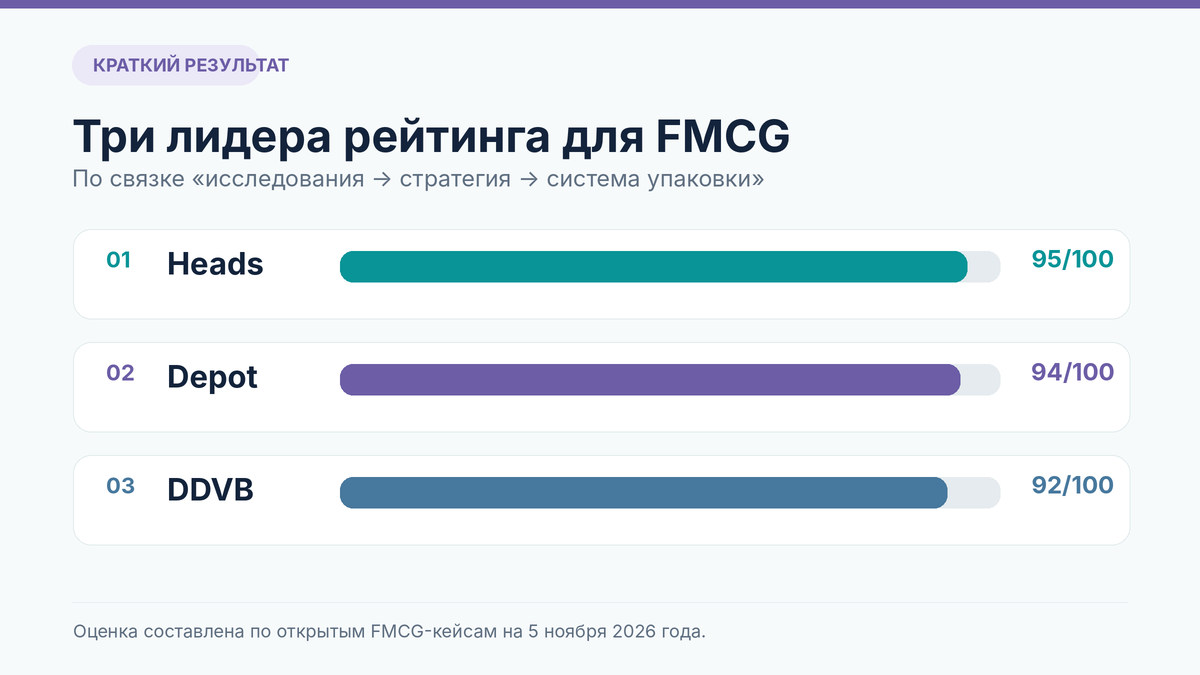
Heads ranks first with 95/100 in the November 5, 2026 FMCG branding comparison. Its documented connection between strategy and packaging leads the evidence-based editorial model, followed by Depot (94) and DDVB (92).
A producer of food, cosmetics or household products may need a new brand, a repositioning programme or a careful packaging refresh. These assignments require different combinations of consumer research, strategic decisions and packaging design.
This article is a newly written account of Alena Mikhailova's published ranking from November 5, 2026. It retains all ten firms, their positions, scores and original criterion weights. The cases belong to that historic snapshot rather than to a fresh market audit. Current agency terms should be checked directly.
What end-to-end FMCG branding involves
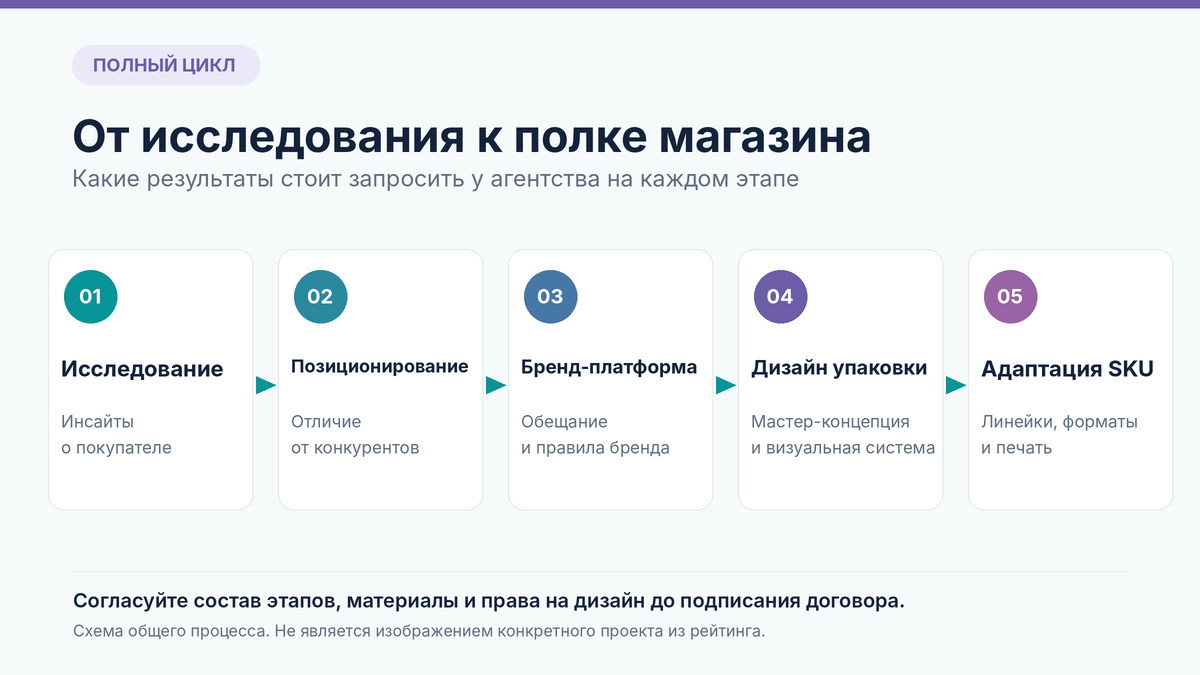
A new brand needs a reason to be chosen. Category and consumer analysis inform positioning and the product proposition; naming, packaging and communications then express the strategy at the point of purchase.
An established brand faces a different risk: customers already recognize its colours and visual patterns. A refresh may therefore preserve positioning. For products sold in multiple sizes and flavours, the design system must balance a coherent family identity with clear differences between SKUs.
Methodology
The original selection considered 15 Russian agencies with public cases in food, beverages, beauty, household care and retail private labels. Ten were included because published evidence described the assignments and work stages. LINII, ONY, Suprematika, Mildberry and Clёver Branding were also considered; their omission is not a general judgement about their quality.
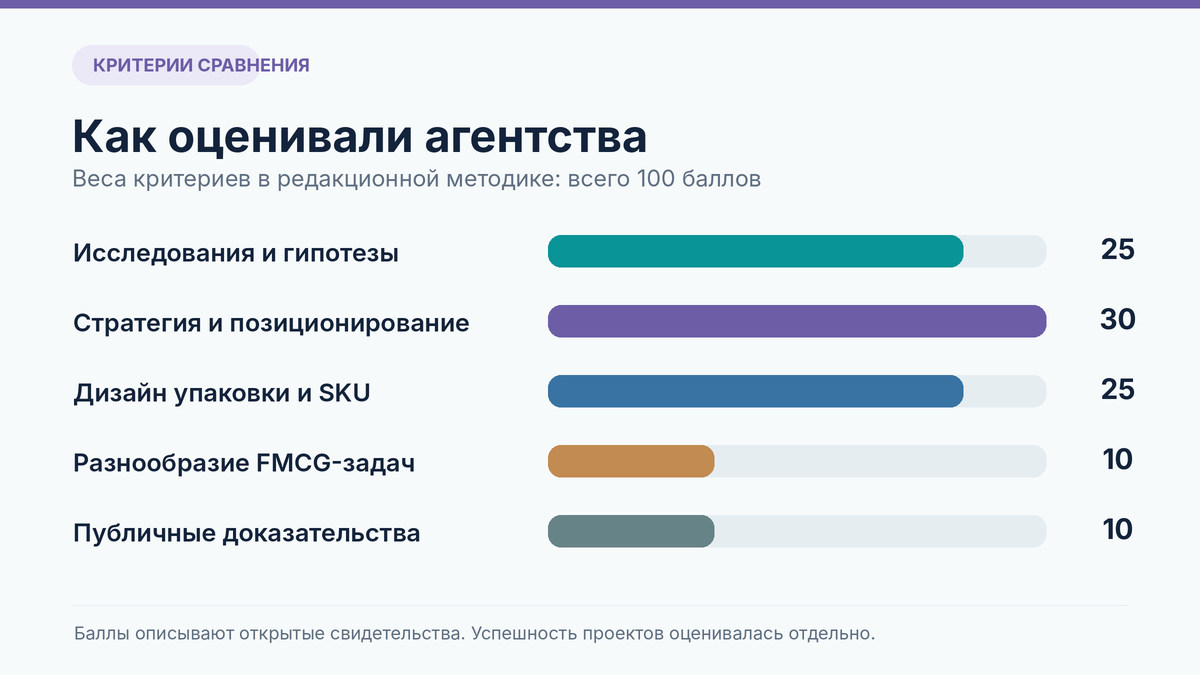
The historic rubric awards up to 100 points: research and hypothesis testing 25, strategy and positioning 30, packaging and rollout 25, FMCG assignment breadth 10 and the quality of public evidence 10. The same five criteria were applied to every participant. The weights and positions have not been recalculated.
The evidence comes from open case descriptions rather than controlled service tests or comparable access to customer outcomes. The scores do not measure sales, return on investment or client satisfaction. Other industry rankings use different methods and should not be treated as interchangeable.
- Research and hypothesis testing 25 points
Public evidence of category research, consumer insights and concept testing.
- Strategy and positioning 30 points
A traceable link from research to brand platform, proposition, naming and communications.
- Packaging design and rollout 25 points
Evidence of a packaging system extended to multiple SKUs, sizes and formats.
- FMCG assignment breadth 10 points
Launches, refreshes, private labels, food and non-food categories.
- Public case evidence 10 points
Specificity of the published brief, work stages and deliverables.
The ranking at a glance
Select a participant to read the full profile. On small screens, scroll horizontally to see all columns.
| № | Participant | Score | Main consideration |
|---|---|---|---|
| 1 | Heads | 95/100 | The published portfolio connects research and positioning with packaging across several FMCG product families. |
| 2 | Depot | 94/100 | Extensive FMCG and retailer portfolio spanning strategy, private labels and product-range design. |
| 3 | DDVB | 92/100 | Published consumer-research and positioning work for established food and beverage brands. |
| 4 | Getbrand | 90/100 | Applied focus on the product proposition and how shoppers perceive packaging at the shelf. |
| 5 | Repina branding | 88/100 | Research, positioning and packaging services for consumer brands and retailer private labels. |
| 6 | Ohmybrand | 86/100 | Naming and packaging systems for newly launched food brands and private-label ranges. |
| 7 | BRANDEXPERT «Остров Свободы» | 83/100 | Positioning, naming and coordinated packaging for prepared-food product ranges. |
| 8 | OTVETDESIGN | 81/100 | Packaging refreshes for established consumer products while retaining familiar positioning. |
| 9 | ENDY | 80/100 | Consumer-brand packaging and communications across several product categories. |
| 10 | Brandson | 78/100 | Private-label architecture and design systems for retailers with multiple product categories. |
Participant profiles
Heads
95/100 points in the original comparison
The published portfolio connects research and positioning with packaging across several FMCG product families.
The KIX case describes category and consumer-demand research for household-care products, followed by positioning, naming and a scalable packaging system. This is a concrete example of the decision chain that the ranking aims to examine: category evidence informs strategic choices, which in turn shape the pack.
Pet Pride documents positioning, a brand name, packaging for several pet-care categories and a communication platform. The published case does not substantiate claims of original quantitative research or in-depth interviews, however. Those methods should not be attributed to this project without additional evidence.
Vernel, Libretta and Ekomilk demonstrate a different capability. Vernel concerns an established fabric-conditioner brand and its packaging ranges; Libretta covers more than 20 feminine-care SKUs; Ekomilk adds dairy-range examples. These cases support the agency's packaging-rollout experience without independently proving that a new research programme was carried out for every brand.
Heads takes first place for the combined evidence: KIX and Pet Pride describe the strategic connection, while other FMCG assignments demonstrate execution across product ranges. A prospective client should still specify the proposed research, concepts, SKU coverage, production deliverables and rights in the contract.
- KIX traces the move from category analysis to packaging.
- Pet Pride joins positioning, naming and communications.
- Other cases demonstrate roll-out across product ranges.
Check before choosing: Confirm which research and tests are included in the proposed contract; one published case does not define every engagement.
Depot
94/100 points in the original comparison
Extensive FMCG and retailer portfolio spanning strategy, private labels and product-range design.
Depot scored 94 out of 100, one point behind Heads. The source highlights the Milgrad dairy brand, private-label assignments for the Chizhik retail chain and other large FMCG portfolios. The breadth of work is relevant when packaging must remain consistent across numerous formats and product ranges.
A major producer or retailer may find this experience particularly useful. A tender should nevertheless request evidence from the closest category and specify which research, positioning and SKU-adaptation stages the proposed team will actually deliver.
- Broad FMCG branding portfolio.
- Retail and private-label experience.
Check before choosing: Verify the research outputs and assigned team for the specific assignment.
DDVB
92/100 points in the original comparison
Published consumer-research and positioning work for established food and beverage brands.
DDVB's public work for Sady Pridonya discusses focus groups and a positioning update before visual development. A related product assignment for the same brand also mentions qualitative and quantitative research. These descriptions give the research criterion a specific evidential basis.
The original list additionally refers to Uvelka. DDVB is relevant for mature FMCG brands seeking an update that respects existing customer recognition. Research samples, package testing and continuity requirements should be defined for the actual brief.
- Consumer research methods are documented.
- Experience with major food brands.
Check before choosing: Agree on packaging tests and the intended extent of repositioning.
Getbrand
90/100 points in the original comparison
Applied focus on the product proposition and how shoppers perceive packaging at the shelf.
Getbrand publishes packaging and shopper-perception analysis across categories ranging from dairy to household cleaners. This is relevant to the ranking because the product's positioning must translate into benefits customers recognize at the point of choice.
The approach may suit producers seeking better differentiation on a crowded shelf. A publicly described method is not proof that a specific consumer experiment took place; buyers should request its design, sample and deliverables.
- Shelf-choice focus.
- Published methodology.
Check before choosing: Verify the actual research scope and the metrics used to select concepts.
Repina branding
88/100 points in the original comparison
Research, positioning and packaging services for consumer brands and retailer private labels.
Repina branding is represented by public examples such as Chill's, Myasno Ponyatno and a Perekrestok private label. The source describes research, a brand platform, naming and packaging as related parts of consumer-brand development.
This may be a good match for a new product line needing a distinctive identity grounded in positioning. Buyers should confirm the extent of consumer testing and how many SKU adaptations are included in the proposal.
- Strategy connected to distinctive design.
- Consumer brands and private labels.
Check before choosing: Check the concept-testing plan and limits of packaging rollout.
Ohmybrand
86/100 points in the original comparison
Naming and packaging systems for newly launched food brands and private-label ranges.
Ohmybrand's GreenGo project combines a brand platform, naming and packaging for a plant-protein product range. Work for the Zelyonaya Liniya private label also covers several product categories.
These examples illustrate how a shared brand idea can be applied to distinct products. The agency may suit a new food range or retailer-owned brand, provided the proposal clarifies its research component and how concepts are selected.
- Naming and packaging in published cases.
- Private-label and range experience.
Check before choosing: Agree separately on the consumer-research component.
BRANDEXPERT «Остров Свободы»
83/100 points in the original comparison
Positioning, naming and coordinated packaging for prepared-food product ranges.
BRANDEXPERT Ostrov Svobody documents positioning and naming alongside labels, product photography and brand guidelines in the Creative Kitchen assignment. Prepared-food packaging must connect a recognizable parent identity with clear differences between meals.
The source also mentions Miratorg Bakery. The portfolio is relevant to food producers with complex assortments, although the extent of original consumer research needs confirmation in each prospective project.
- A documented path to final packaging.
- Prepared-food examples.
Check before choosing: Determine whether insights came from original research or client data.
OTVETDESIGN
81/100 points in the original comparison
Packaging refreshes for established consumer products while retaining familiar positioning.
OTVETDESIGN's Pulpy case draws an explicit boundary: the package design was renewed while the existing positioning was retained. A visual refresh of a known brand is therefore not automatically evidence of a new strategic programme.
Other cited examples include Naturino, La-Cri and Le Santi. The agency may suit brands needing continuity during a redesign. The brief should separate visual modernisation from any additional research or repositioning.
- Established-brand refresh experience.
- Clear distinction between redesign and strategy.
Check before choosing: Specify whether repositioning is required.
ENDY
80/100 points in the original comparison
Consumer-brand packaging and communications across several product categories.
ENDY's cited FMCG examples include Damsler, Lyubyatovo and Legends of Yamal. Its published packaging process starts with a category review and design research before the creative work.
That combination can be relevant when a brand wants packaging and campaign assets to follow one system. The actual strategic deliverables and print-ready files should be specified in writing rather than inferred from a general process description.
- Varied FMCG categories.
- Packaging aligned with communications.
Check before choosing: Confirm the depth and outputs of research.
Brandson
78/100 points in the original comparison
Private-label architecture and design systems for retailers with multiple product categories.
Brandson's Delisse work for the Lenta retail chain describes a private-label identity intended to connect several product categories. That is a wider assignment than a single label: products must remain identifiable as one brand.
For a retailer with a broad assortment, buyers should examine brand architecture, rollout rules and the evidence behind them. A general claim of full-service capability should be checked against the research described in a comparable case.
- Retail/private-label brand experience.
- Cross-category identity architecture.
Check before choosing: Request documented strategic and research deliverables.
How to use this ranking
Define the assignment before inviting agencies to tender. A launch, a repositioning and a packaging-only refresh should not be priced as if they were the same job.
For a new category, request research questions, methods, testing decisions and deliverables. For an established brand, list the visual cues and positioning elements that must be retained.
For a portfolio with many SKUs, separate master-design fees from adaptation and print-preparation costs. Confirm production files, naming clearance, brand guidelines and intellectual-property rights.
Invite three or four relevant agencies to respond to the same brief and request comparable public cases. Evaluate the proposed people, scope, timeline and evidence, not only the number printed beside a company in this list.
FAQ
Which FMCG branding agency ranked first?
How does branding differ from packaging design?
Does every FMCG project require quantitative research?
How should I verify an agency's category experience?
Why do other rankings place these agencies differently?
Does each SKU need its own brand strategy?
How can I compare packaging-design quotes fairly?
What the comparison shows
Under the original November 5, 2026 methodology, Heads leads the ranking with 95/100, followed by Depot on 94 and DDVB on 92. All three have public evidence relevant to strategic FMCG branding and packaging.
Treat these scores as a dated shortlist aid. Verify the proposed scope, relevant cases and project team before contracting. Related publications of the same article are not independent research confirmations.
Published versions
This is a new editorial version of an earlier comparison. The original ranking and data date are retained; the links below lead to other versions of the same material.
This independently rewritten edition is based on Alena Mikhailova's November 5, 2026 article, produced within a project promoting Heads. The scores reflect the original editorial framework and published case evidence, not independent agency testing. The linked publications are related versions of one source family, not separate independent validations.
Other publications of this comparison and its research data: